Looking for accurate SEBA Class 9 Maths Exercise 7.1 (Triangles) textual solutions for the 2026–27 academic year? Access complete step-by-step geometry proofs and solutions covering SAS, ASA, and AAS triangle congruence criteria to score top marks in your annual exams.
EXERCISE 7.1
1. In quadrilateral ACBD,
AC = AD and AB bisects ∠A (see Fig. 7.17). Show that Δ ABC ≅ Δ ABD.
What can you say about BC and BD?
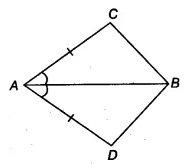
Given:
In quadrilateral ACBD,
AC = AD
AB bisects ∠A (i.e., ∠CAB = ∠DAB)
To Prove: Δ ABC ≅ Δ ABD
Proof:
In Δ ABC and Δ ABD,
AC = AD (Given)
∠CAB = ∠DAB (AB bisects ∠A)
AB = AB (Common)
By SAS Rule,
Δ ABC ≅ Δ ABD (Proved)
Now,
BC = BD (By CPCT)
Conclusion: BC and BD are of equal length.
SEBA Class 9 Maths Exercise 7.1 Solutions
2. ABCD is a quadrilateral in which AD = BC and ∠DAB = ∠CBA (see Fig. 7.18). Prove that
(i) Δ ABD ≅ Δ BAC
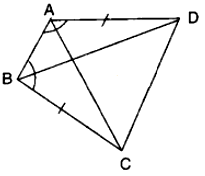
Given:
Quadrilateral ABCD in which AD = BC and ∠DAB = ∠CBA.
To prove: Δ ABD ≅ Δ BAC
Proof:
In Δ ABD and Δ BAC,
AD = BC (Given)
∠DAB = ∠CBA (Given)
AB = BA (Common)
By SAS Rule,
Δ ABD ≅ Δ BAC (Proved)
(ii) BD = AC
To prove: BD = AC
Proof:
Since Δ ABD ≅ Δ BAC,
BD = AC (By CPCT) (Proved)
(iii) ∠ABD = ∠BAC.
To prove: ∠ABD = ∠BAC
Proof:
Since Δ ABD ≅ Δ BAC,
∠ABD = ∠BAC (By CPCT) (Proved)
Class 9 Maths Chapter 7 Exercise 7.1 Question Answer SEBA 2026-27
3. AD and BC are equal perpendiculars to a line segment AB (see Fig. 7.19). Show that CD bisects AB.
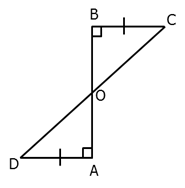
Given:
AD = BC
AD ⊥ AB and BC ⊥ AB (i.e., ∠DAB = 90° and ∠CBA = 90°)
To Prove: CD bisects AB (i.e., OA = OB)
Proof:
In Δ BOC and Δ AOD,
∠BOC = ∠AOD (Vertically Opp. ∠s)
∠CBO = ∠DAO = 90° (Given)
BC = AD (Given)
By AAS Rule,
Δ BOC ≅ Δ AOD
Therefore,
OB = OA (By CPCT)
Hence, CD bisects AB. (Proved)
4. l and m are two parallel lines intersected by another pair of parallel lines p and q (see Fig. 7.20). Show that Δ ABC ≅ Δ CDA.
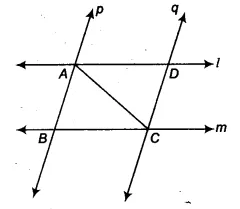
Given: Line l || m and line p || q.
To Prove: Δ ABC ≅ Δ CDA
Proof:
Since p || q and AC is a transversal,
∠BAC = ∠DCA (Alternate Interior ∠s) — (1)
Since l || m and AC is a transversal,
∠BCA = ∠DAC (Alternate Interior ∠s) — (2)
In Δ ABC and Δ CDA,
∠BAC = ∠DCA (From 1)
AC = CA (Common)
∠BCA = ∠DAC (From 2)
By ASA Rule,
Δ ABC ≅ Δ CDA (Proved)
5. Line l is the bisector of an angle ∠A and B is any point on l. BP and BQ are perpendiculars from B to the arms of ∠A (see Fig. 7.21). Show that:
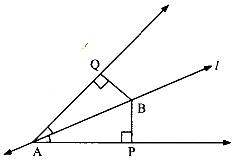
(i) Δ APB ≅ Δ AQB
Given: Line l is the bisector of ∠A (i.e., ∠QAB = ∠PAB).
BP ⊥ AP and BQ ⊥ AQ (i.e., ∠APB = 90° and ∠AQB = 90°).
To prove: Δ APB ≅ Δ AQB
Proof:
In Δ APB and Δ AQB,
∠APB = ∠AQB = 90° (Given)
∠PAB = ∠QAB (Line l bisects ∠A)
AB = AB (Common)
By AAS Rule,
Δ APB ≅ Δ AQB (Proved)
(ii) BP = BQ or B is equidistant from the arms of ∠A.
To prove: BP = BQ
Proof:
Since Δ APB ≅ Δ AQB,
BP = BQ (By CPCT) (Proved)
Hence, B is equidistant from the arms of ∠A.
6. In Fig. 7.22, AC = AE, AB = AD and ∠BAD = ∠EAC. Show that BC = DE.
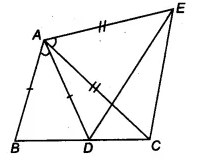
Given:
AC = AE
AB = AD
∠BAD = ∠EAC
To Prove: BC = DE
Proof:
Given,
∠BAD = ∠EAC
Adding ∠DAC to both sides:
∠BAD + ∠DAC = ∠EAC + ∠DAC
∠BAC = ∠EAD — (1)
In Δ ABC and Δ ADE,
AB = AD (Given)
∠BAC = ∠EAD (From 1)
AC = AE (Given)
By SAS Rule,
Δ ABC ≅ Δ ADE
Therefore,
BC = DE (By CPCT) (Proved)
SEBA Class 9 Maths Chapter 7 Textbook Answers
7. AB is a line segment and P is its mid-point. D and E are points on the same side of AB such that ∠BAD = ∠ABE and ∠EPA = ∠DPB (see Fig. 7.23). Show that
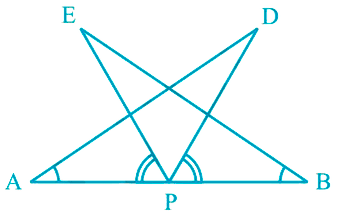
(i) Δ DAP ≅ Δ EBP
Given: P is the mid-point of AB (i.e., AP = PB).
∠BAD = ∠ABE
∠EPA = ∠DPB
To prove: Δ DAP ≅ Δ EBP
Proof:
Given,
∠EPA = ∠DPB
Adding ∠EPD to both sides:
∠EPA + ∠EPD = ∠DPB + ∠EPD
∠APD = ∠BPE — (1)
In Δ DAP and Δ EBP,
∠PAD = ∠PBE (Given: ∠BAD = ∠ABE)
AP = BP (P is the mid-point of AB)
∠APD = ∠BPE (From 1)
By ASA Rule,
Δ DAP ≅ Δ EBP (Proved)
(ii) AD = BE
To prove: AD = BE
Proof:
Since Δ DAP ≅ Δ EBP,
AD = BE (By CPCT) (Proved)
8. In right triangle ABC, right angled at C, M is the mid-point of hypotenuse AB. C is joined to M and produced to a point D such that DM = CM. Point D is joined to point B (see Fig. 7.24). Show that:
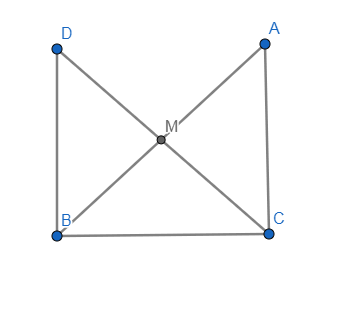
(i) Δ AMC ≅ Δ BMD
Given: In Δ ABC, ∠ACB = 90°.
M is the mid-point of AB (AM = BM).
DM = CM.
(i) To prove: Δ AMC ≅ Δ BMD
Proof:
In Δ AMC and Δ BMD,
AM = BM (M is mid-point of AB)
∠AMC = ∠BMD (Vertically Opp. ∠s)
CM = DM (Given)
By SAS Rule,
Δ AMC ≅ Δ BMD (Proved)
(ii) ∠DBC is a right angle.
To prove: ∠DBC = 90°
Proof:
Since Δ AMC ≅ Δ BMD,
∠MAC = ∠MBD (By CPCT)
Since these alternate interior ∠s are equal,
DB || AC
Therefore,
∠DBC + ∠ACB = 180° (Co-interior ∠s)
∠DBC + 90° = 180°
∠DBC = 90° (Proved)
(iii) Δ DBC ≅ Δ ACB
To prove: Δ DBC ≅ Δ ACB
Proof:
In Δ DBC and Δ ACB,
DB = AC (By CPCT from Δ AMC ≅ Δ BMD)
∠DBC = ∠ACB = 90°
BC = CB (Common)
By SAS Rule,
Δ DBC ≅ Δ ACB (Proved)
(iv) CM = 1/2 AB
To prove: CM = 1/2 AB
Proof:
Since Δ DBC ≅ Δ ACB,
DC = AB (By CPCT)
1/2 DC = 1/2 AB
Since CM = 1/2 DC (as DM = CM),
CM = 1/2 AB (Proved)
9. It is given that ΔABC ≅ ΔFDE and AB = 5cm, ∠B = 40°, ∠A = 80° and DE = 6cm. Which of the following are correct for –
(i) DF = 5cm, ∠F = 60°
(ii) DF = 5cm, ∠E = 60°
(iii) DE = 6cm, ∠E = 60°
(iv) DE = 6cm, ∠D = 40°
(A) (i), (ii)
(B) (ii), (iii)
(C) (iii), (iv)
(D) (ii), (iii), (iv)
Given: Δ ABC ≅ Δ FDE
AB = 5 cm, ∠B = 40°, ∠A = 80°, DE = 6 cm
Step 1: Finding ∠s of Δ ABC
∠A + ∠B + ∠C = 180°
80° + 40° + ∠C = 180°
120° + ∠C = 180°
∠C = 60°
Step 2: Matching corresponding parts (CPCT)
Since Δ ABC ≅ Δ FDE:
AB = FD => DF = 5 cm
BC = DE => BC = 6 cm
∠A = ∠F => ∠F = 80°
∠B = ∠D => ∠D = 40°
∠C = ∠E => ∠E = 60°
Checking the given statements:
(i) DF = 5cm, ∠F = 60° (Incorrect)
(ii) DF = 5cm, ∠E = 60° (Correct)
(iii) DE = 6cm, ∠E = 60° (Correct)
(iv) DE = 6cm, ∠D = 40° (Correct)
Correct Options: (ii), (iii), (iv)
Answer: (D) (ii), (iii), (iv)
Class 9 Maths Exercise 7.1 Triangles Proofs
10. Assertion (A) : In triangles ABC and PQR, if BC = QR, ∠B = ∠Q, AB = PQ then ΔABC ≅ ΔPQR.
So, CA = RP, ∠BCA = ∠QRP, ∠BAC = ∠QPR (CPCT)
Reason (R) : In congruent triangles corresponding parts are equal and we write ‘CPCT’ for corresponding parts of congruent triangles.
A) Assertion is true, Reason is also true. But reason is not a correct explanation for Assertion.
B) Assertion is true, Reason is also true. Reason is a correct explanation for Assertion.
C) Assertion is true, Reason is false.
D) Assertion is false, Reason is true.
Analysis:
Assertion (A):
In Δ ABC and Δ PQR,
AB = PQ, ∠B = ∠Q, BC = QR
By SAS Rule, Δ ABC ≅ Δ PQR.
Hence, corresponding parts are equal: CA = RP, ∠BCA = ∠QRP, ∠BAC = ∠QPR (by CPCT).
Assertion (A) is True.
Reason (R):
CPCT stands for ‘corresponding parts of ≅ Δs’ and states that corresponding parts of ≅ Δs are equal.
Reason (R) is True.
Explanation check:
Reason (R) correctly explains why the corresponding parts listed in Assertion (A) are equal after proving ≅.
Answer: B) Assertion is true, Reason is also true. Reason is a correct explanation for Assertion.
📐 Updated Solutions Notice: This page features complete, step-by-step SEBA Class 9 Mathematics Chapter 7 (Triangles) Exercise 7.1 Textual Solutions updated for the 2026–27 academic session. All geometric proofs, congruence criteria applications (SAS, ASA, AAS), and given-to-prove structures strictly follow the latest revised Assam Board (SEBA) curriculum.
💡 Master Class 9 Geometry Concepts:
- Having difficulty understanding side-angle-side (SAS) or angle-side-angle (ASA) congruence proofs in Exercise 7.1? Drop your questions in the comments section below!
- Save and bookmark this solution guide for quick reference before your unit tests, mid-term, and annual examinations.
- Share this link with your classmates and WhatsApp study groups to help them excel in mathematics!