Looking for accurate SEBA Class 9 Maths Exercise 1.2 (Number Systems) textual solutions for the 2026–27 academic year? Access complete step-by-step solutions covering irrational numbers, state true or false statements with reasons, locating irrational numbers like √2, √3, and √5 on the number line, and constructing square root spirals to score top marks in your annual exams.
EXERCISE 1.2
Q1. State whether the following statements are true or false. Justify your answers.
(i) Every irrational number is a real number.
Answer: True
Reason: The collection of real numbers is made up of both rational and irrational numbers.
(ii) Every point on the number line is of the form root m, where m is a natural number.
Answer: False
Reason: No negative number can be the square root of any natural number.
(iii) Every real number is an irrational number.
Answer: False
Reason: Real numbers also include rational numbers. For example, 2 is a real number but not an irrational number.
SEBA Class 9 Maths Exercise 1.2 Solutions
Q2. Are the square roots of all positive integers irrational? If not, give an example of the square root of a number that is a rational number.
Solution:
No, the square roots of all positive integers are not irrational.
Example:
root 4 = 2
Here, 2 is a rational number.
3. Show how root 5 can be represented on the number line.
To represent the value of root 5 (√5) on the number line, we need to follow a geometric construction method. It involves using the Pythagoras Theorem and constructing a right triangle to find the precise location of √5 on the number line.
Steps to Represent √5 on the Number Line:
Step 1: Start by marking the point 2 units from 0 on the number line. Label this point as A. The distance between 0 and A represents 2 units, i.e., the segment AB = 2 units.
Step 2: At point B, draw a perpendicular line and mark the point C such that the distance BC = 1 unit. Now, connect points A and C. This will form a right-angled triangle ABC, with AC as the hypotenuse. Using the Pythagoras Theorem, we can calculate the length of the hypotenuse AC.
According to the Pythagorean theorem:
AC² = AB² + BC²
AC² = 2² + 1² = 4 + 1 = 5
AC = √5 units
Thus, we can conclude that the hypotenuse AC represents the value of root 5 (√5).
Step 3: Now, with point A as the center and the length of the hypotenuse AC as the radius, draw an arc with radius AC. This arc will intersect the number line at point D. Since AC = AD = √5 units, the point D represents the value of √5 on the number line.
Conclusion
By following these steps, we can accurately represent the value of root 5 (√5) on the number line. This method involves constructing a right triangle and applying the Pythagoras Theorem to find the hypotenuse, which gives us the value of √5

Class 9 Maths Chapter 1 Exercise 1.2 Question Answer SEBA 2026-27
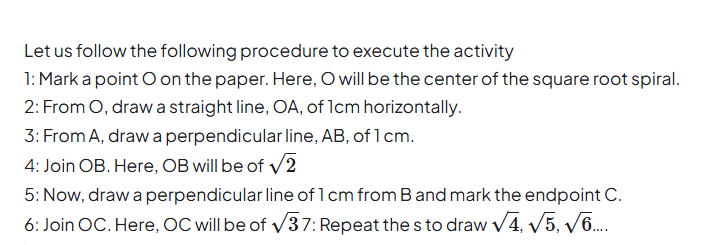
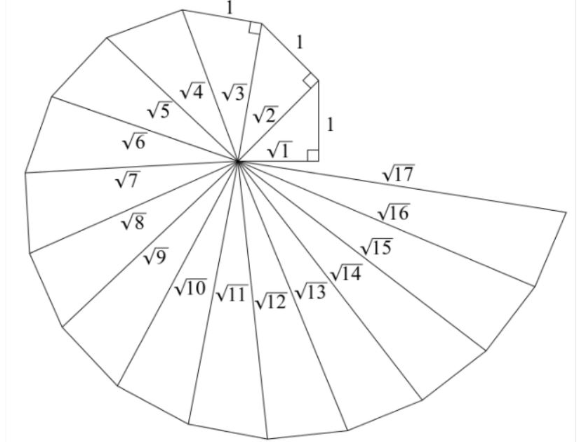
4. Classroom activity (Constructing the ‘square root spiral’) : Take a large sheet of paper and construct the ‘square root spiral’ in the following fashion. Start with a point O and draw a line segment OP_1 of unit length. Draw a line segment P_1 P_2 perpendicular to OP_1 of unit length (see Fig. 1.9). Now draw a line segment P_2 P_3 perpendicular to OP_2. Then draw a line segment P_3 P_4 perpendicular to OP_3. Continuing in this manner, you can get the line segment P_(n-1) P_n by drawing a line segment of unit length perpendicular to OP_(n-1). In this manner, you will have created the points P_2, P_3, …, P_n, …, and joined them to create a beautiful spiral depicting root 2, root 3, root 4, …
Number Systems Class 9 SEBA Ex 1.2 Solutions
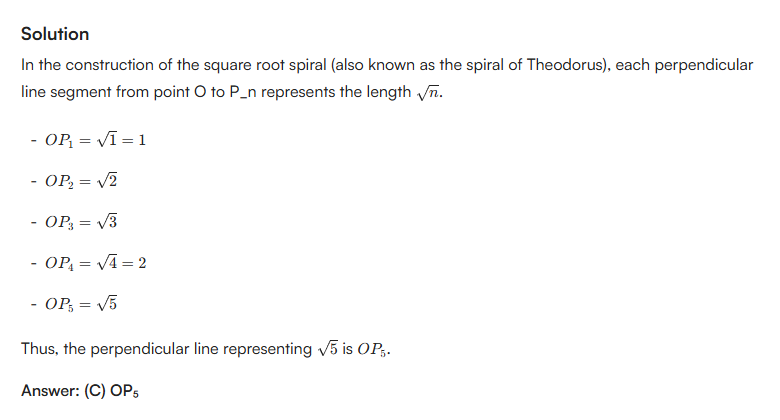
5. In the adjacent construction of square root spiral which perpendicular line represents root 5?
(A) OP_4
(B) OP_2
(C) OP_5
(D) OP_3
Locate Root 5 on Number Line Class 9 SEBA
SEBA Class 9 Maths Chapter 1 Exercise 1.2 Textbook Answers
📐 Updated Solutions Notice: This page features complete, step-by-step SEBA Class 9 Mathematics Chapter 1 (Number Systems) Exercise 1.2 Textual Solutions updated for the 2026–27 academic session. All irrational number concepts, true/false conceptual justifications, geometric number line representations(sqrt(2), sqrt(3), sqrt(5)), and square root spiral steps strictly follow the latest revised Assam Board (SEBA) curriculum. (sqrt(2), sqrt(3), sqrt(5)), and square root spiral steps strictly follow the latest revised Assam Board (SEBA) curriculum.
📐 Updated Solutions Notice: This page features complete, step-by-step SEBA Class 9 Mathematics Chapter 1 (Number Systems) Exercise 1.2 Textual Solutions updated for the 2026–27 academic session. All irrational number concepts, true/false conceptual justifications, geometric number line representations(sqrt(2), sqrt(3), sqrt(5)), and square root spiral steps strictly follow the latest revised Assam Board (SEBA) curriculum.