Looking for complete, step-by-step textbook solutions for SEBA Class 10 Mathematics Chapter 5 (Arithmetic Progressions) Exercise 5.1 for the 2026–27 academic session? Access clear, verified solutions for every question in Ex 5.1, including checking real-life situational word problems to determine whether they form an AP, writing the first four terms given the first term ($a$) and common difference ($d$), finding $a$ and $d$ from given series, checking whether number patterns form an AP (including square root radicals like $\sqrt{2}, \sqrt{8}, \sqrt{18}, \sqrt{32}$), and exam-oriented model answers tailored strictly for Assam Board HSLC students.
EXERCISE 5.1
1. In which of the following situations, does the list of numbers involved make an arithmetic progression, and why?
(i) The taxi fare after each km when the fare is Rs 15 for the first km and Rs 8 for each additional km.
Solution:
Taxi fare for 1 km = a₁ = Rs 15
Taxi fare for 2 km = a₂ = 15 + 8 = Rs 23
Taxi fare for 3 km = a₃ = 23 + 8 = Rs 31
Taxi fare for 4 km = a₄ = 31 + 8 = Rs 39
List of numbers: 15, 23, 31, 39, …
a₂ – a₁ = 23 – 15 = 8
a₃ – a₂ = 31 – 23 = 8
a₄ – a₃ = 39 – 31 = 8
Since the difference between successive terms is constant, it forms an AP.
(ii) The amount of air present in a cylinder when a vacuum pump removes 1/4 of the air remaining in the cylinder at a time.
Solution:
Let the initial volume of air in the cylinder be V.
First removal: Remaining air = a₁ = V
Second removal: a₂ = V – (1/4)V = (3/4)V
Third removal: a₃ = (3/4)V – (1/4)(3/4)V = (9/16)V
Now, a₂ – a₁ = (3/4)V – V = -(1/4)V a₃ – a₂ = (9/16)V – (3/4)V = -(3/16)V
Since a₂ – a₁ ≠ a₃ – a₂, it does not form an AP.
(iii) The cost of digging a well after every metre of digging, when it costs Rs 150 for the first metre and rises by Rs 50 for each subsequent metre.
Solution:
Cost for digging 1 m = a₁ = Rs 150 Cost for digging 2 m = a₂ = 150 + 50 = Rs 200 Cost for digging 3 m = a₃ = 200 + 50 = Rs 250 Cost for digging 4 m = a₄ = 250 + 50 = Rs 300
List of numbers: 150, 200, 250, 300, …
a₂ – a₁ = 200 – 150 = 50
a₃ – a₂ = 250 – 200 = 50
a₄ – a₃ = 300 – 250 = 50
Since the difference between successive terms is constant, it forms an AP.
(iv) The amount of money in the account every year, when Rs 10000 is deposited at compound interest at 8 % per annum.
Solution:
Formula: A = P(1 + r/100)ⁿ
Amount after 1st year: a₁ = 10000(1 + 8/100) = 10800
Amount after 2nd year: a₂ = 10000(1 + 8/100)² = 11664
Amount after 3rd year: a₃ = 10000(1 + 8/100)³ = 12597.12
Now, a₂ – a₁ = 11664 – 10800 = 864 a₃ – a₂ = 12597.12 – 11664 = 933.12
Since a₂ – a₁ ≠ a₃ – a₂, it does not form an AP.
SEBA Class 10 Maths Exercise 5.1 Solutions
2. Write first four terms of the AP, when the first term a and the common difference d are given as follows:
(i) a = 10, d = 10
a₁ = a = 10
a₂ = a + d = 10 + 10 = 20
a₃ = a₂ + d = 20 + 10 = 30
a₄ = a₃ + d = 30 + 10 = 40
First four terms are: 10, 20, 30, 40
(ii) a = -2, d = 0
a₁ = a = -2
a₂ = a + d = -2 + 0 = -2
a₃ = a₂ + d = -2 + 0 = -2
a₄ = a₃ + d = -2 + 0 = -2
First four terms are: -2, -2, -2, -2
(iii) a = 4, d = -3
a₁ = a = 4
a₂ = a + d = 4 + (-3) = 1
a₃ = a₂ + d = 1 + (-3) = -2
a₄ = a₃ + d = -2 + (-3) = -5
First four terms are: 4, 1, -2, -5
(iv) a = -1, d = 1/2
a₁ = a = -1
a₂ = a + d = -1 + 1/2 = -1/2
a₃ = a₂ + d = -1/2 + 1/2 = 0
a₄ = a₃ + d = 0 + 1/2 = 1/2
First four terms are: -1, -1/2, 0, 1/2
(v) a = -1.25, d = -0.25
a₁ = a = -1.25
a₂ = a + d = -1.25 + (-0.25) = -1.50
a₃ = a₂ + d = -1.50 + (-0.25) = -1.75
a₄ = a₃ + d = -1.75 + (-0.25) = -2.00
First four terms are: -1.25, -1.50, -1.75, -2.00
Class 10 Maths Chapter 5 Arithmetic Progressions Ex 5.1 SEBA 2026-27
3. For the following APs, write the first term and the common difference:
(i) 3, 1, -1, -3, …
First term (a) = 3
Common difference (d) = a₂ – a₁ = 1 – 3 = -2
(ii) -5, -1, 3, 7, …
First term (a) = -5
Common difference (d) = a₂ – a₁ = -1 – (-5) = -1 + 5 = 4
(iii) 1/3, 5/3, 9/3, 13/3, …
First term (a) = 1/3
Common difference (d) = a₂ – a₁ = 5/3 – 1/3 = 4/3
(iv) 0.6, 1.7, 2.8, 3.9, …
First term (a) = 0.6
Common difference (d) = a₂ – a₁ = 1.7 – 0.6 = 1.1
SEBA Class 10 Maths AP Common Difference First Term Solutions
4. Which of the following are APs? If they form an AP, find the common difference d and write three more terms.
(i) 2, 4, 8, 16, …
a₂ – a₁ = 4 – 2 = 2
a₃ – a₂ = 8 – 4 = 4
Since a₂ – a₁ ≠ a₃ – a₂, it is not an AP.
(ii) 2, 5/2, 3, 7/2, …
a₂ – a₁ = 5/2 – 2 = 1/2
a₃ – a₂ = 3 – 5/2 = 1/2
a₄ – a₃ = 7/2 – 3 = 1/2
Since the difference is constant, it is an AP.
Common difference (d) = 1/2
Next three terms:
a₅ = 7/2 + 1/2 = 8/2 = 4
a₆ = 4 + 1/2 = 9/2
a₇ = 9/2 + 1/2 = 10/2 = 5
(iii) -1.2, -3.2, -5.2, -7.2, …
a₂ – a₁ = -3.2 – (-1.2) = -2
a₃ – a₂ = -5.2 – (-3.2) = -2
a₄ – a₃ = -7.2 – (-5.2) = -2
Since the difference is constant, it is an AP.
Common difference (d) = -2
Next three terms:
a₅ = -7.2 + (-2) = -9.2
a₆ = -9.2 + (-2) = -11.2
a₇ = -11.2 + (-2) = -13.2
(iv) -10, -6, -2, 2, …
a₂ – a₁ = -6 – (-10) = 4
a₃ – a₂ = -2 – (-6) = 4
a₄ – a₃ = 2 – (-2) = 4
Since the difference is constant, it is an AP.
Common difference (d) = 4
Next three terms:
a₅ = 2 + 4 = 6
a₆ = 6 + 4 = 10
a₇ = 10 + 4 = 14
(v) 3, 3 + √2, 3 + 2√2, 3 + 3√2, …
a₂ – a₁ = (3 + √2) – 3 = √2
a₃ – a₂ = (3 + 2√2) – (3 + √2) = √2
a₄ – a₃ = (3 + 3√2) – (3 + 2√2) = √2
Since the difference is constant, it is an AP.
Common difference (d) = √2
Next three terms:
a₅ = (3 + 3√2) + √2 = 3 + 4√2
a₆ = (3 + 4√2) + √2 = 3 + 5√2
a₇ = (3 + 5√2) + √2 = 3 + 6√2
(vi) 0.2, 0.22, 0.222, 0.2222, …
a₂ – a₁ = 0.22 – 0.2 = 0.02
a₃ – a₂ = 0.222 – 0.22 = 0.002
Since a₂ – a₁ ≠ a₃ – a₂, it is not an AP.
(vii) 0, -4, -8, -12, …
a₂ – a₁ = -4 – 0 = -4
a₃ – a₂ = -8 – (-4) = -4
a₄ – a₃ = -12 – (-8) = -4
Since the difference is constant, it is an AP.
Common difference (d) = -4
Next three terms:
a₅ = -12 + (-4) = -16
a₆ = -16 + (-4) = -20
a₇ = -20 + (-4) = -24
(viii) -1/2, -1/2, -1/2, -1/2, …
a₂ – a₁ = -1/2 – (-1/2) = 0
a₃ – a₂ = -1/2 – (-1/2) = 0
a₄ – a₃ = -1/2 – (-1/2) = 0
Since the difference is constant, it is an AP.
Common difference (d) = 0
Next three terms: a₅ = -1/2
a₆ = -1/2
a₇ = -1/2
(ix) 1, 3, 9, 27, …
a₂ – a₁ = 3 – 1 = 2
a₃ – a₂ = 9 – 3 = 6
Since a₂ – a₁ ≠ a₃ – a₂, it is not an AP.
(x) a, 2a, 3a, 4a, …
a₂ – a₁ = 2a – a = a
a₃ – a₂ = 3a – 2a = a
a₄ – a₃ = 4a – 3a = a
Since the difference is constant, it is an AP.
Common difference (d) = a
Next three terms:
a₅ = 4a + a = 5a
a₆ = 5a + a = 6a
a₇ = 6a + a = 7a
(xi) a, a², a³, a⁴, …
a₂ – a₁ = a² – a = a(a – 1)
a₃ – a₂ = a³ – a² = a²(a – 1)
Since a₂ – a₁ ≠ a₃ – a₂, it is not an AP.
(xii) √2, √8, √18, √32, …
Rewriting the terms: √2, 2√2, 3√2, 4√2, …
a₂ – a₁ = 2√2 – √2 = √2
a₃ – a₂ = 3√2 – 2√2 = √2
a₄ – a₃ = 4√2 – 3√2 = √2
Since the difference is constant, it is an AP.
Common difference (d) = √2
Next three terms:
a₅ = 4√2 + √2 = 5√2 = √50
a₆ = 5√2 + √2 = 6√2 = √72
a₇ = 6√2 + √2 = 7√2 = √98
(xiii) √3, √6, √9, √12, …
a₂ – a₁ = √6 – √3
a₃ – a₂ = √9 – √6 = 3 – √6
Since a₂ – a₁ ≠ a₃ – a₂, it is not an AP.
(xiv) 1², 3², 5², 7², …
Rewriting the terms: 1, 9, 25, 49, …
a₂ – a₁ = 9 – 1 = 8 a₃ – a₂ = 25 – 9 = 16
Since a₂ – a₁ ≠ a₃ – a₂, it is not an AP.
(xv) 1², 5², 7², 73, ..
Rewriting the terms: 1, 25, 49, 73, …
a₂ – a₁ = 25 – 1 = 24 a₃ – a₂ = 49 – 25 = 24 a₄ – a₃ = 73 – 49 = 24
Since the difference is constant, it is an AP.
Common difference (d) = 24
Next three terms: a₅ = 73 + 24 = 97 a₆ = 97 + 24 = 121 a₇ = 121 + 24 = 145
Exercise 5.1 Class 10 Maths Textual Questions Assam Board
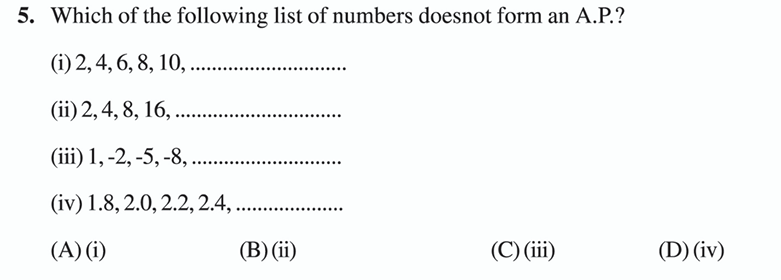
SOLUTION:
Checking each list of numbers:
(i) 2, 4, 6, 8, 10, … 4 – 2 = 2 6 – 4 = 2 Since the common difference is constant, it forms an AP.
(ii) 2, 4, 8, 16, … 4 – 2 = 2 8 – 4 = 4 Since 4 – 2 ≠ 8 – 4 (difference is not constant), it does not form an AP.
(iii) 1, -2, -5, -8, … -2 – 1 = -3 -5 – (-2) = -3 Since the common difference is constant, it forms an AP.
(iv) 1.8, 2.0, 2.2, 2.4, … 2.0 – 1.8 = 0.2 2.2 – 2.0 = 0.2 Since the common difference is constant, it forms an AP.
Therefore, list (ii) does not form an AP.
Correct Option: (B) (ii)
6. Consider the statements P to S. They form jumbled links of common difference in A.P. Choose the option that represents the correct increasing sequence of common difference of the A.P.
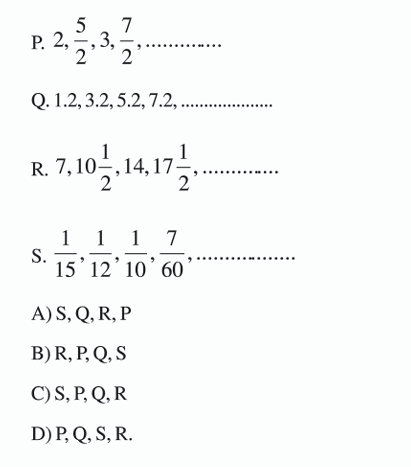
SOLUTION:
Finding the common difference (d) for each progression:
For P: 2, 5/2, 3, 7/2, … d_P = 5/2 – 2 = 1/2 = 0.5
For Q: 1.2, 3.2, 5.2, 7.2, … d_Q = 3.2 – 1.2 = 2
For R: 7, 10 1/2, 14, 17 1/2, … d_R = 10 1/2 – 7 = 21/2 – 7 = 7/2 = 3.5
For S: 1/15, 1/12, 1/10, 7/60, … d_S = 1/12 – 1/15 = (5 – 4)/60 = 1/60 ≈ 0.0167
Arranging the common differences in increasing order:
1/60 < 1/2 < 2 < 7/2
dS < dP < dQ < dR
The correct increasing sequence is: S, P, Q, R
Correct Option: (C) S, P, Q, R
7. If p, 2p – 1 and 2p + 1 are three consecutive terms of an A.P, the value of p is
(A) -3 (B) -2 (C) 3 (D) 6
SOLUTION:
Given terms: p, 2p – 1, 2p + 1 are in AP.
Since they are consecutive terms, the common difference is equal:
(2p – 1) – p = (2p + 1) – (2p – 1)
p – 1 = 2p + 1 – 2p + 1
p – 1 = 2
p = 2 + 1
p = 3
Correct Option: (C) 3
8. Show that a – b, a, a + b form consecutive terms of an A.P.
SOLUTION:
Let the three terms be:
a₁ = a – b
a₂ = a
a₃ = a + b
Finding the difference between consecutive terms:
a₂ – a₁ = a – (a – b)
= a – a + b
= b
a₃ – a₂ = (a + b) – a
= b
Since a₂ – a₁ = a₃ – a₂ = b (constant difference), the terms a – b, a, a + b form consecutive terms of an AP.
Hence proved.
📐 HSLC Mathematics Solutions Notice: This page features the complete SEBA Class 10 Maths Chapter 5 (Arithmetic Progressions) Exercise 5.1 Step-by-Step Textbook Solutions updated for the 2026–27 academic session. Structured with rigorous mathematical working, clear explanations of consecutive difference checks ($a_{k+1} – a_k$), and algebraic proofs, these solutions build the foundational concepts required to score full marks in both objective 1-mark MCQs and 2-mark short questions in your board examinations.
💡 Master HSLC Class 10 Mathematics Arithmetic Progressions:
- Having difficulty simplifying radicals like $\sqrt{3}, \sqrt{6}, \sqrt{9}, \sqrt{12}$ to check for an AP, or determining why the compound interest problem does not form an arithmetic progression? Drop your question in the comments section below!
- Bookmark this page for fast reference before your weekly class tests, half-yearly exams, pre-boards, and the final HSLC board examination.
- Share this link with your classmates and WhatsApp study groups to make Class 10 Maths problem-solving straightforward and error-free!