Looking for complete, step-by-step textbook solutions for SEBA Class 10 Mathematics Chapter 5 (Arithmetic Progression – Exercise 5.3) for the 2026–27 academic session? Access verified solutions to all textual questions based on the sum of the first n terms formulas(Sn = n/2 [2a + (n – 1)d] and Sn = n/2 [a + l]), including finding the sum of given arithmetic series, solving for missing variables (a, d, n, an, Sn) in multi-step problems, finding the sum of odd numbers between 0 and 50, practical real-life word problems (school tree plantation, cash prizes, potato race, spiral length), and exam-oriented model solutions designed strictly according to the Assam Board (SEBA) HSLC blueprint.
1. Find the sum of the following APs:
(i) 2, 7, 12, …, to 10 terms.
Here, a = 2, d = 7 – 2 = 5, n = 10
S₁₀ = (10/2)[2(2) + (10 – 1)5]
S₁₀ = 5[4 + 9(5)]
S₁₀ = 5[4 + 45]
S₁₀ = 5 × 49
S₁₀ = 245
(ii) -37, -33, -29, …, to 12 terms.
Here, a = -37, d = -33 – (-37) = 4, n = 12
S₁₂ = (12/2)[2(-37) + (12 – 1)4]
S₁₂ = 6[-74 + 11(4)]
S₁₂ = 6[-74 + 44]
S₁₂ = 6 × (-30)
S₁₂ = -180
(iii) 0.6, 1.7, 2.8, …, to 100 terms.
Here, a = 0.6, d = 1.7 – 0.6 = 1.1, n = 100
S₁₀₀ = (100/2)[2(0.6) + (100 – 1)1.1]
S₁₀₀ = 50[1.2 + 99(1.1)]
S₁₀₀ = 50[1.2 + 108.9]
S₁₀₀ = 50 × 110.1
S₁₀₀ = 5505
(iv) 1/15, 1/12, 1/10, …, to 11 terms.
Here, a = 1/15, d = 1/12 – 1/15 = (5 – 4)/60 = 1/60, n = 11
S₁₁ = (11/2)[2(1/15) + (11 – 1)(1/60)]
S₁₁ = (11/2)[2/15 + 10/60]
S₁₁ = (11/2)[2/15 + 1/6]
S₁₁ = (11/2)[(4 + 5)/30]
S₁₁ = (11/2)[9/30]
S₁₁ = (11/2)[3/10]
S₁₁ = 33/20
2. Find the sums given below :
(i) 7 + 10 1/2 + 14 + … + 84
Here, a = 7, d = 21/2 – 7 = 7/2, l = aₙ = 84
aₙ = a + (n – 1)d
84 = 7 + (n – 1)(7/2)
77 = (n – 1)(7/2)
n – 1 = 77 × (2/7)
n – 1 = 22
n = 23
S₂₃ = (n/2)(a + l)
S₂₃ = (23/2)(7 + 84)
S₂₃ = (23/2) × 91
S₂₃ = 2093/2 = 1046 1/2
(ii) 34 + 32 + 30 + … + 10
Here, a = 34, d = 32 – 34 = -2, l = aₙ = 10
aₙ = a + (n – 1)d
10 = 34 + (n – 1)(-2)
-24 = (n – 1)(-2)
n – 1 = 12
n = 13
S₁₃ = (n/2)(a + l)
S₁₃ = (13/2)(34 + 10)
S₁₃ = (13/2) × 44
S₁₃ = 13 × 22
S₁₃ = 286
(iii) -5 + (-8) + (-11) + … + (-230)
Here, a = -5, d = -8 – (-5) = -3, l = aₙ = -230
aₙ = a + (n – 1)d
-230 = -5 + (n – 1)(-3)
-225 = (n – 1)(-3)
n – 1 = 75
n = 76
S₇₆ = (n/2)(a + l)
S₇₆ = (76/2)[-5 + (-230)]
S₇₆ = 38 × (-235)
S₇₆ = -8930
3. In an AP:
(i) given a = 5, d = 3, an = 50, find n and Sn.
aₙ = a + (n – 1)d 50 = 5 + (n – 1)3 45 = 3(n – 1) n – 1 = 15 n = 16
S₁₆ = (16/2)(a + aₙ) S₁₆ = 8(5 + 50) S₁₆ = 8 × 55 S₁₆ = 440
Answer: n = 16, Sₙ = 440
(ii) given a = 7, a13 = 35, find d and S13.
a₁₃ = a + 12d 35 = 7 + 12d 28 = 12d d = 28/12 d = 7/3
S₁₃ = (13/2)(a + a₁₃) S₁₃ = (13/2)(7 + 35) S₁₃ = (13/2) × 42 S₁₃ = 13 × 21 S₁₃ = 273
Answer: d = 7/3, S₁₃ = 273
(iii) given a12 = 37, d = 3, find a and S12.
a₁₂ = a + 11d 37 = a + 11(3) 37 = a + 33 a = 4
S₁₂ = (12/2)(a + a₁₂) S₁₂ = 6(4 + 37) S₁₂ = 6 × 41 S₁₂ = 246
Answer: a = 4, S₁₂ = 246
(iv) given a3 = 15, S10 = 125, find d and a10.
a + 2d = 15 … (1)
S₁₀ = (10/2)[2a + 9d] 125 = 5[2a + 9d] 2a + 9d = 25 … (2)
Multiplying (1) by 2: 2a + 4d = 30 … (3)
Subtracting (3) from (2): 5d = -5 d = -1
Substitute d = -1 into (1): a + 2(-1) = 15 a = 17
a₁₀ = a + 9d = 17 + 9(-1) = 17 – 9 = 8
Answer: d = -1, a₁₀ = 8
(v) given d = 5, S9 = 75, find a and a9.
S₉ = (9/2)[2a + (9 – 1)d]
75 = (9/2)[2a + 8(5)]
75 × (2/9) = 2a + 40
50/3 = 2a + 40
2a = 50/3 – 40
2a = -70/3
a = -35/3
a₉ = a + 8d
a₉ = -35/3 + 8(5)
a₉ = -35/3 + 40
a₉ = (-35 + 120)/3
a₉ = 85/3
Answer: a = -35/3, a₉ = 85/3
(vi) given a = 2, d = 8, Sn = 90, find n and an.
Sₙ = (n/2)[2a + (n – 1)d]
90 = (n/2)[2(2) + (n – 1)8]
180 = n[4 + 8n – 8]
180 = n[8n – 4]
180 = 8n² – 4n
2n² – n – 45 = 0
2n² – 10n + 9n – 45 = 0
2n(n – 5) + 9(n – 5) = 0
(2n + 9)(n – 5) = 0
Since n cannot be negative or fractional: n = 5
a₅ = a + 4d = 2 + 4(8) = 2 + 32 = 34
Answer: n = 5, aₙ = 34
(vii) given a = 8, an = 62, Sn = 210, find n and d.
Sₙ = (n/2)(a + aₙ)
210 = (n/2)(8 + 62)
210 = (n/2)(70)
210 = 35n
n = 210/35
n = 6
Now, aₙ = a + (n – 1)d
62 = 8 + (6 – 1)d
54 = 5d
d = 54/5
Answer: n = 6, d = 54/5
(viii) given an = 4, d = 2, Sn = -14, find n and a.
aₙ = a + (n – 1)d
4 = a + (n – 1)2
4 = a + 2n – 2
a = 6 – 2n … (1)
Sₙ = (n/2)(a + aₙ)
-14 = (n/2)(a + 4)
-28 = n(6 – 2n + 4) [Using (1)]
-28 = n(10 – 2n)
-28 = 10n – 2n²
2n² – 10n – 28 = 0
n² – 5n – 14 = 0
(n – 7)(n + 2) = 0
Since n must be positive: n = 7
Substitute n = 7 into (1):
a = 6 – 2(7)
= 6 – 14
= -8
Answer: n = 7, a = -8
(ix) given a = 3, n = 8, S = 192, find d.
S = (n/2)[2a + (n – 1)d]
192 = (8/2)[2(3) + (8 – 1)d]
192 = 4[6 + 7d]
48 = 6 + 7d
7d = 42
d = 6
Answer: d = 6
(x) given l = 28, S = 144, and there are total 9 terms. Find a.
S = (n/2)(a + l)
144 = (9/2)(a + 28)
144 × (2/9) = a + 28
32 = a + 28
a = 4
Answer: a = 4
4. How many terms of the AP : 9, 17, 25, … must be taken to give a sum of 636?
Given AP: 9, 17, 25, … Here, a = 9, d = 17 – 9 = 8, Sₙ = 636
Sₙ = (n/2)[2a + (n – 1)d]
636 = (n/2)[2(9) + (n – 1)8]
636 = (n/2)[18 + 8n – 8]
636 = (n/2)[8n + 10]
636 = n(4n + 5)
4n² + 5n – 636 = 0
4n² + 53n – 48n – 636 = 0
n(4n + 53) – 12(4n + 53) = 0
(4n + 53)(n – 12) = 0
Since n cannot be negative or fractional:
n = 12
Answer: 12 terms must be taken.
5. The first term of an AP is 5, the last term is 45 and the sum is 400. Find the number of terms and the common difference.
Given: a = 5, l = aₙ = 45, Sₙ = 400
Sₙ = (n/2)(a + l)
400 = (n/2)(5 + 45)
400 = 25n
n = 16
Now,
l = a + (n – 1)d
45 = 5 + (16 – 1)d
40 = 15d
d = 40/15
d = 8/3
Answer: Number of terms = 16, Common difference = 8/3
SEBA Class 10 Maths Exercise 5.3 Solutions
6. The first and the last terms of an AP are 17 and 350 respectively. If the common difference is 9, how many terms are there and what is their sum?
Given: a = 17, l = 350, d = 9
l = a + (n – 1)d
350 = 17 + (n – 1)9
333 = 9(n – 1)
n – 1 = 37
n = 38
S₃₈ = (n/2)(a + l)
S₃₈ = (38/2)(17 + 350)
S₃₈ = 19 × 367
S₃₈ = 6973
Answer: Number of terms = 38, Sum = 6973
7. Find the sum of first 22 terms of an AP in which d = 7 and 22nd term is 149.
Given: n = 22, d = 7, a₂₂ = 149
a₂₂ = a + 21d
149 = a + 21(7)
149 = a + 147
a = 2
S₂₂ = (n/2)(a + a₂₂)
S₂₂ = (22/2)(2 + 149)
S₂₂ = 11 × 151
S₂₂ = 1661
Answer: S₂₂ = 1661
8. Find the sum of first 51 terms of an AP whose second and third terms are 14 and 18 respectively.
Given: a₂ = 14, a₃ = 18, n = 51
Common difference (d) = a₃ – a₂ = 18 – 14 = 4
First term (a) = a₂ – d = 14 – 4 = 10
S₅₁ = (51/2)[2(10) + (51 – 1)4]
S₅₁ = (51/2)[20 + 50(4)]
S₅₁ = (51/2)[20 + 200]
S₅₁ = (51/2) × 220
S₅₁ = 51 × 110
S₅₁ = 5610
Answer: S₅₁ = 5610
9. If the sum of first 7 terms of an AP is 49 and that of 17 terms is 289, find the sum of first n terms.
Given: S₇ = 49 and S₁₇ = 289
S₇ = (7/2)[2a + 6d] = 49
7(a + 3d) = 49
a + 3d = 7 … (1)
S₁₇ = (17/2)[2a + 16d] = 289
17(a + 8d) = 289
a + 8d = 17 … (2)
Subtracting (1) from (2):
5d = 10
d = 2
Substitute d = 2 into (1):
a + 3(2) = 7
a = 1
Sum of first n terms:
Sₙ = (n/2)[2a + (n – 1)d]
Sₙ = (n/2)[2(1) + (n – 1)2]
Sₙ = (n/2)[2 + 2n – 2]
Sₙ = (n/2)(2n)
Sₙ = n²
Answer: Sₙ = n²
10. Show that a_1, a_2, …, a_n, … form an AP where a_n is defined as below :
(i) an = 3 + 4n
a₁ = 3 + 4(1) = 7
a₂ = 3 + 4(2) = 11
a₃ = 3 + 4(3) = 15
a₂ – a₁ = 11 – 7 = 4
a₃ – a₂ = 15 – 11 = 4 Since the difference is constant, it forms an AP with a = 7, d = 4.
S₁₅ = (15/2)[2(7) + (15 – 1)4]
S₁₅ = (15/2)[14 + 14(4)]
S₁₅ = (15/2)[14 + 56]
S₁₅ = (15/2) × 70
S₁₅ = 15 × 35
S₁₅ = 525
(ii) an = 9 – 5n
Also find the sum of the first 15 terms in each case.
a₁ = 9 – 5(1) = 4
a₂ = 9 – 5(2) = -1
a₃ = 9 – 5(3) = -6
a₂ – a₁ = -1 – 4 = -5
a₃ – a₂ = -6 – (-1) = -5
Since the difference is constant, it forms an AP with a = 4, d = -5.
S₁₅ = (15/2)[2(4) + (15 – 1)(-5)]
S₁₅ = (15/2)[8 + 14(-5)]
S₁₅ = (15/2)[8 – 70]
S₁₅ = (15/2) × (-62)
S₁₅ = 15 × (-31)
S₁₅ = -465
Class 10 Maths Chapter 5.3 Arithmetic Progression SEBA 2026-27
11. If the sum of the first n terms of an AP is 4n – n^2, what is the first term (that is S1)? What is the sum of first two terms? What is the second term? Similarly, find the 3rd, the 10th and the nth terms.
is the sum of first two terms? What is the second term? Similarly, find the 3rd, the 10th and the nth terms.
Soln:
Given: Sₙ = 4n – n²
First term = S₁ = 4(1) – (1)² = 4 – 1 = 3
Sum of first two terms = S₂ = 4(2) – (2)² = 8 – 4 = 4
Second term (a₂) = S₂ – S₁ = 4 – 3 = 1
Common difference (d) = a₂ – a₁ = 1 – 3 = -2
3rd term: a₃ = a + 2d = 3 + 2(-2) = 3 – 4 = -1
10th term: a₁₀ = a + 9d = 3 + 9(-2) = 3 – 18 = -15
nth term: aₙ = a + (n – 1)d = 3 + (n – 1)(-2) = 3 – 2n + 2 = 5 – 2n
Answers:
- First term (S₁) = 3
- Sum of first two terms (S₂) = 4
- Second term (a₂) = 1
- 3rd term (a₃) = -1
- 10th term (a₁₀) = -15
- nth term (aₙ) = 5 – 2n
12. Find the sum of the first 40 positive integers divisible by 6.
Soln:
First 40 positive integers divisible by 6 are: 6, 12, 18, …, to 40 terms
Here, a = 6, d = 6, n = 40
S₄₀ = (40/2)[2(6) + (40 – 1)6]
S₄₀ = 20[12 + 39(6)]
S₄₀ = 20[12 + 234]
S₄₀ = 20 × 246
S₄₀ = 4920
13. Find the sum of the first 15 multiples of 8.
Soln:
First 40 positive integers divisible by 6 are: 6, 12, 18, …, to 40 terms
Here, a = 6, d = 6, n = 40
S₄₀ = (40/2)[2(6) + (40 – 1)6]
S₄₀ = 20[12 + 39(6)]
S₄₀ = 20[12 + 234]
S₄₀ = 20 × 246
S₄₀ = 4920
14. Find the sum of the odd numbers between 0 and 50.
Soln:
Odd numbers between 0 and 50 are: 1, 3, 5, …, 49
Here, a = 1, d = 2, l = aₙ = 49
aₙ = a + (n – 1)d
49 = 1 + (n – 1)2
48 = 2(n – 1)
n – 1 = 24
n = 25
S₂₅ = (n/2)(a + l)
S₂₅ = (25/2)(1 + 49)
S₂₅ = (25/2) × 50
S₂₅ = 25 × 25
S₂₅ = 625
15. A contract on construction job specifies a penalty for delay of completion beyond a certain date as follows: Rs 200 for the first day, Rs 250 for the second day, Rs 300 for the third day, etc., the penalty for each succeeding day being Rs 50 more than for the preceding day. How much money the contractor has to pay as penalty, if he has delayed the work by 30 days?
Soln:
Penalty amounts form an AP: 200, 250, 300, … Here, a = 200, d = 50, n = 30
S₃₀ = (30/2)[2(200) + (30 – 1)50]
S₃₀ = 15[400 + 29(50)]
S₃₀ = 15[400 + 1450]
S₃₀ = 15 × 1850
S₃₀ = 27750
Answer: The contractor has to pay Rs 27750 as penalty.
SEBA Class 10 Maths Ex 5.3 Question Answer
16. A sum of Rs 700 is to be used to give seven cash prizes to students of a school for their overall academic performance. If each prize is Rs 20 less than its preceding prize, find the value of each of the prizes.
Soln:
Given: Total sum S₇ = 700, n = 7, d = -20
S₇ = (7/2)[2a + (7 – 1)(-20)]
700 = (7/2)[2a – 120]
700 × (2/7) = 2a – 120
200 = 2a – 120
2a = 320
a = 160
Value of each of the 7 prizes: 160, 140, 120, 100, 80, 60, 40 (in Rs)
17. In a school, students thought of planting trees in and around the school to reduce air pollution. It was decided that the number of trees, that each section of each class will plant, will be the same as the class, in which they are studying, e.g., a section of Class I will plant 1 tree, a section of Class II will plant 2 trees and so on till Class XII. There are three sections of each class. How many trees will be planted by the students?
Soln:
Number of sections per class = 3
Classes run from I to XII (n = 12)
Trees planted by each class:
Class 1 = 1 × 3 = 3
Class 2 = 2 × 3 = 6
Class 3 = 3 × 3 = 9
…
Class 12 = 12 × 3 = 36
This forms an AP: 3, 6, 9, …, 36
Here, a = 3, d = 3, l = 36, n = 12
S₁₂ = (12/2)(a + l)
S₁₂ = 6(3 + 36)
S₁₂ = 6 × 39
S₁₂ = 234
Answer: Total trees planted = 234
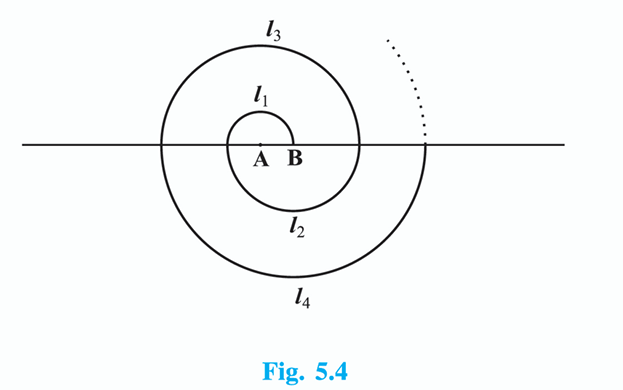
18. A spiral is made up of successive semicircles, with centres alternately at A and B, starting with centre at A, of radii 0.5 cm, 1.0 cm, 1.5 cm, 2.0 cm, … as shown in Fig. 5.4. What is the total length of such a spiral made up of thirteen consecutive semicircles? (Take pi = 22/7)
Soln:
Lengths of successive semicircles: l = πr
Given: r₁ = 0.5 cm, r₂ = 1.0 cm, r₃ = 1.5 cm, …, n = 13
l₁ = π(0.5)
l₂ = π(1.0)
l₃ = π(1.5)
Total length = l₁ + l₂ + … + l₁₃
= π[0.5 + 1.0 + 1.5 + … to 13 terms]
For the AP inside: a = 0.5, d = 0.5, n = 13
S₁₃ = (13/2)[2(0.5) + (13 – 1)(0.5)]
S₁₃ = (13/2)[1 + 12(0.5)]
S₁₃ = (13/2)[1 + 6]
S₁₃ = (13/2) × 7
Total length = (22/7) × (13/2) × 7 = 11 × 13 = 143 cm
Answer: Total length of the spiral = 143 cm
19. 200 logs are stacked in the following manner: 20 logs in the bottom row, 19 in the next row, 18 in the row next to it and so on (see Fig. 5.5). In how many rows are the 200 logs placed and how many logs are in the top row?

Soln:
Number of logs per row forms an AP: 20, 19, 18, …
Here, a = 20, d = -1, Sₙ = 200
Sₙ = (n/2)[2a + (n – 1)d]
200 = (n/2)[2(20) + (n – 1)(-1)]
400 = n[40 – n + 1]
400 = n(41 – n)
n² – 41n + 400 = 0
n² – 25n – 16n + 400 = 0
n(n – 25) – 16(n – 25) = 0
(n – 16)(n – 25) = 0
n = 16 or n = 25
Checking for n = 25:
a₂₅ = 20 + 24(-1) = -4 (number of logs cannot be negative)
Therefore, n = 16.
Logs in the top row: a₁₆ = a + 15d = 20 + 15(-1) = 20 – 15 = 5
Answer:
- Total rows = 16 PNG
- Logs in the top row = 5
20. In a potato race, a bucket is placed at the starting point, which is 5 m from the first potato, and the other potatoes are placed 3 m apart in a straight line. There are ten potatoes in the line (see Fig. 5.6).
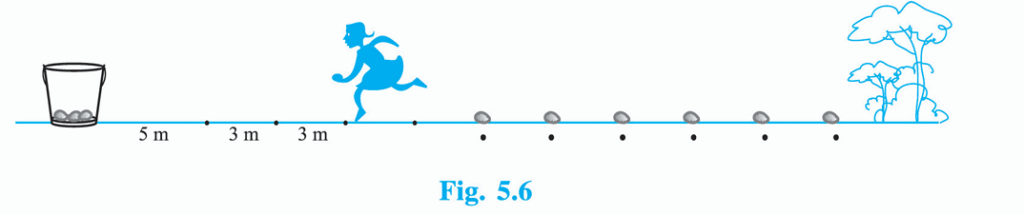
A competitor starts from the bucket, picks up the nearest potato, runs back with it, drops it in the bucket, runs back to pick up the next potato, runs to the bucket to drop it in, and she continues the same way until all the potatoes are in the bucket. What is the total distance the competitor has to run?
[Hint : To pick up the first potato and the second potato, the total distance (in metres) run by a competitor is 2 x 5 + 2 x (5 + 3)]
Soln:
Distance run for: 1st potato = 2 × 5 = 10 m 2nd potato = 2 × (5 + 3) = 16 m 3rd potato = 2 × (5 + 3 + 3) = 22 m … to 10 potatoes
This forms an AP: 10, 16, 22, … to 10 terms
Here, a = 10, d = 6, n = 10
S₁₀ = (10/2)[2(10) + (10 – 1)6]
S₁₀ = 5[20 + 9(6)]
S₁₀ = 5[20 + 54]
S₁₀ = 5 × 74
S₁₀ = 370 m
Answer: Total distance run by the competitor = 370 m
Class 10 Maths Sum of AP Formula Step by Step Solutions
21. The first and the last terms of an AP are 1 and 11 respectively. If the sum of its terms is 36, then the number of terms will be
(A) 5
(B) 6
(C) 7
(D) 8
Soln:
Given: a = 1, l = 11, Sₙ = 36
Sₙ = (n/2)(a + l)
36 = (n/2)(1 + 11)
36 = (n/2)(12)
36 = 6n
n = 6
Correct Option: (B) 6
Soln:
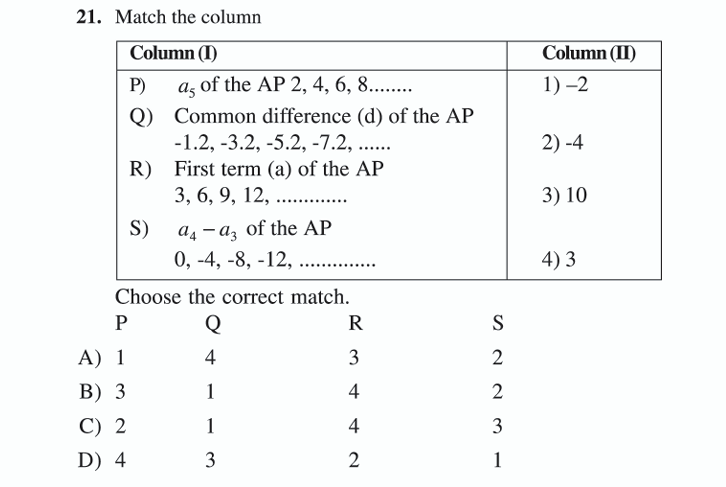
P) Sum of first n natural numbers = n(n + 1)/2 –> (3)
Q) Sum up to n terms of AP = (n/2)[2a + (n – 1)d] –> (4)
R) Sum of first n odd natural numbers = n² –> (1)
S) Sum of first n even natural numbers = n(n + 1) –> (2)
Matching: P-3, Q-4, R-1, S-2
Correct Option: (C)
23. Which of the following is correct for the AP 5, 9, 13, ………, 185?
(i) a_n = 1 + 4n
(ii) a_3 + a_4 = 30
(iii) S_n = n/2 x 190
(iv) n = 43
A) (i), (iii)
B) (ii), (iii)
C) (i), (ii), (iii)
D) (i), (ii), (iii), (iv)
Soln:
Given AP: 5, 9, 13, …, 185
Here, a = 5, d = 4
(i) aₙ = a + (n – 1)d = 5 + (n – 1)4 = 4n + 1 [Correct]
(ii) a₃ + a₄ = (a + 2d) + (a + 3d) = (5 + 8) + (5 + 12) = 13 + 17 = 30 [Correct]
(iii) Sₙ = (n/2)(a + l) = (n/2)(5 + 185) = (n/2) × 190 [Correct]
(iv) aₙ = 185 => 1 + 4n = 185 => 4n = 184 => n = 46 (Not 43, so incorrect)
Therefore, statements (i), (ii), and (iii) are correct.
Correct Option: (C) (i), (ii), (iii)
24. Assertion (A) : The sum of 10 terms of the sequence 11, 13, 15, 17,…….. is 200.
Reason (R) : The sum of first n odd natural number is n^2
(A) (A) and (R) both are true and (R) is the correct explanation for (A)
(B) (A) and (R) both are true but (R) is not the correct explanation for (A)
(C) (A) is true but (R) is false
(D) (A) is false but (R) is true.
Soln:
Assertion (A):
Sequence: 11, 13, 15, 17, … to 10 terms
Here, a = 11, d = 2, n = 10
S₁₀ = (10/2)[2(11) + 9(2)] = 5[22 + 18] = 5(40) = 200 [True]
Reason (R):
Sum of first n odd natural numbers is n². [True]
However, the given sequence in Assertion (A) does not start from the first odd natural number (1).
Therefore, (R) is true, but it is not the correct explanation for (A).
Correct Option: (B) (A) and (R) both are true but (R) is not the correct explanation for (A)
25. If the sum of the first n odd number is S_1 and the sum of the first n natural number is S2 then the value of S1 / S2 is
(A) 2n / n+1 (B) n+1 / 2n (C) n / n+1 (D) n+1 / n
Soln:
Sum of first n odd numbers: S₁ = n²
Sum of first n natural numbers: S₂ = n(n + 1)/2
Ratio:
S₁ / S₂ = n² / [n(n + 1)/2]
= (2 × n²) / [n(n + 1)]
= 2n / (n + 1)
Correct Option: (A) 2n / (n + 1)
SEBA HSLC Class 10 Maths Chapter 5 Exercise 5.3 Solved PDF
26. A fruit seller brings a cartoon of apples which contains 240 apples. He arranges the apples such that in the first row 6 apples, in the the second row there are 10 apples, in the third row there are 14 apples and so on.
(i) Find the total number of rows of apples
Soln:
Total number of rows:
Sₙ = (n/2)[2a + (n – 1)d]
240 = (n/2)[2(6) + (n – 1)4]
240 = (n/2)[12 + 4n – 4]
240 = (n/2)[4n + 8]
240 = n(2n + 4)
2n² + 4n – 240 = 0
n² + 2n – 120 = 0
(n + 12)(n – 10) = 0
Since n must be positive, n = 10.
Total number of rows = 10
(ii) Find the difference in number of apples placed in 7th and 3rd row.
Soln:
Difference in apples between 7th and 3rd row:
a₇ – a₃ = (a + 6d) – (a + 2d)
= 4d
= 4 × 4
= 16 apples
(iii) Find the number of apples in last 3rd row
Soln:
Number of apples in the last 3rd row:
Total rows = 10
Last 3rd row is the 8th row (rows are 10th, 9th, 8th).
a₈ = a + 7d
a₈ = 6 + 7(4)
a₈ = 6 + 28
a₈ = 34 apples
(iv) Check if there is any row containing 32 apples.
Soln:
Let aₙ = 32
a + (n – 1)d = 32
6 + (n – 1)4 = 32
4(n – 1) = 26
n – 1 = 26/4 = 6.5
n = 7.5
Since n must be a positive integer, no row contains 32 apples.
📐 HSLC Class 10 Maths Exercise 5.3 Notice: This page provides complete, step-by-step SEBA Class 10 Mathematics Chapter 5 (Arithmetic Progression) Exercise 5.3 Official Textual Solutions updated for the 2026–27 academic session. Formatted according to the standard HSLC board evaluation method, every problem is worked out with detailed derivations using the summation formulas $S_n = \frac{n}{2}[2a + (n – 1)d]$ and $S_n = \frac{n}{2}[a + l]$—covering table-based unknown value calculations, finding sums of positive integers, and high-weightage word problems (cash prizes, log stacking, and the potato race)—to help you secure maximum marks in your final exams.
💡 Master SEBA Class 10 Arithmetic Progressions:
- Having trouble finding the number of terms when $S_n$ results in a quadratic equation, or calculating the total length of the 13 consecutive semicircular spirals? Post your question in the comments section below!
- Bookmark this page for quick formula review and revision before your unit tests, pre-board exams, and the upcoming HSLC examinations.
- Share this link with your classmates and WhatsApp study groups to make Class 10 Mathematics problem-solving fast and effortless!