Looking for complete, step-by-step textbook solutions for SEBA Class 10 Mathematics Chapter 5 (Arithmetic Progression – Exercise 5.2) for the 2026–27 academic session? Access verified solutions to all textual questions based on the nth term of an AP formula ($a_n = a + (n – 1)d$), including finding missing terms in tabular boxes, determining which term of an AP equals a given value, finding terms from the end, two-digit and three-digit numbers divisible by given integers, word problems on salaries and savings, and exam-oriented model solutions designed strictly according to the Assam Board (SEBA) HSLC curriculum.
EXERCISE 5.2
Fill in the blanks in the following table, given that a is the first term, d the common difference and an the nth term of the AP:
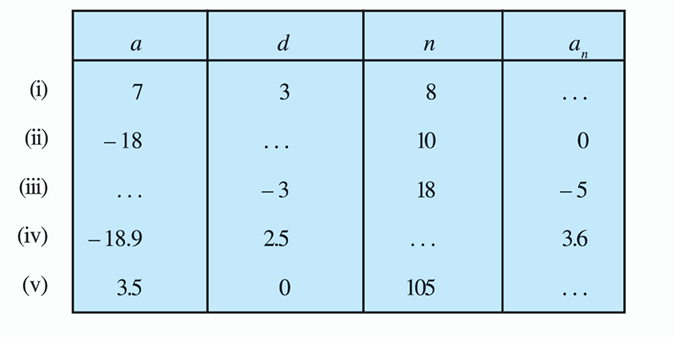
i) Given:
a = 7, d = 3, n = 8
a₈ = 7 + (8 – 1) × 3
a₈ = 7 + 7 × 3
a₈ = 7 + 21
a₈ = 28
(ii) Given:
a = -18, n = 10,
aₙ = 0
0 = -18 + (10 – 1)d
18 = 9d
d = 18 / 9
d = 2
(iii) Given:
d = -3, n = 18,
aₙ = -5
-5 = a + 17(-3)
-5 = a – 51
a = -5 + 51
a = 46
(iv) Given:
a = -18.9, d = 2.5,
aₙ = 3.6
3.6 = -18.9 + (n – 1)(2.5)
3.6 + 18.9 = (n – 1)(2.5)
22.5 = (n – 1)(2.5)
n – 1 = 22.5 / 2.5
n – 1 = 9
n = 10
(v) Given:
a = 3.5, d = 0,
n = 105
aₙ = 3.5 + (105 – 1)(0)
aₙ = 3.5 + 0 aₙ = 3.5
2. Choose the correct choice in the following and justify :
(i) 30th term of the AP: 10, 7, 4, …, is
(A) 97 (B) 77 (C) -77 (D) -87
Given AP: 10, 7, 4, …
Here, a = 10, d = 7 – 10 = -3, n = 30
a₃₀ = a + (30 – 1)d a₃₀ = 10 + 29(-3)
a₃₀ = 10 – 87
a₃₀ = -77
Correct Option: (C) -77
(ii) 11th term of the AP: -3, -1/2, 2, …, is
(A) 28 (B) 22 (C) -38 (D) -48 1/2
Given AP: -3, -1/2, 2, … Here, a = -3, d = -1/2 – (-3) = -1/2 + 3 = 5/2, n = 11
a₁₁ = a + (11 – 1)d
a₁₁ = -3 + 10(5/2)
a₁₁ = -3 + 25
a₁₁ = 22
Correct Option: (B) 22
3. In the following APs, find the missing terms in the boxes :
(i) 2, [ ], 26
Here, a₁ = a = 2,
a₃ = 26
a₃ = a + 2d
26 = 2 + 2d
24 = 2d
d = 12
Missing term = a₂ = a + d = 2 + 12 = 14
Answer: 2, [ 14 ], 26
(ii) [ ], 13, [ ], 3
Here, a₂ = 13 and a₄ = 3
a + d = 13 … (1)
a + 3d = 3 … (2)
Subtracting (1) from (2):
2d = -10
d = -5
Putting d = -5 in (1):
a + (-5) = 13
a = 18
Third term: a₃ = a + 2d = 18 + 2(-5) = 18 – 10 = 8
Answer: [ 18 ], 13, [ 8 ], 3
(iii) 5, [ ], [ ], 9 1/2
Here, a = 5, a₄ = 9 1/2 = 19/2
a₄ = a + 3d
19/2 = 5 + 3d
3d = 19/2 – 5
3d = 9/2
d = 3/2
Missing terms:
a₂ = a + d = 5 + 3/2 = 13/2 = 6 1/2
a₃ = a₂ + d = 13/2 + 3/2 = 16/2 = 8
Answer: 5, [ 6 1/2 ], [ 8 ], 9 1/2
(iv) -4, [ ], [ ], [ ], [ ], 6
Here, a = -4, a₆ = 6
a₆ = a + 5d
6 = -4 + 5d
10 = 5d
d = 2
Missing terms:
a₂ = -4 + 2 = -2
a₃ = -2 + 2 = 0
a₄ = 0 + 2 = 2
a₅ = 2 + 2 = 4
Answer: -4, [ -2 ], [ 0 ], [ 2 ], [ 4 ], 6
(v) [ ], 38, [ ], [ ], [ ], -22
Here, a₂ = 38 and a₆ = -22
a + d = 38 … (1)
a + 5d = -22 … (2)
Subtracting (1) from (2):
4d = -60
d = -15
Putting d = -15 in (1):
a – 15 = 38
a = 53
Missing terms:
a₁ = 53
a₃ = 38 + (-15) = 23
a₄ = 23 + (-15) = 8
a₅ = 8 + (-15) = -7
Answer: [ 53 ], 38, [ 23 ], [ 8 ], [ -7 ], -22
4. Which term of the AP : 3, 8, 13, 18, … is 78?
Soln:
Given AP: 3, 8, 13, 18, … Here, a = 3, d = 8 – 3 = 5, aₙ = 78
aₙ = a + (n – 1)d
78 = 3 + (n – 1)5
75 = (n – 1)5
n – 1 = 15
n = 16
Therefore, the 16th term of the AP is 78.
5. Find the number of terms in each of the following APs :
(i) 7, 13, 19, …, 205
Here, a = 7, d = 13 – 7 = 6, aₙ = 205
aₙ = a + (n – 1)d 205 = 7 + (n – 1)6 198 = (n – 1)6 n – 1 = 198 / 6 n – 1 = 33 n = 34
The number of terms is 34.
(ii) 18, 15 1/2, 13, …, -47
Here, a = 18, d = 31/2 – 18 = -5/2, aₙ = -47
aₙ = a + (n – 1)d
-47 = 18 + (n – 1)(-5/2)
-47 – 18 = (n – 1)(-5/2)
-65 = (n – 1)(-5/2)
n – 1 = (-65) × (-2/5)
n – 1 = 26
n = 27
The number of terms is 27.
SEBA Class 10 Maths Exercise 5.2 Solutions
6. Check whether -150 is a term of the AP : 11, 8, 5, 2 …
Soln:
Given AP: 11, 8, 5, 2, …
Here, a = 11, d = 8 – 11 = -3
Let aₙ = -150
a + (n – 1)d = -150
11 + (n – 1)(-3) = -150
(n – 1)(-3) = -161
n – 1 = 161 / 3
n = 161/3 + 1
n = 164 / 3 = 54 2/3
Since n must be a positive integer, -150 is not a term of this AP.
7. Find the 31st term of an AP whose 11th term is 38 and the 16th term is 73.
Soln:
Given: a₁₁ = 38 and a₁₆ = 73
a + 10d = 38 … (1)
a + 15d = 73 … (2)
Subtracting (1) from (2):
5d = 35
d = 7
Substitute d = 7 into (1):
a + 10(7) = 38
a + 70 = 38
a = -32
Now,
a₃₁ = a + 30d
a₃₁ = -32 + 30(7)
a₃₁ = -32 + 210
a₃₁ = 178
8. An AP consists of 50 terms of which 3rd term is 12 and the last term is 106. Find the 29th term.
Soln:
Given: Total terms n = 50, a₃ = 12, a₅₀ = 106
a + 2d = 12 … (1)
a + 49d = 106 … (2)
Subtracting (1) from (2):
47d = 94
d = 2[
Substitute d = 2 into (1):
a + 2(2) = 12
a + 4 = 12
a = 8
Now,
a₂₉ = a + 28d
a₂₉ = 8 + 28(2)
a₂₉ = 8 + 56
a₂₉ = 64
9. If the 3rd and the 9th terms of an AP are 4 and -8 respectively, which term of this AP is zero?
Soln:
Given: a₃ = 4 and a₉ = -8
a + 2d = 4 … (1)
a + 8d = -8 … (2)
Subtracting (1) from (2):
6d = -12
d = -2
Substitute d = -2 into (1):
a + 2(-2) = 4
a – 4 = 4
a = 8
Let the nth term be 0:
aₙ = a + (n – 1)d = 0
8 + (n – 1)(-2) = 0
-2(n – 1) = -8
n – 1 = 4
n = 5
Therefore, the 5th term of this AP is zero.
10. The 17th term of an AP exceeds its 10th term by 7. Find the common difference.
Soln:
Given: a₁₇ – a₁₀ = 7
[a + (17 – 1)d] – [a + (10 – 1)d] = 7
(a + 16d) – (a + 9d) = 7
7d = 7
d = 1
Common difference = 1
Class 10 Maths Chapter 5.2 Arithmetic Progression SEBA 2026-27
11. Which term of the AP : 3, 15, 27, 39, … will be 132 more than its 54th term?
Soln:
Given AP: 3, 15, 27, 39, …
Here, a = 3, d = 15 – 3 = 12
a₅₄ = a + 53d
a₅₄ = 3 + 53(12)
a₅₄ = 3 + 636 = 639
Let the required term be aₙ:
aₙ = a₅₄ + 132
aₙ = 639 + 132 = 771
Now,
a + (n – 1)d = 771
3 + (n – 1)12 = 771
(n – 1)12 = 768
n – 1 = 768 / 12
n – 1 = 64
n = 65
Therefore, the 65th term will be 132 more than its 54th term.
12. Two APs have the same common difference. The difference between their 100th terms is 100, what is the difference between their 1000th terms?
Soln:
Let the first term of the two APs be a and b, and their common difference be d.
100th terms:
a₁₀₀ = a + 99d
b₁₀₀ = b + 99d
Given:
a₁₀₀ – b₁₀₀ = 100
(a + 99d) – (b + 99d) = 100
a – b = 100 … (1)
Now, difference between their 1000th terms:
a₁₀₀₀ – b₁₀₀₀ = (a + 999d) – (b + 999d)
= a – b
= 100 [From (1)]
The difference between their 1000th terms is 100.
13. How many three-digit numbers are divisible by 7?
Soln:
The three-digit numbers divisible by 7 are: 105, 112, 119, …, 994
Here, a = 105, d = 7, aₙ = 994
aₙ = a + (n – 1)d
994 = 105 + (n – 1)7
889 = (n – 1)7
n – 1 = 889 / 7
n – 1 = 127
n = 128
Therefore, there are 128 three-digit numbers divisible by 7.
14. How many multiples of 4 lie between 10 and 250?
Soln:
Multiples of 4 between 10 and 250 are:
12, 16, 20, …, 248
Here, a = 12, d = 4, aₙ = 248
aₙ = a + (n – 1)d
248 = 12 + (n – 1)4
236 = (n – 1)4
n – 1 = 236 / 4
n – 1 = 59
n = 60
Therefore, there are 60 multiples of 4 lying between 10 and 250.
15. For what value of n, are the nth terms of two APs: 63, 65, 67, … and 3, 10, 17, … equal?
Soln:
First AP: 63, 65, 67, …
a₁ = 63, d₁ = 65 – 63 = 2
aₙ = 63 + (n – 1)2 = 63 + 2n – 2 = 61 + 2n
Second AP: 3, 10, 17, …
a₂ = 3, d₂ = 10 – 3 = 7
aₙ’ = 3 + (n – 1)7 = 3 + 7n – 7 = 7n – 4
Given that their nth terms are equal:
61 + 2n = 7n – 4
61 + 4 = 7n – 2n
65 = 5n
n = 13
Therefore, the 13th terms of both APs are equal.
SEBA Class 10 Maths Ex 5.2 Question Answer
16. Determine the AP whose third term is 16 and the 7th term exceeds the 5th term by 12.
Soln:
Given:
a₃ = 16
a + 2d = 16 … (1)
Also given:
a₇ – a₅ = 12
(a + 6d) – (a + 4d) = 12
2d = 12
d = 6
Substitute d = 6 into (1):
a + 2(6) = 16
a + 12 = 16
a = 4
The AP is: a, a + d, a + 2d, …
= 4, 10, 16, 22, …
17. Find the 20th term from the last term of the AP : 3, 8, 13, …, 253.
Soln:
Given AP: 3, 8, 13, …, 253
Writing the AP in reverse order:
253, 248, 243, …, 3
Here,
First term (a) = 253
Common difference (d) = 248 – 253 = -5
n = 20
a₂₀ = a + (20 – 1)d
a₂₀ = 253 + 19(-5)
a₂₀ = 253 – 95
a₂₀ = 158
Therefore, the 20th term from the last term is 158.
18. The sum of the 4th and 8th terms of an AP is 24 and the sum of the 6th and 10th terms is 44. Find the first three terms of the AP.
Soln:
Given:
a₄ + a₈ = 24
(a + 3d) + (a + 7d) = 24
2a + 10d = 24
a + 5d = 12 … (1)
Also given:
a₆ + a₁₀ = 44
(a + 5d) + (a + 9d) = 44
2a + 14d = 44
a + 7d = 22 … (2)
Subtracting (1) from (2):
2d = 10
d = 5
Substitute d = 5 into (1):
a + 5(5) = 12
a + 25 = 12
a = -13
First three terms: a₁ = -13
a₂ = -13 + 5 = -8
a₃ = -8 + 5 = -3
The first three terms are: -13, -8, -3
19. Chandana started work in 1995 at an annual salary of Rs 5000 and received an increment of Rs 200 each year. In which year did her income reach Rs 7000?
Soln:
Starting salary (a) = Rs 5000
Annual increment (d) = Rs 200
Target income (aₙ) = Rs 7000
aₙ = a + (n – 1)d
7000 = 5000 + (n – 1)200
2000 = (n – 1)200
n – 1 = 10
n = 11
Starting year = 1995
Year in which income reached Rs 7000 = 1995 + (11 – 1) = 2005
20. Ramcharan saved Rs 5 in the first week of a year and then increased his weekly savings by Rs 1.75. If in the nth week, his weekly savings become Rs 20.75, find n.
Soln:
Savings in first week (a) = Rs 5
Weekly increment (d) = Rs 1.75
Savings in nth week (aₙ) = Rs 20.75
aₙ = a + (n – 1)d
20.75 = 5 + (n – 1)(1.75)
15.75 = (n – 1)(1.75)
n – 1 = 15.75 / 1.75
n – 1 = 9
n = 10
SEBA HSLC Class 10 Maths Chapter 5 Exercise 5.2 Solved PDF
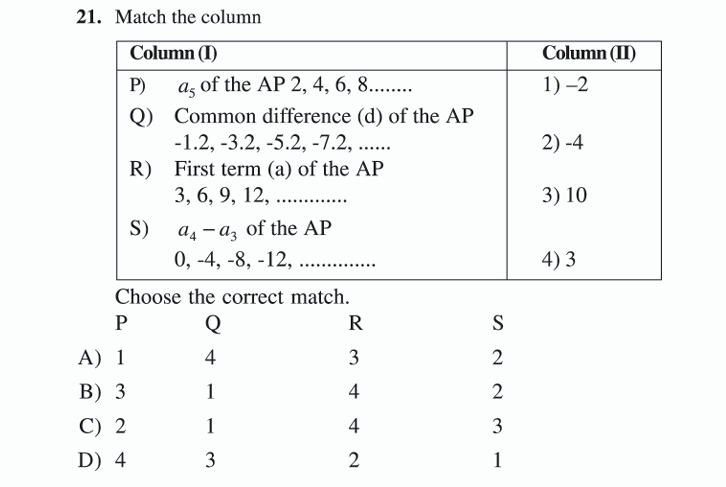
Soln:
P) a₅ of the AP: 2, 4, 6, 8, …
a = 2, d = 2
a₅ = 2 + 4(2) = 10 –> (3)
Q) Common difference (d) of the AP: -1.2, -3.2, -5.2, -7.2, …
d = -3.2 – (-1.2) = -2 –> (1)
R) First term (a) of the AP: 3, 6, 9, 12, …
a = 3 –> (4)
S) a₄ – a₃ of the AP: 0, -4, -8, -12, …
-12 – (-8) = -4 –> (2)
Matching: P-3, Q-1, R-4, S-2
Correct Option: (B)
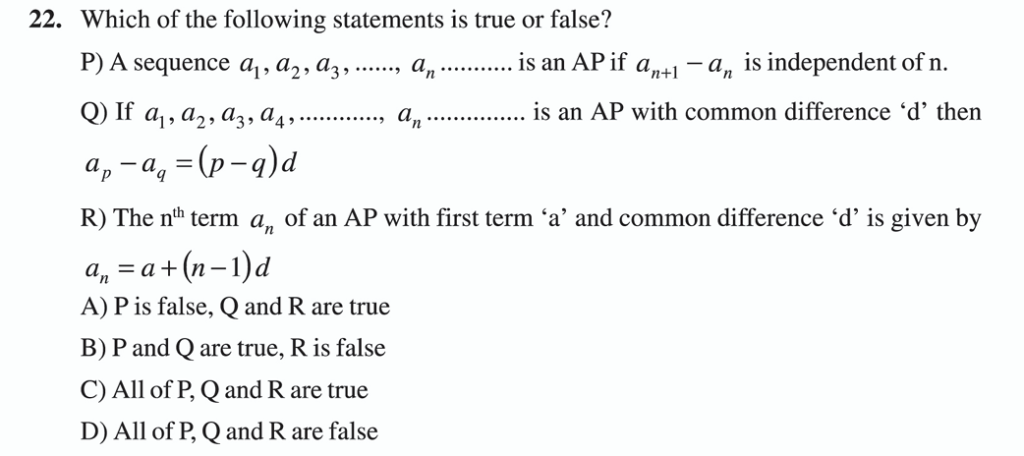
Soln:
P) By definition of an AP, the difference between consecutive terms (aₙ₊₁ – aₙ) is constant (independent of n). [True]
Q) aₚ – a_q = [a + (p – 1)d] – [a + (q – 1)d] = (p – q)d. [True]
R) The nth term of an AP is given by aₙ = a + (n – 1)d. [True]
Since P, Q, and R are all true:
Correct Option: (C) All of P, Q and R are true
23. The steps used to find the total numbers of terms in the AP -1, 3, 7, 11, ………., 95 are jumbled below:
(i) -1 + 4n – 4 = 95
(ii) n = 25
(iii) an = 95
(iv) -1 + (n – 1)4 = 95
Choose the correct option:
(A) (i) -> (iii) -> (ii) -> (iv)
(B) (iii) -> (i) -> (ii) -> (iv)
(C) (iii) -> (iv) -> (i) -> (ii)
(D) (iii) -> (iv) -> (ii) -> (i)
Soln:
Given AP: -1, 3, 7, 11, …, 95
Here, a = -1, d = 4, aₙ = 95
Logical order of steps:
Step 1: (iii) aₙ = 95
Step 2: (iv) -1 + (n – 1)4 = 95
Step 3: (i) -1 + 4n – 4 = 95
Step 4: (ii) n = 25
Sequence: (iii) -> (iv) -> (i) -> (ii)
Correct Option: (C)
24. If the first three terms of an AP are b, c and 2b, then find the ratio of b and c
Soln:
Given that b, c, 2b are the first three terms of an AP.
Common difference:
c – b = 2b – c
c + c = 2b + b
2c = 3b
b / c = 2 / 3
Therefore, the ratio of b and c is 2 : 3.
25. The digit of a positive numbers of three digits are in AP and their sum is 15. The number obtained by reversing the digits is 594 less then the original number. Find the number.
Soln:
Let the hundreds, tens, and units digits be (a + d), a, and (a – d) respectively.
Sum of the digits = 15
(a + d) + a + (a – d) = 15
3a = 15
a = 5
Original number:
100(a + d) + 10(a) + (a – d)
= 100(5 + d) + 10(5) + (5 – d)
= 500 + 100d + 50 + 5 – d
= 555 + 99d
Number obtained by reversing the digits:
100(a – d) + 10(a) + (a + d)
= 100(5 – d) + 10(5) + (5 + d)
= 500 – 100d + 50 + 5 + d
= 555 – 99d
According to the question:
(Original number) – (Reversed number) = 594
(555 + 99d) – (555 – 99d) = 594
198d = 594
d = 3
Digits of the number:
Hundreds digit = a + d = 5 + 3 = 8
Tens digit = a = 5
Units digit = a – d = 5 – 3 = 2
Therefore, the original number is 852.
📐 HSLC Class 10 Maths Exercise 5.2 Notice: This page features the complete, step-by-step SEBA Class 10 Mathematics Chapter 5 (Arithmetic Progression) Exercise 5.2 Official Textual Solutions updated for the 2026–27 academic session. Every solution strictly follows the standard board-marking format using the general term formula an = a + (n – 1)d—covering tabular box puzzles, determining arithmetic terms from both ends, divisibility problems, and simultaneous equations involving terms like a4, a8, and a{10}—to help you secure full marks in your HSLC board examinations.
💡 Master SEBA Class 10 Arithmetic Progressions:
- Stuck on setting up equations for questions involving the 17th term exceeding the 10th term by 7, or finding how many three-digit numbers are divisible by 7? Drop your question in the comments section below!
- Bookmark this page for fast formula lookup and revision before your unit tests, pre-board assessments, and the final HSLC examination.
- Share this link with your classmates and WhatsApp study groups to make Class 10 Maths problem solving straightforward and reliable!