Looking for complete, step-by-step textbook solutions for SEBA Class 10 Mathematics Chapter 14 (Probability) for the 2026–27 academic session? Access verified, board-pattern solutions to all 25 textual questions covering theoretical probability (P(E) = {Number of favorable outcomes}{Total number of possible outcomes}, complementary events (P(E) + P(E) = 1), impossible (P = 0) and sure events (P = 1), coin toss fair decision rationale, rolling a die (prime numbers, numbers lying between 2 and 6, odd numbers), standard 52-card deck problems (face cards, king of red colour, spade, queen of diamonds), defective pens mixed with good pens, box of numbered discs (two-digit numbers, perfect squares, numbers divisible by 5), piggy bank coins, and structured model answers designed strictly according to the Assam Board (SEBA) HSLC curriculum.
EXERCISE 14
1. Complete the following statements:
(i) Probability of an event E + Probability of the event ‘not E’ = ______
= 1
(ii) The probability of an event that cannot happen is ______. Such an event is called ______.
= 0, impossible event
(iii) The probability of an event that is certain to happen is ______. Such an event is called ______.
= 1, sure event
(iv) The sum of the probabilities of all the elementary events of an experiment is ______.
= 1
(v) The probability of an event is greater than or equal to ______ and less than or equal to ______.
= 0, 1
2. Which of the following experiments have equally likely outcomes? Explain.
(i) A driver attempts to start a car. The car starts or does not start.
Soln: Experiment: A driver attempts to start a car. Outcomes: Car starts or does not start. These outcomes are not equally likely because the starting of a car depends on factors like engine condition, fuel, and battery. P(car starts) ≠ P(car does not start)
(ii) A player attempts to shoot a basketball. She/he shoots or misses the shot.
Soln: Experiment: A player attempts to shoot a basketball. Outcomes: She/he shoots or misses the shot. These outcomes are not equally likely because the outcome depends on the skill and technique of the player. P(shoots) ≠ P(misses)
(iii) A trial is made to answer a true-false question. The answer is right or wrong.
Soln: Experiment: Answering a true-false question. Outcomes: Right or wrong. Total possible outcomes = 2 These outcomes are equally likely. P(right) = 1/2 P(wrong) = 1/2
(iv) A baby is born. It is a boy or a girl.
Soln: Experiment: A baby is born. Outcomes: Boy or girl. Total possible outcomes = 2 These outcomes are equally likely. P(boy) = 1/2 P(girl) = 1/2
3. Why is tossing a coin considered to be a fair way of deciding which team should get the ball at the beginning of a football game?
Soln: When a fair coin is tossed, the sample space is S = {H, T}. Total number of possible outcomes = 2 Favorable outcomes for Head = 1 P(Head) = 1/2 Favorable outcomes for Tail = 1 P(Tail) = 1/2 Since P(Head) = P(Tail) = 1/2, the two outcomes are equally likely and unbiased. Therefore, tossing a coin is a fair way of deciding
4. Which of the following cannot be the probability of an event?
(A) 2/3
(B) -1.5
(C) 15%
(D) 0.7
Soln: For any event E, the probability satisfies the condition: 0 ≤ P(E) ≤ 1
Evaluating the options:
(A) 2/3 ≈ 0.67 (valid since 0 ≤ 2/3 ≤ 1)
(B) -1.5 (invalid since probability cannot be negative)
(C) 15% = 15/100 = 0.15 (valid since 0 ≤ 0.15 ≤ 1)
(D) 0.7 (valid since 0 ≤ 0.7 ≤ 1)
Answer: (B) -1.5
5. If P(E) = 0.05, what is the probability of ‘not E’?
Soln: Given: P(E) = 0.05
Formula: P(E) + P(not E) = 1
Calculation:
P(not E) = 1 – P(E) P(not E) = 1 – 0.05 P(not E) = 0.95
Answer: P(not E) = 0.95
6. A bag contains lemon flavoured candies only. Malini takes out one candy without looking into the bag. What is the probability that she takes out
Soln: The bag contains only lemon flavoured candies.
Let the total number of candies in the bag be n.
(i) an orange flavoured candy?
Orange flavoured candy:
Number of orange flavoured candies = 0
P(orange flavoured candy) = 0/n = 0 Answer: 0
(ii) a lemon flavoured candy?
Lemon flavoured candy:
Number of lemon flavoured candies = n
P(lemon flavoured candy) = n/n = 1
Answer: 1
7. It is given that in a group of 3 students, the probability of 2 students not having the same birthday is 0.992. What is the probability that the 2 students have the same birthday?
Soln: Let E = Event that 2 students have the same birthday.
not E = Event that 2 students do not have the same birthday.
Given:
P(not E) = 0.992
Formula: P(E) + P(not E) = 1
Calculation: P(E) = 1 – P(not E) P(E) = 1 – 0.992 P(E) = 0.008
Answer: P(2 students have the same birthday) = 0.008
SEBA Class 10 Maths Chapter 14 Solutions
8. A bag contains 3 red balls and 5 black balls. A ball is drawn at random from the bag. What is the probability that the ball drawn is (i) red ? (ii) not red?
Soln: Number of red balls = 3
Number of black balls = 5
Total number of balls = 3 + 5 = 8
(i) Red ball:
Number of favorable outcomes = 3
P(red) = 3/8
Answer: 3/8
(ii) Not red ball:
P(not red) = 1 – P(red) P(not red)
= 1 – 3/8 P(not red)
= 5/8
Answer: 5/8
9. A box contains 5 red marbles, 8 white marbles and 4 green marbles. One marble is taken out of the box at random. What is the probability that the marble taken out will be (i) red ? (ii) white ? (iii) not green?
Soln: Number of red marbles = 5
Number of white marbles = 8
Number of green marbles = 4
Total number of marbles = 5 + 8 + 4 = 17
(i) Red marble: Number of favorable outcomes = 5 P(red) = 5/17 Answer: 5/17
(ii) White marble: Number of favorable outcomes = 8 P(white) = 8/17 Answer: 8/17
(iii) Not green marble:
Number of marbles not green = Red + White = 5 + 8 = 13
P(not green) = 13/17
Answer: 13/17
10. A piggy bank contains hundred 50p coins, fifty Re 1 coins, twenty Rs 2 coins and ten Rs 5 coins. If it is equally likely that one of the coins will fall out when the bank is turned upside down, what is the probability that the coin (i) will be a 50p coin ? (ii) will not be a Rs 5 coin?
Soln: Number of 50p coins = 100
Number of Re 1 coins = 50
Number of Rs 2 coins = 20
Number of Rs 5 coins = 10
Total number of coins = 100 + 50 + 20 + 10
= 180
(i) 50p coin:
Number of favorable outcomes = 100
P(50p coin) = 100/180
= 5/9
Answer: 5/9
(ii) Not a Rs 5 coin:
Number of coins that are not Rs 5 = 180 – 10 = 170
P(not a Rs 5 coin) = 170/180
= 17/18
Answer: 17/18
11. Gopi buys a fish from a shop for his aquarium. The shopkeeper takes out one fish at random from a tank containing 5 male fish and 8 female fish (see Fig. 14.2). What is the probability that the fish taken out is a male fish?

Soln: Number of male fish = 5
Number of female fish = 8
Total number of fish = 5 + 8 = 13
Number of favorable outcomes = 5
Total number of possible outcomes = 13
P(male fish) = 5/13
Answer: 5/13
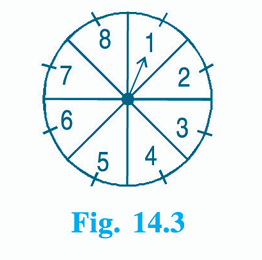
12. A game of chance consists of spinning an arrow which comes to rest pointing at one of the numbers 1, 2, 3, 4, 5, 6, 7, 8 (see Fig. 14.3), and these are equally likely outcomes. What is the probability that it will point at
(i) 8 ?
(ii) an odd number?
(iii) a number greater than 2?
(iv) a number less than 9?
Soln: Total numbers on the spinner = {1, 2, 3, 4, 5, 6, 7, 8}
Total number of possible outcomes = 8
(i) Pointing at 8:
Favorable outcome = {8} (1 outcome)
P(8) = 1/8
Answer: 1/8
(ii) An odd number:
Odd numbers = {1, 3, 5, 7} (4 outcomes)
P(odd number) = 4/8
= 1/2
Answer: 1/2
(iii) A number greater than 2:
Numbers greater than 2 = {3, 4, 5, 6, 7, 8} (6 outcomes)
P(number > 2) = 6/8
= 3/4
Answer: 3/4
(iv) A number less than 9:
Numbers less than 9 = {1, 2, 3, 4, 5, 6, 7, 8} (8 outcomes)
P(number < 9) = 8/8
= 1
13. A die is thrown once. Find the probability of getting
(i) a prime number;
(ii) a number lying between 2 and 6;
(iii) an odd number.
Soln: Sample space when a die is thrown = {1, 2, 3, 4, 5, 6}
Total number of possible outcomes = 6
(i) A prime number:
Prime numbers = {2, 3, 5}
Number of favorable outcomes = 3
P(prime number) = 3/6
= 1/2
(ii) A number lying between 2 and 6:
Numbers lying between 2 and 6 = {3, 4, 5}
Number of favorable outcomes = 3
P(number between 2 and 6) = 3/6
= 1/2
(iii) An odd number:
Odd numbers = {1, 3, 5}
Number of favorable outcomes = 3
P(odd number) = 3/6
= 1/2
14. One card is drawn from a well-shuffled deck of 52 cards. Find the probability of getting
(i) a king of red colour
(ii) a face card
(iii) a red face card
(iv) the jack of hearts
(v) a spade
(vi) the queen of diamonds
Soln: Total number of cards in a deck = 52
(i) A king of red colour:
Favorable cards = King of hearts, King of diamonds = 2
P(king of red colour) = 2/52
= 1/26
(ii) A face card:
Face cards = 4 Kings + 4 Queens + 4 Jacks = 12
P(face card) = 12/52
= 3/13
(iii) A red face card:
Red face cards = 2 Kings + 2 Queens + 2 Jacks = 6
P(red face card) = 6/52
= 3/26
(iv) The jack of hearts:
Favorable card = 1
P(jack of hearts) = 1/52
Answer: 1/52
(v) A spade:
Total spade cards = 13
P(spade) = 13/52
= 1/4
(vi) The queen of diamonds:
Favorable card = 1
P(queen of diamonds) = 1/52
Answer: 1/52
Class 10 Maths Chapter 14 Probability SEBA 2026-27
15. Five cards—the ten, jack, queen, king and ace of diamonds, are well-shuffled with their face downwards. One card is then picked up at random.
(i) What is the probability that the card is the queen?
Soln: Total cards = {10, Jack, Queen, King, Ace}
Total number of outcomes = 5
Card is the queen:
Number of queens = 1
P(queen) = 1/5
Answer: 1/5
(ii) If the queen is drawn and put aside, what is the probability that the second card picked up is (a) an ace? (b) a queen?
Soln: If the queen is drawn and put aside:
Remaining total cards = 5 – 1 = 4 (10, Jack, King, Ace)
(a) An ace:
Number of aces = 1
P(ace) = 1/4
Answer: 1/4
(b) A queen:
Number of queens = 0
P(queen) = 0/4 = 0
Answer: 0
16. 12 defective pens are accidentally mixed with 132 good ones. It is not possible to just look at a pen and tell whether or not it is defective. One pen is taken out at random from this lot. Determine the probability that the pen taken out is a good one.
Soln: Number of defective pens = 12
Number of good pens = 132
Total number of pens = 12 + 132 = 144
Number of favorable outcomes (good pens) = 132
Total number of possible outcomes = 144
P(good pen) = 132/144
= 11/12
17. (i) A lot of 20 bulbs contain 4 defective ones. One bulb is drawn at random from the lot. What is the probability that this bulb is defective?
Soln: Defective bulb:
Total number of bulbs = 20
Number of defective bulbs = 4
P(defective bulb) = 4/20
= 1/5
(ii) Suppose the bulb drawn in (i) is not defective and is not replaced. Now one bulb is drawn at random from the rest. What is the probability that this bulb is not defective ?
Soln: Bulb is not defective:
One non-defective bulb is drawn and not replaced.
Remaining total bulbs = 20 – 1 = 19
Remaining non-defective bulbs = (20 – 4) – 1 = 16 – 1 = 15
P(not defective) = 15/19
18. A box contains 90 discs which are numbered from 1 to 90. If one disc is drawn at random from the box, find the probability that it bears (i) a two-digit number (ii) a perfect square number (iii) a number divisible by 5.
Soln: Total discs numbered from 1 to 90. Total number of possible outcomes = 90
(i) A two-digit number:
Two-digit numbers = {10, 11, 12, …, 90}
Total two-digit numbers = 90 – 9 = 81
P(two-digit number) = 81/90
= 9/10
(ii) A perfect square number:
Perfect squares = {1²=1, 2²=4, 3²=9, 4²=16, 5²=25, 6²=36, 7²=49, 8²=64, 9²=81}
Total favorable outcomes = 9
P(perfect square) = 9/90
= 1/10
(iii) A number divisible by 5:
Multiples of 5 = {5, 10, 15, …, 90}
Number of multiples = 90/5 = 18
P(divisible by 5) = 18/90
= 1/5
19. A child has a die whose six faces show the letters as given below:
| A | B | C | D | E | A |
The die is thrown once. What is the probability of getting (i) A? (ii) D?
Soln: Faces of the die = {A, B, C, D, E, A}
Total number of possible outcomes = 6
(i) Getting A:
Number of faces with ‘A’ = 2
P(A) = 2/6
= 1/3
(ii) Getting D:
Number of faces with ‘D’ = 1
P(D) = 1/6
20. A lot consists of 144 ball pens of which 20 are defective and the others are good. Nuri will buy a pen if it is good, but will not buy if it is defective. The shopkeeper draws one pen at random and gives it to her. What is the probability that
(i) She will buy it ?
(ii) She will not buy it ?
Soln: 20 Total number of pens = 144
Number of defective pens = 20
Number of good pens = 144 – 20 = 124
(i) She will buy it:
Nuri buys the pen if it is good.
Number of favorable outcomes = 124
P(she will buy it) = 124/144
= 31/36
(ii) She will not buy it:
Nuri will not buy the pen if it is defective.
Number of favorable outcomes = 20
P(she will not buy it) = 20/144
= 5/36
SEBA Class 10 Maths Ch 14 Question Answer
21. Refer to Example 11. (i) Complete the following table:

Soln: (i) Complete Table: When two dice are thrown, total outcomes = 6 × 6 = 36.
Favorable outcomes for each sum:
Sum 2: (1,1) -> 1 outcome
Sum 3: (1,2), (2,1) -> 2 outcomes
Sum 4: (1,3), (2,2), (3,1) -> 3 outcomes
Sum 5: (1,4), (2,3), (3,2), (4,1) -> 4 outcomes
Sum 6: (1,5), (2,4), (3,3), (4,2), (5,1) -> 5 outcomes
Sum 7: (1,6), (2,5), (3,4), (4,3), (5,2), (6,1) -> 6 outcomes
Sum 8: (2,6), (3,5), (4,4), (5,3), (6,2) -> 5 outcomes
Sum 9: (3,6), (4,5), (5,4), (6,3) -> 4 outcomes
Sum 10: (4,6), (5,5), (6,4) -> 3 outcomes
Sum 11: (5,6), (6,5) -> 2 outcomes
Sum 12: (6,6) -> 1 outcome
| Event: ‘Sum on 2 dice’ | 2 | 3 | 4 | 5 | 6 | 7 | 8 | 9 | 10 | 11 | 12 |
| Probability | 1/36 | 2/36 | 3/36 | 4/36 | 5/36 | 6/36 | 5/36 | 4/36 | 3/36 | 2/36 | 1/36 |
(ii) A student argues that ‘there are 11 possible outcomes 2, 3, 4, 5, 6, 7, 8, 9, 10, 11 and 12. Therefore, each of them has a probability 1/11. Do you agree with this argument? Justify your answer.
Justification:
No, the argument is incorrect.
The eleven sums are not equally likely outcomes because the number of combinations giving each sum is different.
For example, P(Sum = 2) = 1/36, whereas
P(Sum = 7) = 6/36
= 1/6 ≠ 1/11.
22. A game consists of tossing a one rupee coin 3 times and noting its outcome each time. Hanif wins if all the tosses give the same result i.e., three heads or three tails, and loses otherwise. Calculate the probability that Hanif will lose the game.
Soln: Sample space for tossing a coin 3 times:
S = {HHH, HHT, HTH, THH, HTT, THT, TTH, TTT}
Total number of possible outcomes = 8
Winning outcomes (three heads or three tails) = {HHH, TTT}
Number of winning outcomes = 2
P(Hanif wins) = 2/8
= 1/4
Losing outcomes = {HHT, HTH, THH, HTT, THT, TTH}
Number of favorable outcomes for losing = 8 – 2 = 6
P(Hanif loses) = 6/8
= 3/4
23. A die is thrown twice. What is the probability that
(i) 5 will not come up either time?
Soln: Total outcomes when a die is thrown twice = 6 × 6 = 36
Outcomes where 5 comes up at least once:
{(1,5), (2,5), (3,5), (4,5), (5,5), (6,5), (5,1), (5,2), (5,3), (5,4), (5,6)}
Number of favorable outcomes = 11
5 will not come up either time:
Favorable outcomes = 36 – 11 = 25
P(5 will not come up either time) = 25/36
Answer: 25/36
(ii) 5 will come up at least once?
[Hint : Throwing a die twice and throwing two dice simultaneously are treated as the same experiment]
Soln: 5 will come up at least once:
Favorable outcomes = 11
P(5 will come up at least once) = 11/36
24. Which of the following arguments are correct and which are not correct? Give reasons for your answer.
(i) If two coins are tossed simultaneously there are three possible outcomes—two heads, two tails or one of each. Therefore, for each of these outcomes, the probability is 1/3.
Soln: The argument is incorrect.
Sample space for two coins = {HH, HT, TH, TT}
Total number of equally likely outcomes = 4
P(two heads) = 1/4
P(two tails) = 1/4
P(one of each) = P(HT, TH) = 2/4
= 1/2 ≠ 1/3
(ii) If a die is thrown, there are two possible outcomes—an odd number or an even number. Therefore, the probability of getting an odd number is 1/2.
Soln: The argument is correct.
Sample space for a die = {1, 2, 3, 4, 5, 6}
Total number of outcomes = 6
Odd numbers = {1, 3, 5} -> 3 outcomes
Even numbers = {2, 4, 6} -> 3 outcomes
P(odd number) = 3/6 = 1/2
P(even number) = 3/6
= 1/2
25. Three unbiased coins are tossed together. Find the probability of getting.
(i) one head
Soln: Sample space for three coins:
S = {HHH, HHT, HTH, THH, HTT, THT, TTH, TTT}
Total number of possible outcomes = 8
One head:
Favorable outcomes = {HTT, THT, TTH}
Count = 3
P(one head) = 3/8
Answer: 3/8
(ii) two heads
Soln: Two heads:
Favorable outcomes = {HHT, HTH, THH}
Count = 3
P(two heads) = 3/8
Answer: 3/8
(iii) at least two heads
Soln: At least two heads (2 or 3 heads):
Favorable outcomes = {HHT, HTH, THH, HHH}
Count = 4
P(at least two heads) = 4/8
= 1/2
Answer: 1/2
(iv) at most two heads
Soln: At most two heads (0, 1, or 2 heads):
Favorable outcomes = {TTT, HTT, THT, TTH, HHT, HTH, THH}
Count = 7
P(at most two heads) = 7/8
Answer: 7/8
26. A jar contains 24 marbles, some are green and others are blue. If a marble is drawn at random from the jar the probability that it is green is 2/3. Find the number of blue marbles in the jar.
Soln: Total number of marbles = 24
Let number of green marbles = x P(green) = x/24
Given:
P(green) = 2/3
Equating probabilities:
x/24 = 2/3 x = (2 × 24) / 3 x = 16
Number of green marbles = 16
Number of blue marbles = 24 – 16 = 8
P(blue) = 8/24 = 1/3
Answer: Number of blue marbles = 8
SEBA HSLC Class 10 Maths Chapter 14 Solved Textual Questions PDF
27. The probability of selecting a red ball at random from a jar that contains only red, blue and green balls is 1/5. The probability of selecting a blue ball at random from the same jar is 1/4. If the jar contains 22 green balls. Find the total number of balls in the jar.
Soln: Let the total number of balls in the jar = n.
Given:
P(red) = 1/5 P(blue) = 1/4
Number of green balls = 22
Sum of all probabilities:
P(red) + P(blue) + P(green)
= 1 1/5 + 1/4 + P(green)
= 1 (4 + 5)/20 + P(green)
= 1 9/20 + P(green)
= 1 P(green)
= 1 – 9/20
= 11/20
Equating P(green) with favorable count:
11/20 = 22/n
11n = 22 × 20
n = (22 × 20) / 11
n = 40
Answer: Total number of balls = 40
28. Two dice are thrown simultaneously. Find the probability of getting
(i) the sum as a prime number
Soln: Total outcomes when two dice are thrown = 6 × 6 = 36
The sum as a prime number:
Possible prime sums = {2, 3, 5, 7, 11}
Sum 2: (1,1) -> 1 outcome
Sum 3: (1,2), (2,1) -> 2 outcomes
Sum 5: (1,4), (2,3), (3,2), (4,1) -> 4 outcomes
Sum 7: (1,6), (2,5), (3,4), (4,3), (5,2), (6,1) -> 6 outcomes
Sum 11: (5,6), (6,5) -> 2 outcomes
Total favorable outcomes = 1 + 2 + 4 + 6 + 2 = 15
P(sum is prime) = 15/36
= 5/12
Answer: 5/12
(ii) a multiple of 3 as the sum
Soln: A multiple of 3 as the sum:
Possible sums = {3, 6, 9, 12}
Sum 3: (1,2), (2,1) -> 2 outcomes
Sum 6: (1,5), (2,4), (3,3), (4,2), (5,1) -> 5 outcomes
Sum 9: (3,6), (4,5), (5,4), (6,3) -> 4 outcomes
Sum 12: (6,6) -> 1 outcome
Total favorable outcomes = 2 + 5 + 4 + 1 = 12
P(multiple of 3 as sum) = 12/36
= 1/3
Answer: 1/3
(iii) same even number on both dice (or a doublet of even number)
Soln: Same even number on both dice (doublet of even number):
Favorable outcomes = {(2,2), (4,4), (6,6)}
Total favorable outcomes = 3
P(doublet of even number) = 3/36
= 1/12
Answer: 1/12
(iv) the sum as an even number
Soln: The sum as an even number:
Possible even sums = {2, 4, 6, 8, 10, 12}
Favorable outcomes = 1 + 3 + 5 + 5 + 3 + 1 = 18
P(sum is even) = 18/36
= 1/2
Answer: 1/2
29. In a survey on holiday, 120 people were asked to state which type of transport they used on their last holiday. The following pie chart shows the results of the survey.
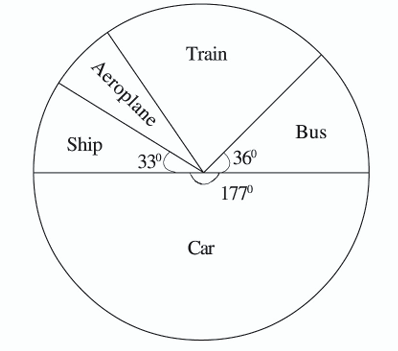
Observe the pie chart and answer the following questions.
(i) If one person is selected at random find the probability that he/she travelled by bus or ship.
Soln: Total surveyed people = 120
Total angle of pie chart = 360°
Given angles:
Angle for Bus = 36°
Angle for Car = 177°
Angle for Ship = 33°
Probability that a person travelled by bus or ship:
Central angle for bus or ship = 36° + 33° = 69°
P(bus or ship) = 69° / 360°
= 23/120
Answer: 23/120
(ii) Which is most favourite mode of transport and how many people used it.
Soln: Most favourite mode of transport:
Largest central angle is for Car = 177° Most favourite mode = Car
Number of people who used car = (177° / 360°) × 120
= 177/3 = 59 people
P(car) = 59/120
Answer: Car; 59 people
(iii) A person is selected at random. If the probability that he did not use train is 4/5. Find the number of people who used train.
Soln: Number of people who used train:
P(did not use train) = 4/5
P(used train) = 1 – 4/5 = 1/5
Number of people who used train = 1/5 × 120
= 24 people
Answer: 24 people
(iv) The probability that randomly selected person used aeroplane is 7/60. Find the revenue collected by air company at the rate of Rs. 5000 per person.
Soln: Revenue collected by air company:
P(aeroplane) = 7/60
Number of people who used aeroplane = 7/60 × 120
= 14 people
Rate per person = Rs. 5000
Revenue collected = 14 × 5000
= Rs. 70,000
Answer: Rs. 70,000
30. A number is selected from the first 100 natural numbers. The probability that the number is divisible by 8 is
(a) 3/25
(b) 8/25
(c) 1/6
(d) 1/100
Soln: Total numbers = {1, 2, 3, …, 100}
Total possible outcomes = 100
Numbers divisible by 8:
{8, 16, 24, 32, 40, 48, 56, 64, 72, 80, 88, 96}
Total favorable outcomes = 12
P(divisible by 8) = 12/100
= 3/25
Answer: (a) 3/25
31. In a single throw of a pair of dice, the probability of getting the sum as a non-perfect square is
(a) 7/36
(b) 29/36
(c) 1/12
(d) 1/6
Soln: Total outcomes when a pair of dice is thrown = 36
Possible sums = {2, 3, 4, 5, 6, 7, 8, 9, 10, 11, 12}
Perfect square sums in this range = 4, 9
Outcomes for sum 4: (1,3), (2,2), (3,1) -> 3
Outcomes for sum 9: (3,6), (4,5), (5,4), (6,3) -> 4
Total favorable outcomes for perfect square sum = 3 + 4 = 7
P(perfect square sum) = 7/36
P(non-perfect square sum) = 1 – P(perfect square sum) P(non-perfect square sum)
= 1 – 7/36
= 29/36
Answer: (b) 29/36
32. Consider the following statements
Statement (i) : The number of possible outcomes of throwing two dice simultaneously is 12
Statement (ii) : A die is thrown once. The probability of getting an even prime number is 1/6
(a) both the statement (i) and (ii) are true
(b) both the statement (i) and (ii) are false
(c) statement (i) is true but (ii) is false
(d) statement (i) is false but (ii) true.
Soln: Statement (i):
When two dice are thrown simultaneously, total possible outcomes = 6 × 6 = 36.
The statement says 12. Hence, Statement (i) is false.
Statement (ii):
When a die is thrown once, total outcomes = 6.
Even prime number = {2} -> 1 outcome.
P(even prime) = 1/6. Hence, Statement (ii) is true.
Answer: (d) statement (i) is false but (ii) true.
33. Two unbiased coins are tossed simultaneously. Match column I with the probabilities given in column
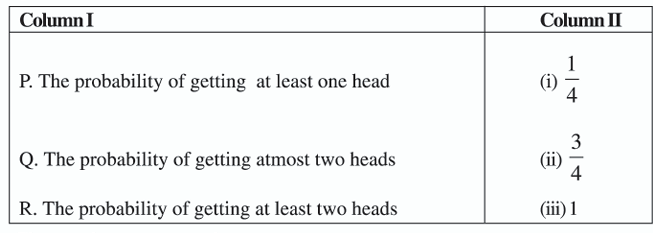
Choose the correct option
(a) P → (iii), Q → (i), R → (ii)
(b) P → (i), Q → (iii), R → (ii)
(c) P → (ii), Q → (iii), R → (i)
(d) P → (ii), Q → (i), R → (iii)
Soln: Two unbiased coins are tossed:
S = {HH, HT, TH, TT}
Total outcomes = 4
P. At least one head:
Favorable outcomes = {HT, TH, HH}
P(at least one head) = 3/4 -> (ii)
Q. At most two heads:
Favorable outcomes = {TT, HT, TH, HH}
P(at most two heads) = 4/4 = 1 -> (iii)
R. At least two heads:
Favorable outcomes = {HH}
P(at least two heads) = 1/4 -> (i)
Matching: P → (ii), Q → (iii), R → (i)
34. All face cards of spades are removed from a pack of 52 playing cards and the remaining pack is shuffled well. A card is then drawn at random from the remaining pack then the probability of getting the card a face card is
(a) 9/49
(b) 9/52
(c) 12/49
(d) 3/52
Soln: Total cards initially = 52
Face cards of spades = King, Queen, Jack of spades = 3 cards
Remaining cards = 52 – 3 = 49
Total possible outcomes = 49
Initial face cards = 12
Remaining face cards = 12 – 3 = 9
Total favorable outcomes = 9
P(getting a face card) = 9/49
Answer: (a) 9/49
🎲 HSLC Class 10 Maths Chapter 14 Notice: This page features the complete, step-by-step SEBA Class 10 Mathematics Chapter 14 (Probability) Official Textual Solutions updated for the 2026–27 academic session. Formatted according to the strict HSLC board marking criteria, every theoretical and numerical problem—from basic definitions, impossible and certain events, to high-scoring multi-part questions on well-shuffled decks of 52 playing cards, numbered discs, defective bulbs, and complementary events—is worked out with clear sample space listings and step-by-step fraction reductions to ensure you secure full marks in your 1-mark, 2-mark, and 3-mark board exam questions.
💡 Master SEBA Class 10 Probability:
- Having doubts about calculating probabilities for non-face cards, finding the chance of picking a black face card, determining defective bulb probabilities when drawing without replacement in Question 17, or working out the game of chance with an arrow pointing to numbers 1 to 8? Drop your question in the comments section below!
- Bookmark this page for quick formula review and step-by-step verification before your unit evaluations, pre-board exams, and the final HSLC examinations.
- Share this link with your classmates and WhatsApp study groups to make Class 10 Mathematics probability questions simple, logical, and scoring!