Looking for complete, step-by-step textbook solutions for SEBA Class 10 Mathematics Chapter 12 (Surface Areas and Volumes – Exercise 12.1) for the 2026–27 academic session? Access verified solutions to all 9 textual questions based on the surface area of combinations of solids. Master problems involving two cubes of volume 64 cm³ joined end to end, a hollow cylinder mounted on a hollow hemisphere (vessel), a toy in the form of a cone surmounted on a hemisphere of radius 3.5 cm, a cubical block surmounted by a hemisphere, decorative wooden blocks, a medicine capsule shaped like a cylinder with two hemispherical ends, a conical circus tent over a cylindrical base, a solid wooden toy with hemispherical depressions, and exam-oriented model solutions designed strictly according to the Assam Board (SEBA) HSLC curriculum.
EXERCISE 12.1
Unless stated otherwise, take π=722.
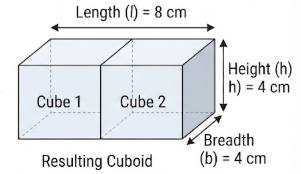
1. 2 cubes each of volume 64 cm3 are joined end to end. Find the surface area of the resulting cuboid.
Soln:
Given:
Volume of each cube = 64 cm³
Let the side of each cube be ‘a’.
Volume of cube = a³
a³ = 64
a = ³√64
a = 4 cm
When two cubes are joined end to end, the dimensions of the resulting cuboid are:
Length (l) = 4 cm + 4 cm = 8 cm
Breadth (b) = 4 cm
Height (h) = 4 cm
Surface area of the resulting cuboid = 2(lb + bh + hl)
= 2(8 × 4 + 4 × 4 + 8 × 4)
= 2(32 + 16 + 32)
= 2(80)
= 160 cm²
Answer: The surface area of the resulting cuboid is 160 cm².
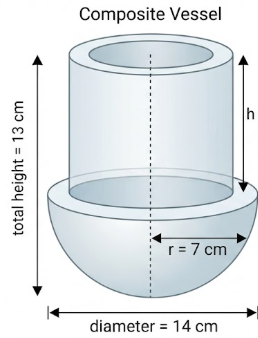
2. A vessel is in the form of a hollow hemisphere mounted by a hollow cylinder. The diameter of the hemisphere is 14 cm and the total height of the vessel is 13 cm. Find the inner surface area of the vessel.
Soln:
Given:
Diameter of the hemisphere = 14 cm
Radius of hemisphere (r) = 14 / 2 = 7 cm
Total height of the vessel = 13 cm
Radius of cylindrical part (r) = 7 cm
Height of cylindrical part (h) = Total height – Radius of hemisphere
h = 13 – 7 = 6 cm
Inner surface area of the vessel = CSA of cylinder + CSA of hemisphere
= 2πrh + 2πr²
= 2πr(h + r)
= 2 × (22/7) × 7 × (6 + 7)
= 44 × 13
= 572 cm²
Answer: The inner surface area of the vessel is 572 cm².
SEBA Class 10 Maths Exercise 12.1 Solutions
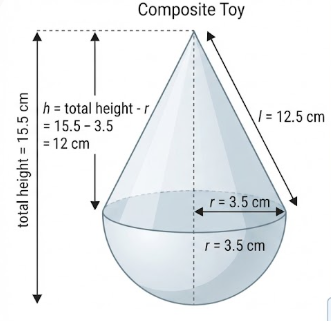
3. A toy is in the form of a cone of radius 3.5 cm mounted on a hemisphere of same radius. The total height of the toy is 15.5 cm. Find the total surface area of the toy.
Soln:
Given:
Radius of cone and hemisphere (r) = 3.5 cm = 7/2 cm
Total height of the toy = 15.5 cm
Height of conical part (h) = Total height – Radius of hemisphere
h = 15.5 – 3.5 = 12 cm
Slant height of cone (l) = √(r² + h²)
l = √((3.5)² + (12)²)
l = √(12.25 + 144)
l = √156.25
l = 12.5 cm
Total surface area of the toy = CSA of cone + CSA of hemisphere
= πrl + 2πr²
= πr(l + 2r)
= (22/7) × 3.5 × (12.5 + 2 × 3.5)
= 11 × (12.5 + 7)
= 11 × 19.5
= 214.5 cm²
Answer: The total surface area of the toy is 214.5 cm².
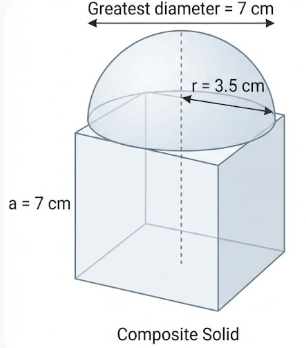
4. A cubical block of side 7 cm is surmounted by a hemisphere. What is the greatest diameter the hemisphere can have? Find the surface area of the solid.
Soln:
Given:
Edge of the cubical block (a) = 7 cm
Part (i): Greatest diameter
The greatest diameter the hemisphere can have is equal to the edge of the cube.
Greatest diameter = 7 cm
Part (ii): Surface area of the solid
Radius of hemisphere (r) = 7 / 2 = 3.5 cm
Surface area of solid = TSA of cube – Base area of hemisphere + CSA of hemisphere
= 6a² – πr² + 2πr²
= 6a² + πr²
= 6(7)² + (22/7) × (7/2)²
= 6 × 49 + (22/7) × (49/4)
= 294 + 38.5
= 332.5 cm²
Answer:
Greatest diameter = 7 cm
Surface area of the solid = 332.5 cm²
Class 10 Maths Chapter 12.1 Surface Areas and Volumes SEBA 2026-27
5. A hemispherical depression is cut out from one face of a cubical wooden block such that the diameter l of the hemisphere is equal to the edge of the cube. Determine the surface area of the remaining solid.
Soln:

Given:
Diameter of hemisphere = Edge of cube = l
Radius of hemisphere (r) = l / 2
Surface area of remaining solid = TSA of cube – Base area of hemisphere + CSA of hemisphere
= 6(edge)² – πr² + 2πr²
= 6l² + πr²
= 6l² + π(l/2)²
= 6l² + πl²/4
= (l²/4)(24 + π) sq. units
Answer: The surface area of the remaining solid is (l²/4)(24 + π) sq. units.
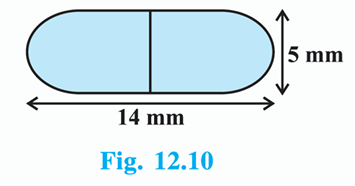
6. A medicine capsule is in the shape of a cylinder with two hemispheres stuck to each of its ends(see Fig. 12.10). The length of the entire capsule is 14 mm and the diameter of the capsule is 5 mm. Find its surface area.
Soln: Given:
Diameter of capsule = 5 mm
Radius of cylinder and hemispheres (r) = 5 / 2 = 2.5 mm
Total length of capsule = 14 mm
Length of cylindrical part (h) = Total length – 2 × (Radius of hemisphere)
h = 14 – 2(2.5) = 14 – 5 = 9 mm
Surface area of capsule = CSA of cylinder + 2 × (CSA of hemisphere)
= 2πrh + 2(2πr²)
= 2πrh + 4πr²
= 2πr(h + 2r)
= 2 × (22/7) × (2.5) × (9 + 2 × 2.5)
= 2 × (22/7) × (5/2) × (9 + 5)
= (110/7) × 14
= 110 × 2
= 220 mm²
Answer: The surface area of the capsule is 220 mm².
SEBA Class 10 Maths Ex 12.1 Question Answer
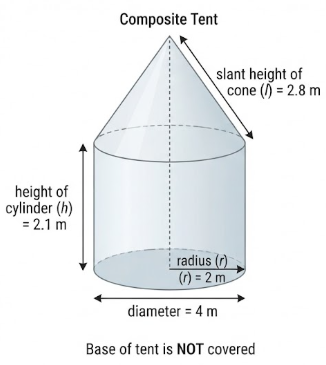
7. A tent is in the shape of a cylinder surmounted by a conical top. If the height and diameter of the cylindrical part are 2.1 m and 4 m respectively, and the slant height of the top is 2.8 m, find the area of the canvas used for making the tent. Also, find the cost of the canvas of the tent at the rate of Rs 500 per m2. (Note that the base of the tent will not be covered with canvas.)
Soln:
Given:
For cylindrical part:
Diameter = 4 m => Radius (r) = 4 / 2 = 2 m
Height (h) = 2.1 m
For conical part: Radius (r) = 2 m
Slant height (l) = 2.8 m
Area of canvas used:
Area of canvas = CSA of cylinder + CSA of cone
= 2πrh + πrl
= πr(2h + l)
= (22/7) × 2 × (2 × 2.1 + 2.8)
= (44/7) × (4.2 + 2.8)
= (44/7) × 7
= 44 m²
Cost of canvas:
Rate = Rs 500 per m²
Total cost = Area × Rate = 44 × 500
= Rs 22,000
Answer:
Area of canvas = 44 m²
Cost of canvas = Rs 22,000
8. From a solid cylinder whose height is 2.4 cm and diameter 1.4 cm, a conical cavity of the same height and same diameter is hollowed out. Find the total surface area of the remaining solid to the nearest cm2.
Soln:

Given:
Height of cylinder (h) = 2.4 cm
Diameter of cylinder = 1.4 cm
Radius of cylinder and conical cavity (r) = 1.4 / 2 = 0.7 cm
Height of conical cavity (h) = 2.4 cm
Slant height of conical cavity (l) = √(r² + h²)
l = √((0.7)² + (2.4)²)
l = √(0.49 + 5.76)
l = √6.25
l = 2.5 cm
Total surface area of remaining solid = CSA of cylinder + Area of one cylindrical base + CSA of conical cavity
= 2πrh + πr² + πrl
= πr(2h + r + l)
= (22/7) × 0.7 × (2 × 2.4 + 0.7 + 2.5)
= 2.2 × (4.8 + 0.7 + 2.5)
= 2.2 × 8.0
= 17.6 cm²
Rounding to the nearest cm²:
17.6 cm² ≈ 18 cm²
Answer: The total surface area of the remaining solid is 18 cm² (to the nearest cm²).
Class 10 Surface Area Combination of Solids Solutions Assam Board
9. A wooden article was made by scooping out a hemisphere from each end of a solid cylinder, as shown in Fig. 12.11. If the height of the cylinder is 10 cm, and its base is of radius 3.5 cm, find the total surface area of the article. (Fig. 12.11 shows a cylinder with hemispherical depressions scooped out at both top and bottom ends)

Soln: Given:
Height of cylinder (h) = 10 cm
Radius of cylinder and hemispherical ends (r) = 3.5 cm
Total surface area of article = CSA of cylinder + 2 × (CSA of hemisphere)
= 2πrh + 2(2πr²)
= 2πrh + 4πr²
= 2πr(h + 2r)
= 2 × (22/7) × 3.5 × (10 + 2 × 3.5)
= 22 × (10 + 7)
= 22 × 17
= 374 cm²
Answer: The total surface area of the article is 374 cm².
10. A solid is hemispherical at the bottom and the top is conical. If the surface area of the two parts are equal, then ratio of its radius to the height of its conical part is:
a) 1:2
b) 2:1
c) 1:3
d) 3:1
Soln:
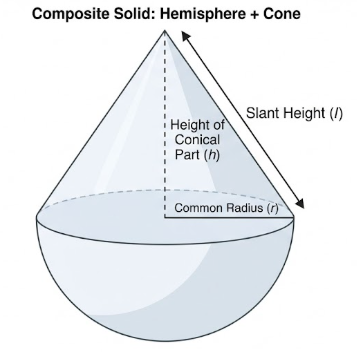
Let the common radius of the hemisphere and cone be ‘r’.
Let the height of the conical part be ‘h’, and slant height be ‘l’.
Given:
Surface area of hemispherical part = Surface area of conical part
2πr² = πrl
2r = l
Squaring both sides:
(2r)² = l²
4r² = r² + h² (Since l² = r² + h²)
4r² – r² = h²
3r² = h²
r² / h² = 1 / 3
r / h = 1 / √3
Ratio of radius to height (r : h) = 1 : √3
Answer: c) 1 : √3
SEBA HSLC Class 10 Maths Chapter 12 Exercise 12.1 Solved PDF
11. Two statements are given, one labelled as Assertion (A) and the other labelled as Reason (R) Assertion (A) : If a right circular cylinder of radius r and height h (h>2r) just encloses a sphere, then the diameter of sphere is 2r.
Reason (R) : The surface area of the sphere is 2πr(r+h)
Choose the correct alternatives
a) Both Assertion (A) and Reason (R) are true and R is the correct explanation of Assertion (A)
b) Both Assertion (A) and Reason (R) are true but R is not the correct explanation of Assertion (A).
c) Assertion (A) is true but Reason (R) is false
d) Assertion (A) is false but Reason (R) is true
Soln: Assertion (A):
If a cylinder of radius r and height h (h > 2r) encloses a sphere, the diameter of the sphere is 2r.
This statement is True.
Reason (R):
Surface area of a sphere of radius r is given by 4πr².
The formula given in Reason is 2πr(r + h).
This statement is False.
Answer: c) Assertion (A) is true but Reason (R) is false
12. Match solids with their number of faces/curved surfaces:
| Column-I (solids) | Column-II (faces/curved surface) |
|---|---|
| P) Sphere | i) Two flat + one curved face |
| Q) Cylinder | ii) Six flat surfaces |
| R) Cone | iii) One curved surface only |
| S) Cube | iv) One curved + one flat surface |
Select the correct option
a) P→(iii),Q→(iv),R→(i),S→(ii)
b) P→(i),Q→(ii),R→(iii),S→(iv)
c) P→(iii),Q→(i),R→(iv),S→(ii)
d) P→(iii),Q→(i),R→(ii),S→(iv)
Soln: Matching solids to their faces/curved surfaces:
P) Sphere -> iii) One curved surface only
Q) Cylinder -> i) Two flat + one curved face
R) Cone -> iv) One curved + one flat surface
S) Cube -> ii) Six flat surfaces
Answer: c) P -> (iii), Q -> (i), R -> (iv), S -> (ii)
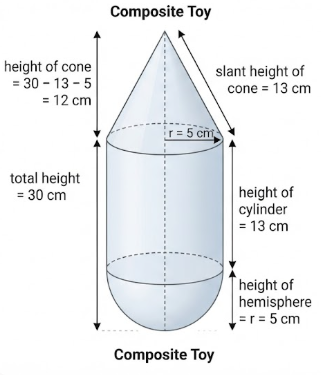
13. A toy is in the shape of a right circular cylinder with a hemisphere on one end and a cone on the other. The radius and height of the cylindrical parts are 5 cm and 13 cm respectively. The radii of the hemispherical and conical parts are the same as that of the cylindrical part. Find the surface area of the toy if the total height of the toy is 30 cm.
Soln:
Given:
Radius of cylinder (r) = 5 cm
Height of cylindrical part (h) = 13 cm
Radius of hemispherical part (r) = 5 cm
Radius of conical part (r) = 5 cm
Total height of toy = 30 cm
Height of hemisphere = r = 5 cm
Height of conical part (h_cone) = Total height – Height of cylinder – Height of hemisphere
h_cone = 30 – 13 – 5 = 12 cm
Slant height of cone (l) = √(r² + h_cone²)
l = √(5² + 12²)
l = √(25 + 144)
l = √169
l = 13 cm
Total surface area of the toy = CSA of hemisphere + CSA of cylinder + CSA of cone
= 2πr² + 2πrh + πrl
= πr(2r + 2h + l)
= (22/7) × 5 × (2 × 5 + 2 × 13 + 13)
= (110/7) × (10 + 26 + 13)
= (110/7) × 49
= 110 × 7
= 770 cm²
Answer: The surface area of the toy is 770 cm².
14. A vessel in the form of a hollow hemisphere mounted by a hollow cylinder. The diameter of the hemisphere is 14 cm and the total height of the vessel is 13 cm. Find the inner surface area of the vessel.
Soln:

Given:
Diameter of hemisphere = 14 cm
Radius of hemisphere (r) = 14 / 2 = 7 cm
Total height of vessel = 13 cm
Radius of cylinder (r) = 7 cm
Height of cylinder (h) = Total height – Radius of hemisphere
h = 13 – 7 = 6 cm
Inner surface area of the vessel = CSA of cylinder + CSA of hemisphere
= 2πrh + 2πr²
= 2πr(h + r)
= 2 × (22/7) × 7 × (6 + 7)
= 44 × 13
= 572 cm²
Answer: The inner surface area of the vessel is 572 cm².
🧊 HSLC Class 10 Maths Exercise 12.1 Notice: This page features the complete, step-by-step SEBA Class 10 Mathematics Chapter 12 (Surface Areas and Volumes) Exercise 12.1 Official Textual Solutions updated for the 2026–27 academic session. Formatted strictly according to the HSLC board evaluation standard, every combination-of-solids problem—including joined cubes forming a cuboid, hollow vessels, surmounted cones, and cylindrical medicine capsules—is worked out with labeled geometric diagrams, explicit formula breakdowns (2πrh + 2πr²), and step-by-step arithmetic substitutions to ensure you secure full marks in your board examinations.
💡 Master SEBA Class 10 Mensuration:
- Having doubts about finding the slant height l = √(r² + h²)of a conical top, subtracting the circular base area when a hemisphere is placed on a cube, or solving the total surface area of the cylindrical capsule in Question 6? Leave your question in the comments section below!
- Bookmark this page for quick formula review and step-by-step calculation verification before your unit tests, pre-board exams, and the final HSLC examinations.
- Share this link with your classmates and WhatsApp study groups to make Class 10 Mathematics mensuration problems clear, accurate, and high-scoring!