Looking for complete, step-by-step textbook solutions for SEBA Class 10 Mathematics Chapter 11 (Areas Related to Circles) for the 2026–27 academic session? Access verified solutions to all textual questions covering sector and segment of a circle, arc length formula(l = θ/360° × 2πr), area of a sector (θ/360° × πr²), area of minor and major segments, minute hand clock sweep problems, horse tethered with a peg in a square field, wiper blades cleaning car glasses, lighthouse warning ships over underwater rocks, brooch wire design questions, and exam-oriented model solutions designed strictly according to the Assam Board (SEBA) HSLC curriculum.
EXERCISE 11
Unless stated otherwise, use π = 22/7.
1. Find the area of a sector of a circle with radius 6 cm if angle of the sector is 60°.
Soln:

Given:
Radius of circle (r) = 6 cm
Sector angle (θ) = 60°
Formula:
Area of sector = (θ / 360°) × πr²
Calculation:
Area = (60° / 360°) × (22 / 7) × 6 × 6
= (1 / 6) × (22 / 7) × 36
= (22 × 6) / 7
= 132 / 7 cm² (or ≈ 18.86 cm²)
Answer:
The area of the sector is 132/7 cm² (or 18.86 cm²).
2. Find the area of a quadrant of a circle whose circumference is 22 cm.
Soln:

Given:
Circumference of circle = 22 cm
Step 1: Find radius (r)
2πr = 22
2 × (22 / 7) × r = 22
r = (22 × 7) / (2 × 22)
r = 7 / 2 cm
Step 2: Area of quadrant
For a quadrant, θ = 90°
Area = (1 / 4) × πr²
= (1 / 4) × (22 / 7) × (7 / 2) × (7 / 2)
= (1 / 4) × 11 × (7 / 2)
= 77 / 8 cm² (or 9.625 cm²)
Answer:
The area of the quadrant is 77/8 cm² (or 9.625 cm²).
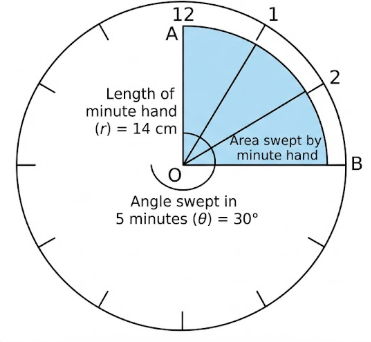
3. The length of the minute hand of a clock is 14 cm. Find the area swept by the minute hand in 5 minutes.
Soln:
Given:
Length of minute hand (r) = 14 cm
Time = 5 minutes
Step 1: Find angle swept in 5 minutes (θ)
Angle swept in 60 minutes = 360°
Angle swept in 1 minute = 360° / 60 = 6°
Angle swept in 5 minutes (θ) = 5 × 6° = 30°
Step 2: Area swept by minute hand
Area = (θ / 360°) × πr²
= (30° / 360°) × (22 / 7) × 14 × 14
= (1 / 12) × 22 × 2 × 14
= (1 / 12) × 616
= 154 / 3 cm² (or ≈ 51.33 cm²)
Answer:
The area swept by the minute hand is 154/3 cm² (or 51.33 cm²).
4. A chord of a circle of radius 10 cm subtends a right angle at the centre. Find the area of the corresponding:
Soln:

Given:
Radius of circle (r) = 10 cm
Angle subtended at centre (θ) = 90°
π = 3.14
(i) minor segment
Soln: Area of minor sector = (θ / 360°) × πr²
= (90° / 360°) × 3.14 × 10 × 10
= (1 / 4) × 314
= 78.5 cm²
Area of right triangle = (1 / 2) × base × height
= (1 / 2) × r × r
= (1 / 2) × 10 × 10
= 50 cm²
Area of minor segment = Area of minor sector – Area of triangle
= 78.5 – 50
= 28.5 cm²
(ii) major sector. (Use π = 3.14)
Soln: Angle of major sector = 360° – 90° = 270°
Area of major sector = (270° / 360°) × πr²
= (3 / 4) × 3.14 × 10 × 10
= (3 / 4) × 314
= 235.5 cm²
Answer: (i) Area of minor segment = 28.5 cm²
(ii) Area of major sector = 235.5 cm²
5. In a circle of radius 21 cm, an arc subtends an angle of 60° at the centre. Find:
Soln:

Given:
Radius (r) = 21 cm
Angle (θ) = 60°
Use π = 22/7
(i) the length of the arc
Soln: Formula:
Length of arc = (θ / 360°) × 2πr
Length = (60° / 360°) × 2 × (22 / 7) × 21
= (1 / 6) × 2 × 22 × 3
= 22 cm
(ii) area of the sector formed by the arc
Soln: Formula: Area of sector = (θ / 360°) × πr²
Area = (60° / 360°) × (22 / 7) × 21 × 21
= (1 / 6) × 22 × 3 × 21
= 11 × 21
= 231 cm²
(iii) area of the segment formed by the corresponding chord
Soln: Since θ = 60° and OA = OB = r, ΔOAB is an equilateral triangle.
Area of equilateral triangle = (√3 / 4) × r²
= (√3 / 4) × 21²
= (441√3 / 4) cm²
Area of segment = Area of sector – Area of triangle
= (231 – 441√3 / 4) cm² (or ≈ 40.04 cm²)
SEBA Class 10 Maths Chapter 11 Solutions
6. A chord of a circle of radius 15 cm subtends an angle of 60° at the centre. Find the areas of the corresponding minor and major segments of the circle. (Use π = 3.14 and √3 = 1.73)
Soln:

Given:
Radius (r) = 15 cm
Angle (θ) = 60°
π = 3.14, √3 = 1.73
Step 1: Area of minor sector
Area = (60° / 360°) × 3.14 × 15 × 15
= (1 / 6) × 3.14 × 225
= 117.75 cm²
Step 2: Area of triangle (equilateral triangle, θ = 60°)
Area = (√3 / 4) × r²
= (1.73 / 4) × 225
= 97.3125 cm²
Step 3: Area of minor segment
Area of minor segment = Area of sector – Area of triangle
= 117.75 – 97.3125
= 20.4375 cm²
Step 4: Area of circle
Area of circle = πr²
= 3.14 × 15 × 15
= 706.5 cm²
Step 5: Area of major segment
Area of major segment = Area of circle – Area of minor segment
= 706.5 – 20.4375
= 686.0625 cm²
Answer:
Area of minor segment = 20.4375 cm²
Area of major segment = 686.0625 cm²
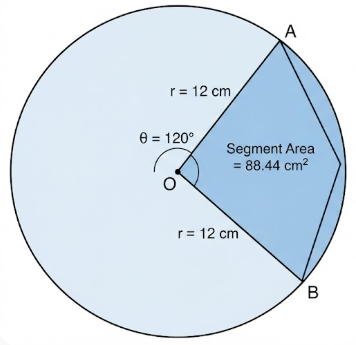
7. A chord of a circle of radius 12 cm subtends an angle of 120° at the centre. Find the area of the corresponding segment of the circle. (Use π = 3.14 and √3 = 1.73)
Soln:
Given:
Radius (r) = 12 cm
Angle (θ) = 120°
π = 3.14, √3 = 1.73
Step 1: Area of sector
Area of sector = (120° / 360°) × πr²
= (1 / 3) × 3.14 × 12 × 12
= 3.14 × 4 × 12
= 150.72 cm²
Step 2: Area of triangle with θ = 120°
Area of triangle = (1 / 2) × r² × sin(120°)
= (1 / 2) × 12 × 12 × (√3 / 2)
= 36 × √3
= 36 × 1.73
= 62.28 cm²
Step 3: Area of corresponding segment
Area of segment = Area of sector – Area of triangle
= 150.72 – 62.28
= 88.44 cm²
Answer:
The area of the corresponding segment is 88.44 cm².
8. A horse is tied to a peg at one corner of a square shaped grass field of side 15 m by means of a 5 m long rope (see Fig. 11.8). Find

(i) the area of that part of the field in which the horse can graze.
Soln: Given:
Side of square field = 15 m
Peg is at corner, so angle θ = 90°
Use π = 3.14
Area = (90° / 360°) × πr₁²
= (1 / 4) × 3.14 × 5 × 5
= (1 / 4) × 78.5
= 19.625 m²
(ii) the increase in the grazing area if the rope were 10 m long instead of 5 m. (Use π = 3.14)
Soln: Area with 10 m rope
= (1 / 4) × πr₂²
= (1 / 4) × 3.14 × 10 × 10
= (1 / 4) × 314
= 78.5 m²
Increase in area = 78.5 – 19.625
= 58.875 m²
SEBA HSLC Class 10 Maths Chapter 11 Solved Textual Questions PDF
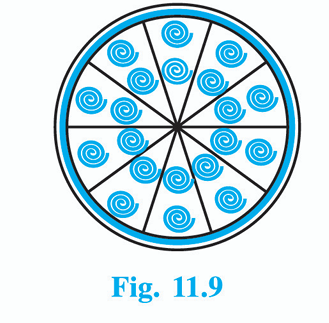
9. A brooch is made with silver wire in the form of a circle with diameter 35 mm. The wire is also used in making 5 diameters which divide the circle into 10 equal sectors as shown in Fig. 11.9. Find:
(i) the total length of the silver wire required.
Soln: Given:
Diameter of circle (d) = 35 mm
Radius (r) = 35 / 2 mm
Number of diameters = 5
Number of equal sectors = 10
Length of wire = Circumference of circle + Length of 5 diameters
= 2πr + 5d
= [2 × (22 / 7) × (35 / 2)] + [5 × 35]
= 110 + 175
= 285 mm
(ii) the area of each sector of the brooch.
Soln: Area of each sector = (1 / 10) × πr²
= (1 / 10) × (22 / 7) × (35 / 2) × (35 / 2)
= (1 / 10) × 11 × 5 × (35 / 2)
= (1 / 2) × 11 × (35 / 4)
= 385 / 4 mm² (or 96.25 mm²)
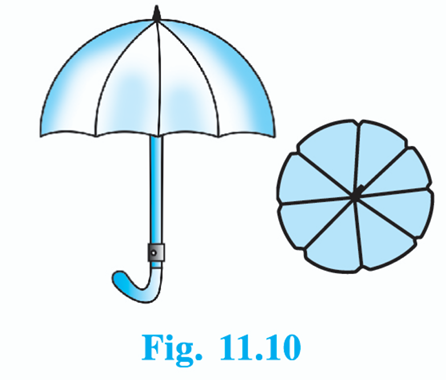
10. An umbrella has 8 ribs which are equally spaced (see Fig. 11.10). Assuming umbrella to be a flat circle of radius 45 cm, find the area between the two consecutive ribs of the umbrella.
Soln: Given:
Radius of flat circle (r) = 45 cm
Number of ribs = 8
Angle between two consecutive ribs (θ) = 360° / 8 = 45°
Area between two consecutive ribs = (1 / 8) × πr²
= (1 / 8) × (22 / 7) × 45 × 45
= (11 / 28) × 2025
= 22275 / 28 cm² (or ≈ 795.54 cm²)
Answer:
The area between two consecutive ribs is 22275/28 cm² (or 795.54 cm²).
Class 10 Maths Chapter 11 Areas Related to Circles SEBA 2026-27
11. A car has two wipers which do not overlap. Each wiper has a blade of length 25 cm sweeping through an angle of 115°. Find the total area cleaned at each sweep of the blades.
Soln: Given:
Length of blade (r) = 25 cm
Sweeping angle (θ) = 115°
Number of wipers = 2
Calculation:
Total area cleaned = 2 × [(θ / 360°) × πr²]
= 2 × [(115° / 360°) × (22 / 7) × 25 × 25]
= 2 × [(23 / 72) × (22 / 7) × 625]
= (23 / 36) × (22 / 7) × 625
= (23 × 11 × 625) / (18 × 7)
= 158125 / 126 cm² (or ≈ 1254.96 cm²)
Answer:
Total area cleaned at each sweep is 158125/126 cm² (or 1254.96 cm²).
12. To warn ships for underwater rocks, a lighthouse spreads a red coloured light over a sector of angle 80° to a distance of 16.5 km. Find the area of the sea over which the ships are warned. (Use π = 3.14)
Soln:
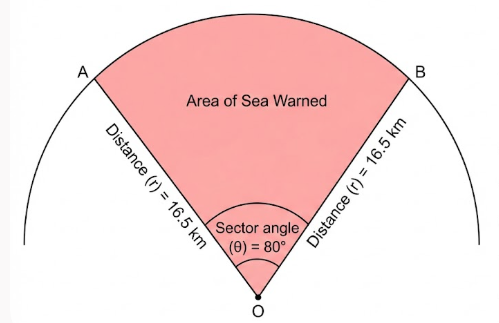
Given:
Radius (r) = 16.5 km
Sector angle (θ) = 80°
π = 3.14
Calculation:
Area of sea warned = (θ / 360°) × πr²
= (80° / 360°) × 3.14 × 16.5 × 16.5
= (2 / 9) × 3.14 × 272.25
= (2 / 9) × 854.865
= 1709.73 / 9
= 189.97 km²
Answer:
The area of the sea over which the ships are warned is 189.97 km².
13. A round table cover has six equal designs as shown in Fig. 11.11. If the radius of the cover is 28 cm, find the cost of making the designs at the rate of Rs 0.35 per cm². (Use √3 = 1.7)
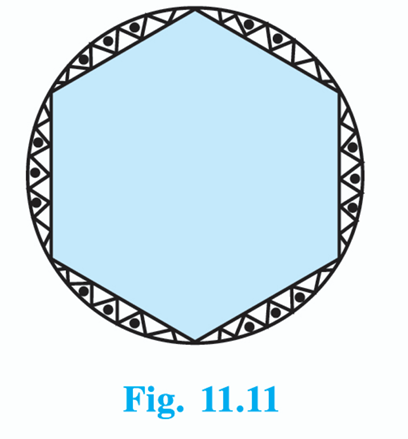
Soln: Given:
Radius (r) = 28 cm
Number of equal designs = 6 Rate
= Rs 0.35 per cm²
√3 = 1.7
Step 1: Angle of each sector
θ = 360° / 6 = 60°
Step 2: Area of one sector
Area of sector = (60° / 360°) × πr²
= (1 / 6) × (22 / 7) × 28 × 28
= (1 / 6) × 22 × 4 × 28
= 2464 / 6
= 1232 / 3 cm² ≈ 410.67 cm²
Step 3: Area of one equilateral triangle (θ = 60°)
Area of triangle = (√3 / 4) × r²
= (1.7 / 4) × 28 × 28
= 1.7 × 7 × 28
= 333.2 cm²
Step 4: Area of one design (segment)
Area of 1 design = Area of sector – Area of triangle
= (1232 / 3) – 333.2
= 410.67 – 333.2
= 77.47 cm²
Step 5: Area of 6 designs
Total area = 6 × [(1232 / 3) – 333.2]
= (2 × 1232) – (6 × 333.2)
= 2464 – 1999.2
= 464.8 cm²
Step 6: Total cost
Cost = Total area × Rate
= 464.8 × 0.35
= Rs 162.68
Answer:
The cost of making the designs is Rs 162.68.
Class 10 Maths Area of Sector and Segment Solutions Assam Board
14. Tick the correct answer in the following: Area of a sector of angle p (in degrees) of a circle with radius R is
(A) (p / 180) × 2πR
(B) (p / 180) × πR²
(C) (p / 360) × 2πR
(D) (p / 720) × 2πR²
Soln: Given:
Angle of sector = p°
Radius = R
Standard formula:
Area of sector = (p / 360) × πR²
Checking options:
(A) (p / 180) × 2πR = (p / 90) × πR
(B) (p / 180) × πR²
(C) (p / 360) × 2πR
(D) (p / 720) × 2πR² = (p / 360) × πR²
Answer: (D) (p / 720) × 2πR²
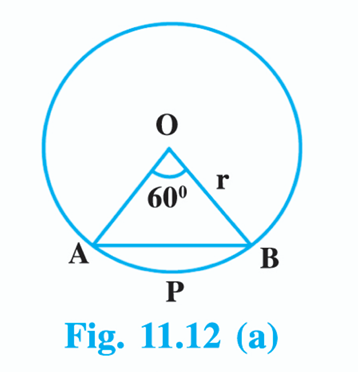
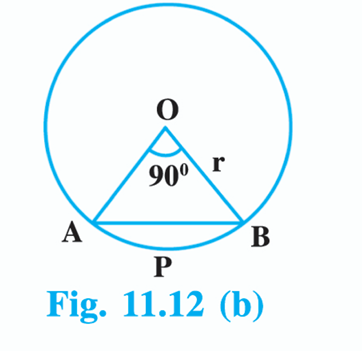
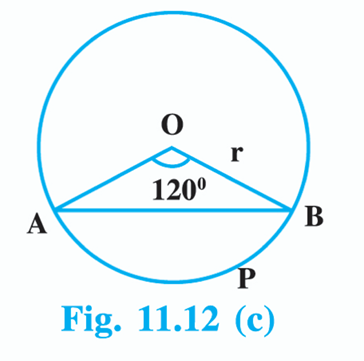
15. OAPB is the sector of a circle with centre O and radius r, as shown below in different figures.
(i) If ∠AOB = 60°, then the area of the equilateral triangle AOB is (√3 / 4) × r² [Fig. 11.12 (a)]
(ii) If ∠AOB = 90°, then area of the right angled triangle AOB is (1 / 2) r² [Fig. 11.12 (b)]
(iii) If ∠AOB = 120°, then area of the isosceles triangle AOB is (√3 / 4) r² [Fig. 11.12 (c)]
Which of the above statements are true?
A) Only (i) is true
B) Only (i) & (ii) are true
C) Only (ii) and (iii) are true
D) All (i), (ii) & (iii) are true.
Soln: Analysis of statements:
(i) For ∠AOB = 60°, ΔAOB is equilateral with sides r. Area = (√3 / 4) × r². [Statement (i) is TRUE]
(ii) For ∠AOB = 90°, ΔAOB is a right isosceles triangle with base = r and height = r.
Area = (1 / 2) × r × r = (1 / 2)r². [Statement (ii) is TRUE]
(iii) For ∠AOB = 120°, Area = (1 / 2) × r² × sin(120°) = (1 / 2) × r² × (√3 / 2) = (√3 / 4)r².
[Statement (iii) is TRUE]
Therefore, all (i), (ii), and (iii) are true.
Answer: D) All (i), (ii) & (iii) are true.
SEBA Class 10 Maths Ch 11 Question Answer
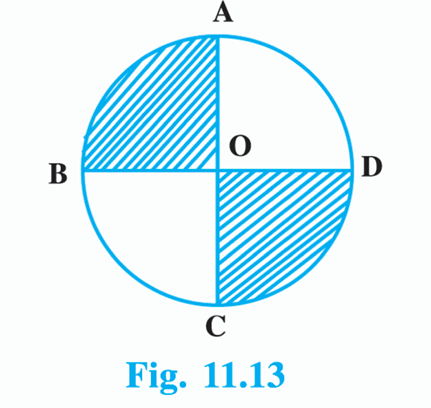
16. AC and BD are two perpendicular diameters of a circle ABCD with centre at O. It is given that area of the shaded portion is 308 cm². What is the measure of length AC? (Fig. 11.13)
A) 7 cm
B) 14 cm
C) 28 cm
(D) 616 cm
Soln: Given:
AC and BD are perpendicular diameters dividing circle into 4 equal quadrants.
Area of shaded portion (2 quadrants) = 308 cm²
Step 1: Find total area of circle
Area of circle = 2 × 308 = 616 cm²
Step 2: Find radius (r)
πr² = 616
(22 / 7) × r² = 616
r² = (616 × 7) / 22
r² = 28 × 7 = 196
r = √196 = 14 cm
Step 3: Find length of diameter AC
AC = 2r = 2 × 14 = 28 cm
Answer: C) 28 cm
17. Assertion (A): The area of a segment of a circle formed by a chord of length 8 cm subtending an angle of 90° at the centre is 8(π + 2) cm² Reason
(R): The area of a segment of a circle formed by a chord of length 2a subtending an angle 90° at the centre is (π – 2)(a² / 2) sq. unit.
A) A and R both are true and R is the correct explanation of A
B) A and R both are true but R is not the correct explanation of A.
C) A is true but R is false
D) A is false but R is true
Soln: Let chord length be 2a subtending 90° at the centre.
In the right-angled triangle formed by radii r and chord c:
r² + r² = c²
2r² = (2a)² = 4a² ==> r² = 2a²
Area of sector (θ = 90°) = (1 / 4)πr² = (1 / 4)π(2a²) = (π / 2)a²
Area of triangle = (1 / 2)r² = (1 / 2)(2a²) = a²
Area of segment = Area of sector – Area of triangle
= (π / 2)a² – a² = (π – 2)(a² / 2) sq. units
Thus, Reason (R) is TRUE.
For Assertion (A):
Chord length = 8 cm ==> 2a = 8 ==> a = 4
Area of segment = (π – 2) × (4² / 2) = (π – 2) × 8 = 8(π – 2) cm²
Given in (A) is 8(π + 2) cm², which is incorrect.
Thus, Assertion (A) is FALSE.
Answer: D) A is false but R is true
18. Which of the following statement is true or false?
P) Area and perimeter of the sector of a circle with r as the radius, θ as the angle of the sector and l unit as the length of the arc of the sector of angle θ are (θ / 360) × πr² and l + 2r
Q) Area of a circle is πr² and perimeter or circumference of the same circle is 2πr, where r is the radius of the circle.
A) P is true, Q is false
B) P is false, Q is true
C) Both P and Q are true
D) Both P and Q are false.
Soln: Analysis of statements:
P) Area of sector = (θ / 360) × πr²
Perimeter of sector = length of arc + 2 × radius = l + 2r
Statement P is TRUE.
Q) Area of circle = πr²
Circumference of circle
= 2πr Statement Q is TRUE.
Answer: C) Both P and Q are true


Calculations:
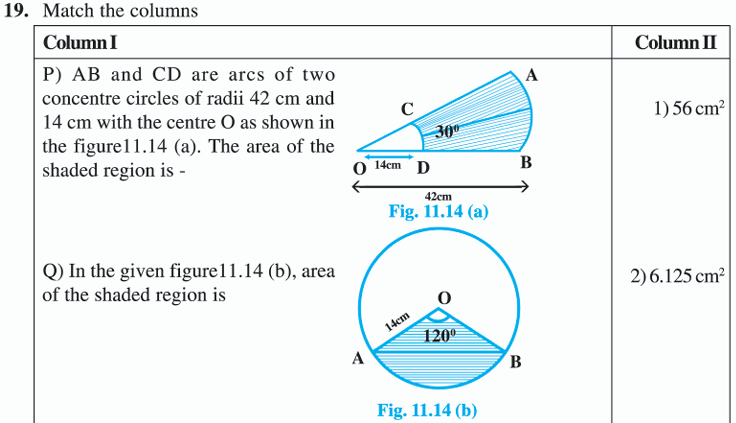
P) Shaded region between concentric arcs:
R = 42 cm, r = 14 cm, θ = 30°
Area = (θ / 360°) × π(R² – r²)
= (30° / 360°) × (22 / 7) × (42² – 14²)
= (1 / 12) × (22 / 7) × (1764 – 196)
= (1 / 12) × (22 / 7) × 1568
= (1 / 12) × 22 × 224
= 4928 / 12
= 410.67 cm² ==> P matches 3
Q) Sector with θ = 120°, r = 14 cm:
Area = (120° / 360°) × πr²
= (1 / 3) × (22 / 7) × 14 × 14
= (1 / 3) × 22 × 28 = 616 / 3
= 205.33 cm² ==> Q matches 4
R) Segment APB with θ = 90°, r = 14 cm:
Area of segment = Area of sector – Area of triangle
= [(90° / 360°) × (22 / 7) × 14 × 14] – [(1 / 2) × 14 × 14]
= [(1 / 4) × 616] – [98]
= 154 – 98
= 56 cm² ==> R matches 1
S) Quadrant with r = 3.5 cm, OD = 2 cm:
Area of shaded region = Area of quadrant – Area of ΔOBD
= [(1 / 4) × (22 / 7) × 3.5 × 3.5] – [(1 / 2) × 3.5 × 2]
= 9.625 – 3.5
= 6.125 cm² ==> S matches 2
Matching: P -> 3, Q -> 4, R -> 1, S -> 2
Answer: B) 3 4 1 2
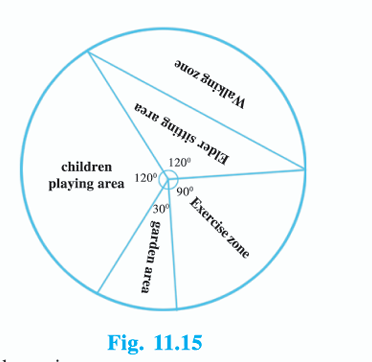
20. In Brahmaputra Nilachal Housing Complex, there is a circular health care zone having flag post at the centre. It is divided into four parts- children playing area, garden area, exercise zone and the fourth part is divided into elder’s sitting arrangement and walking zone. All the four parts have shapes of sectors having angle 120°, 30°, 90° & 120° respectively with radius 28 m. (Fig. 11.15)
(i) What is the area of the children park?
Soln: Given:
Radius (r) = 28 m
Total area of the circle = πr²
= (22 / 7) × 28 × 28
= 22 × 4 × 28
= 2464 m²
Angles of sectors:
Children park = 120°
Garden area = 30°
Exercise zone = 90°
Fourth part = 120°
From the figure, the fourth part is divided into:
- Elder’s sitting area (sector angle = 120° – 60° = 60°)
- Walking zone (segment part / remaining portion of the sector)
θ = 120°
Area = (120° / 360°) × πr²
= (1 / 3) × 2464
= 2464 / 3 m² (or ≈ 821.33 m²)
(ii) What is the area of the walking zone?
Soln: The walking zone is the segment corresponding to the sector of 120°:
Area of walking zone = Area of sector (120°) – Area of triangle (120°)
= [2464 / 3] – [(1 / 2) × r² × sin(120°)]
= 821.33 – [(1 / 2) × 28 × 28 × (√3 / 2)]
= 821.33 – [196√3]
= 821.33 – [196 × 1.732]
= 821.33 – 339.47
= 481.86 m²
(iii) Find the total area of elders sitting area and exercise zone.
Soln: Area of elders sitting area (Δ with r = 28 m, θ = 120°):
Area = (1 / 2) × r² × sin(120°)
= 196√3 ≈ 339.47 m²
Area of exercise zone (θ = 90°):
Area = (90° / 360°) × πr²
= (1 / 4) × 2464 = 616 m²
Total area = 339.47 + 616 = 955.47 m²
(iv) Find the total area of garden area and exercise zone.
Soln: Combined angle = 30° + 90° = 120°
Total area = (120° / 360°) × πr²
= (1 / 3) × 2464
= 2464 / 3 m² (or ≈ 821.33 m²)
⭕ HSLC Class 10 Maths Chapter 11 Notice: This page features the complete, step-by-step SEBA Class 10 Mathematics Chapter 11 (Areas Related to Circles) Official Textual Solutions updated for the 2026–27 academic session. Formatted strictly according to the HSLC board marking scheme, every numerical problem—from calculating sector areas, lengths of arcs, and areas of shaded segments using standard pi values (22/7 or 3.14) to real-world geometric applications (umbrella ribs, circular table covers, and wiping blades)—is worked out with labeled geometric diagrams and clear substitution steps to ensure you secure full marks in your board examinations.
💡 Master SEBA Class 10 Mensuration & Circles:
- Having trouble subtracting the triangle area(1/2 r² sin θ) to calculate minor segments for central angles like 60°, 90°, or 120°, or solving the round table cover design cost problem? Drop your question in the comments section below!
- Bookmark this page for quick formula review and step-by-step calculation checks before your unit tests, pre-board exams, and the upcoming HSLC examinations.
- Share this link with your classmates and WhatsApp study groups to make Class 10 Mathematics mensuration problems fast, structured, and easy to score!