Looking for complete, step-by-step textbook solutions for SEBA Class 10 Mathematics Chapter 10 (Circles – Exercise 10.2) for the 2026–27 academic session? Access verified, board-pattern solutions to all 13 textual questions based on Theorem 10.2 (the lengths of tangents drawn from an external point to a circle are equal). Master essential geometric proofs, including proving tangents subtend equal angles at the centre, angles between two tangents and radii are supplementary, tangents drawn at the ends of a diameter are parallel, circumscribed quadrilaterals(AB + CD = AD + BC), circumscribed parallelograms are rhombuses, the high-weightage triangle ABC circumscribing a circle with radius 4 cm (CD = 6 cm, BD = 8 cm), and exam-oriented model solutions designed strictly according to the Assam Board (SEBA) HSLC curriculum.
EXERCISE 10.2
1. From a point Q, the length of the tangent to a circle is 24 cm and the distance of Q from the centre is 25 cm. The radius of the circle is
(A) 7 cm
(B) 12 cm
(C) 15 cm
(D) 24.5 cm
Soln:
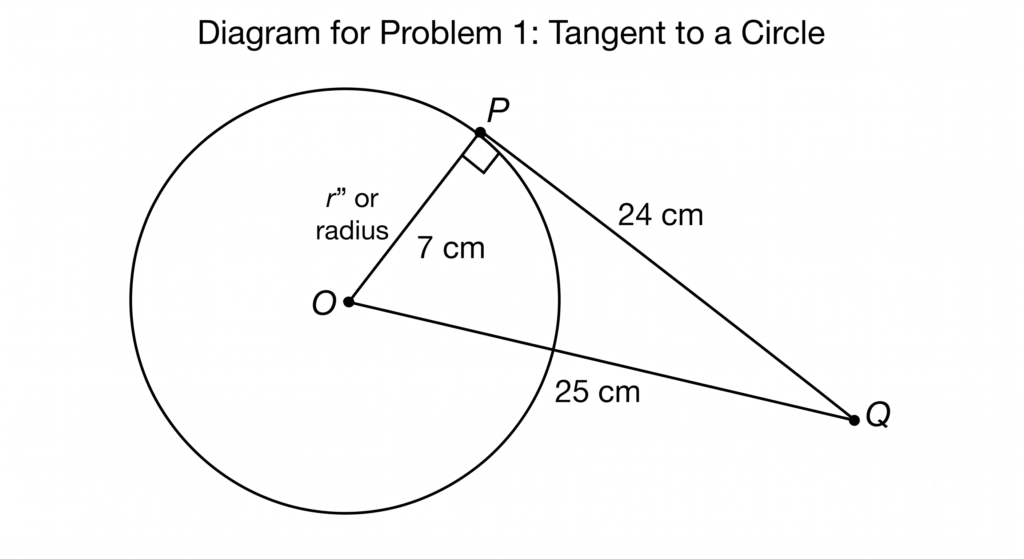
Given:
Length of tangent (PQ) = 24 cm
Distance from centre (OQ) = 25 cm
Let the radius of the circle be OP = r.
Since the tangent at any point of a circle is perpendicular to the radius through the point of contact,
∠OPQ = 90°
In right-angled triangle OPQ, by Pythagoras theorem:
OQ² = OP² + PQ²
25² = r² + 24²
625 = r² + 576
r² = 625 – 576
r² = 49
r = √49 = 7 cm
Correct Option: (A) 7 cm
2. In Fig. 10.15, if TP and TQ are the two tangents to a circle with centre O so that ∠POQ = 110°, then ∠PTQ is equal to (A) 60° (B) 70° (C) 80° (D) 90°
Soln:
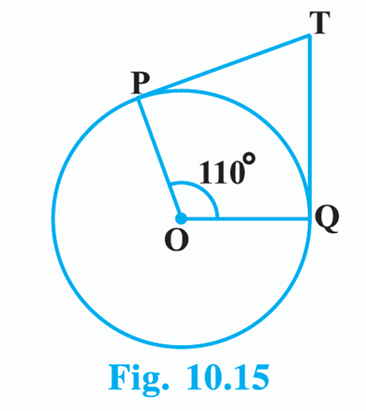
Given:
TP and TQ are tangents to the circle with centre O.
∠POQ = 110°
Since radius is perpendicular to the tangent at the point of contact:
∠OPT = 90°
∠OQT = 90°
In quadrilateral OPTQ:
∠OPT + ∠POQ + ∠OQT + ∠PTQ = 360°
90° + 110° + 90° + ∠PTQ = 360°
290° + ∠PTQ = 360°
∠PTQ = 360° – 290°
∠PTQ = 70°
Correct Option: (B) 70°
3. If tangents PA and PB from a point P to a circle with centre O are inclined to each other at angle of 80°, then ∠POA is equal to
(A) 50°
(B) 60°
(C) 70°
(D) 80°
Soln:
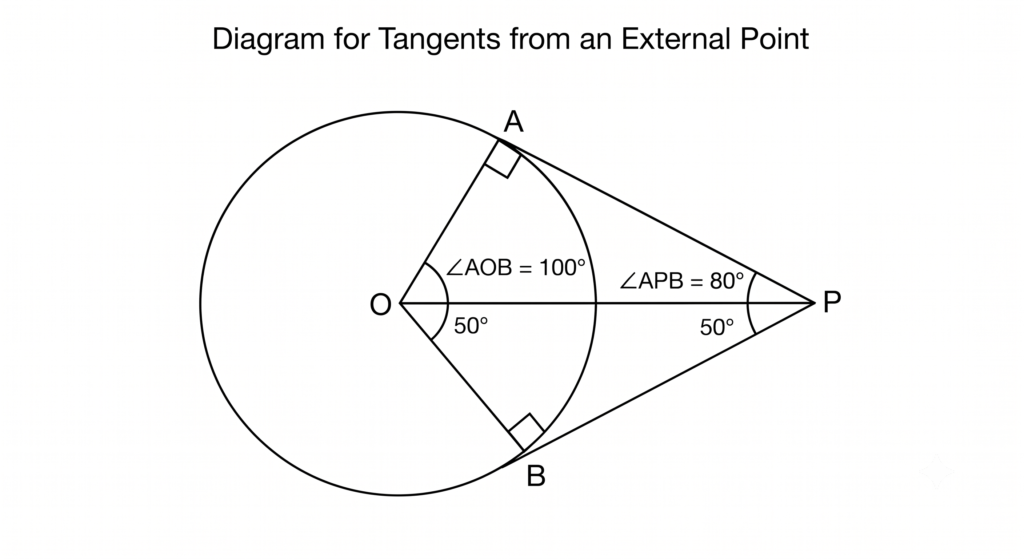
Given:
PA and PB are tangents to the circle with centre O.
∠APB = 80°
Since radius is perpendicular to the tangent at the point of contact:
∠OAP = 90°
∠OBP = 90°
In quadrilateral OAPB:
∠AOB + ∠APB = 180°
∠AOB + 80° = 180°
∠AOB = 100°
In ΔOAP and ΔOBP:
OA = OB (Radii of the same circle)
PA = PB (Tangents from an external point)
OP = OP (Common side)
∴ ΔOAP ≅ ΔOBP (by SSS congruence criterion)
Hence, ∠POA = ∠POB (CPCT)
∠POA = (1/2) × ∠AOB
∠POA = (1/2) × 100° = 50°
Correct Option: (A) 50°
4. Prove that the tangents drawn at the ends of a diameter of a circle are parallel.
Soln:
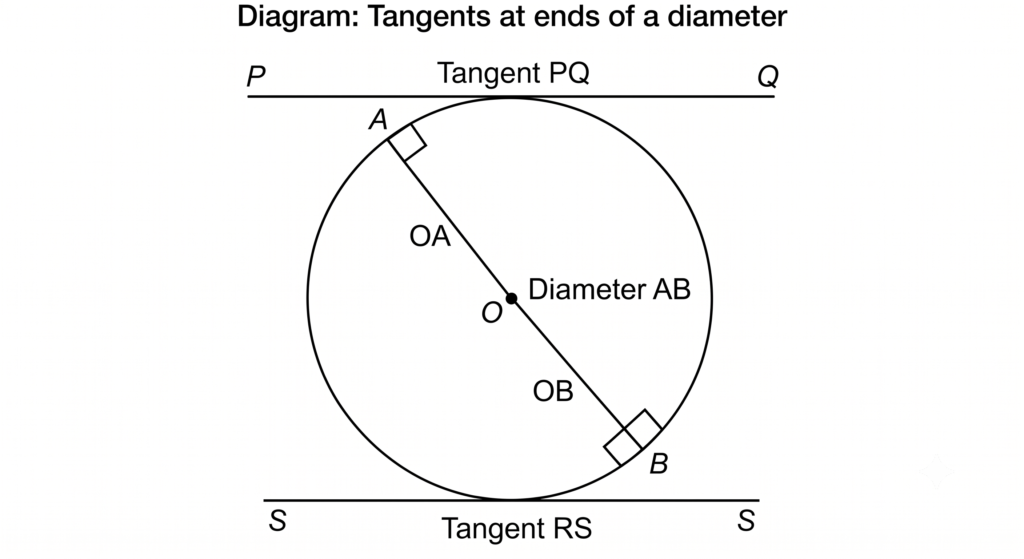
Given:
AB is a diameter of a circle with centre O.
Let PQ and RS be tangents drawn at points A and B respectively.
To Prove: PQ || RS
Proof: Since PQ is a tangent at point A and OA is the radius:
OA ⊥ PQ
⇒ ∠PAB = 90° …(1)
Since RS is a tangent at point B and OB is the radius:
OB ⊥ RS
⇒ ∠SBA = 90° …(2)
From (1) and (2):
∠PAB = ∠SBA = 90°
Since these alternate interior angles are equal, PQ || RS. Hence proved.
5. Prove that the perpendicular at the point of contact to the tangent to a circle passes through the centre.
Soln:
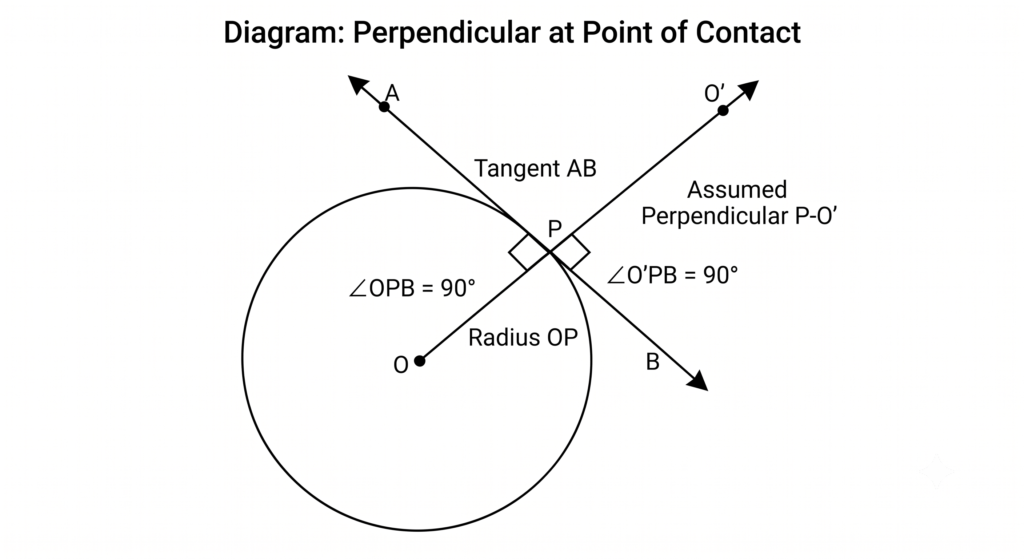
Given:
A circle with centre O and a tangent AB touching the circle at point P.
To Prove:
The perpendicular to AB at P passes through the centre O.
Proof:
Let us assume that the perpendicular to AB at P does not pass through O.
Let it pass through another point O’.
Then, ∠O’PB = 90° …(1)
By theorem, the radius through the point of contact is perpendicular to the tangent:
OP ⊥ AB
⇒ ∠OPB = 90° …(2)
From (1) and (2):
∠O’PB = ∠OPB
This is possible only when OP and O’P coincide.
Therefore, the perpendicular to the tangent at the point of contact must pass through the centre.
Hence proved.
SEBA Class 10 Maths Exercise 10.2 Solutions
6. The length of a tangent from a point A at distance 5 cm from the centre of the circle is 4 cm. Find the radius of the circle.
Soln:
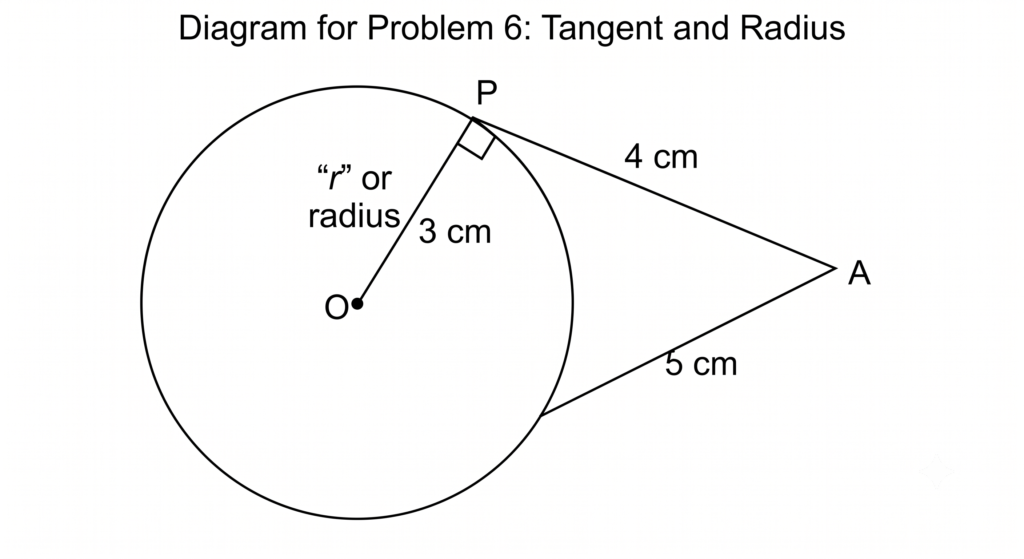
Given:
Let O be the centre of the circle and A be the external point.
Distance OA = 5 cm
Length of tangent AP = 4 cm
Since OP ⊥ AP:
In right-angled triangle OPA, by Pythagoras theorem:
OA² = OP² + AP²
5² = OP² + 4²
25 = OP² + 16
OP² = 25 – 16 = 9
OP = √9 = 3 cm
Radius of the circle = 3 cm.
7. Two concentric circles are of radii 5 cm and 3 cm. Find the length of the chord of the larger circle which touches the smaller circle.
Soln:

Given:
Two concentric circles with common centre O.
Radius of larger circle (R) = 5 cm
Radius of smaller circle (r) = 3 cm
Let AB be a chord of the larger circle touching the smaller circle at point P.
OP is the radius to the smaller circle, so OP ⊥ AB.
The perpendicular from the centre to a chord bisects the chord:
AP = PB = (1/2)AB
In right-angled triangle OPA:
OA² = OP² + AP²
5² = 3² + AP²
25 = 9 + AP²
AP² = 16
AP = 4 cm
Length of chord AB = 2 × AP = 2 × 4 = 8 cm.
8. A quadrilateral ABCD is drawn to circumscribe a circle (see Fig. 10.16). Prove that AB + CD = AD + BC.
Soln:

Given:
Quadrilateral ABCD circumscribes a circle touching at points P, Q, R, S.
To Prove: AB + CD = AD + BC
Proof:
The lengths of tangents drawn from an external point to a circle are equal.
AP = AS …(1)
BP = BQ …(2)
CR = CQ …(3)
DR = DS …(4)
Adding equations (1), (2), (3), and (4):
(AP + BP) + (CR + DR) = (AS + BQ + CQ + DS)
AB + CD = (AS + DS) + (BP + CQ)
AB + CD = (AS + DS) + (BQ + CQ)
AB + CD = AD + BC
Hence proved.
9. In Fig. 10.17, XY and X′Y′ are two parallel tangents to a circle with centre O and another tangent AB with point of contact C intersecting XY at A and X′Y′ at B. Prove that ∠AOB = 90°.
Soln:
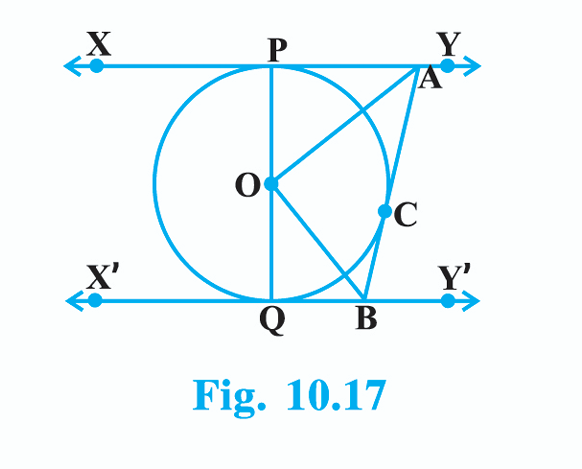
Given:
XY || X’Y’ are parallel tangents to a circle with centre O.
Tangent AB touches the circle at C.
To Prove:
∠AOB = 90°
Construction:
Join OC.
Proof:
In ΔOPA and ΔOCA:
OP = OC (Radii of the same circle)
AP = AC (Tangents from external point A)
OA = OA (Common side)
∴ ΔOPA ≅ ΔOCA (by SSS congruence criterion)
⇒ ∠POA = ∠COA
⇒ ∠POC = 2∠AOC …(1)
Similarly, in ΔOQB and ΔOCB:
ΔOQB ≅ ΔOCB (by SSS congruence criterion)
⇒ ∠QOB = ∠COB
⇒ ∠QOC = 2∠BOC …(2)
Since POQ is a diameter, POQ is a straight line:
∠POC + ∠QOC = 180°
2∠AOC + 2∠BOC = 180°
2(∠AOC + ∠BOC) = 180°
∠AOC + ∠BOC = 90°
∠AOB = 90°
Hence proved.
10. Prove that the angle between the two tangents drawn from an external point to a circle is supplementary to the angle subtended by the line-segment joining the points of contact at the centre.
Soln:
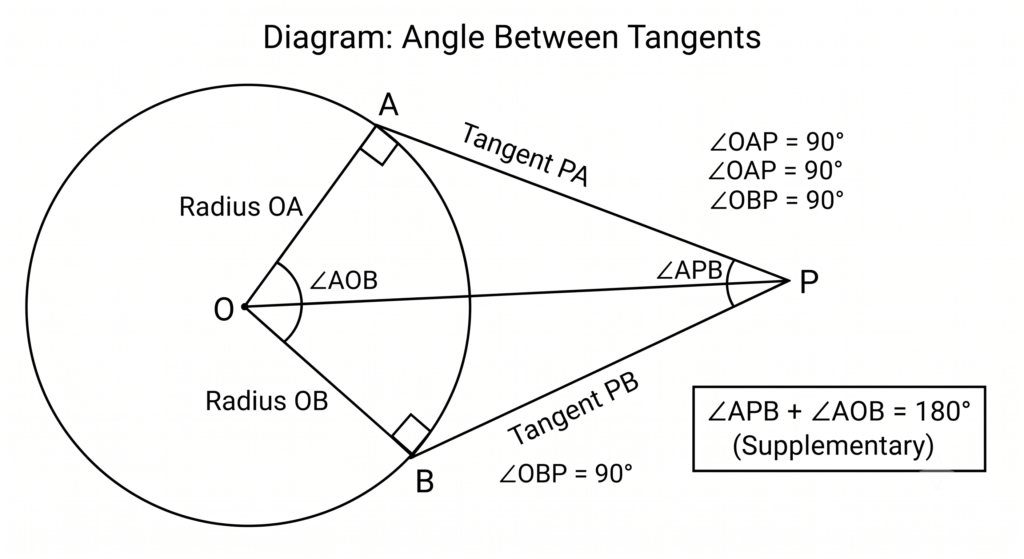
Given:
Tangents PA and PB are drawn from an external point P to a circle with centre O.
To Prove:
∠APB + ∠AOB = 180°
Proof:
Since radius is perpendicular to tangent at the point of contact:
OA ⊥ PA ⇒ ∠OAP = 90°
OB ⊥ PB ⇒ ∠OBP = 90°
In quadrilateral OAPB:
∠OAP + ∠APB + ∠OBP + ∠AOB = 360°
90° + ∠APB + 90° + ∠AOB = 360°
180° + ∠APB + ∠AOB = 360°
∠APB + ∠AOB = 180°
Hence, the angles are supplementary.
Hence proved.
Class 10 Maths Chapter 10.2 Circles SEBA 2026-27
11. Prove that the parallelogram circumscribing a circle is a rhombus.
Soln:
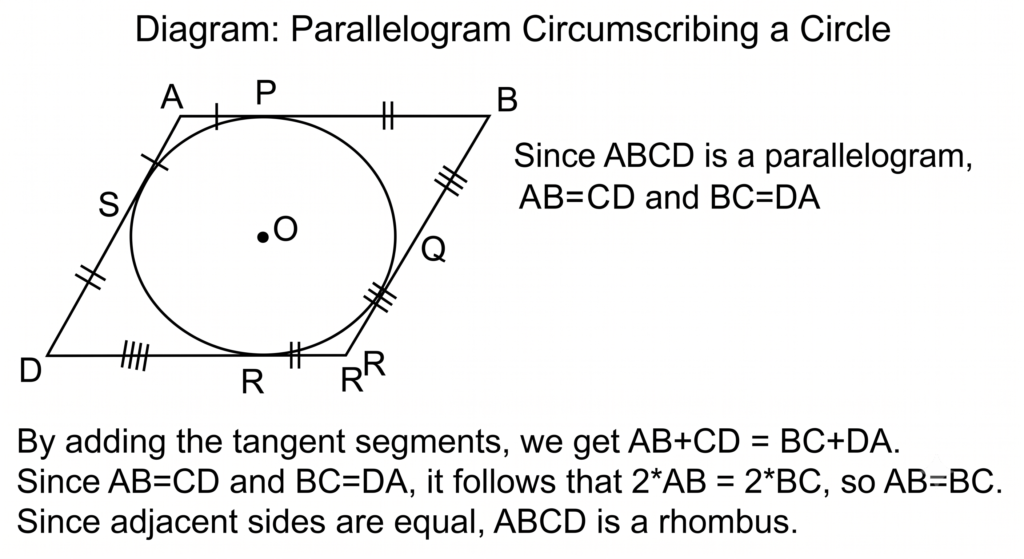
Given:
Parallelogram ABCD circumscribes a circle.
To Prove:
ABCD is a rhombus.
Proof:
Since ABCD is a parallelogram:
AB = CD …(1)
AD = BC …(2)
Tangents from an external point are equal:
AP = AS, BP = BQ, CR = CQ, DR = DS
Adding these equations:
(AP + BP) + (CR + DR) = (AS + DS) + (BQ + CQ)
AB + CD = AD + BC
Substituting (1) and (2):
AB + AB = BC + BC
2AB = 2BC
AB = BC
From (1), (2), and AB = BC:
AB = BC = CD = DA
Therefore, ABCD is a rhombus.
Hence proved.
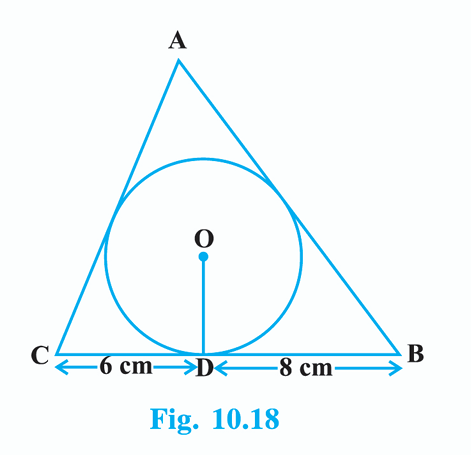
12. A triangle ABC is drawn to circumscribe a circle of radius 4 cm such that the segments BD and DC into which BC is divided by the point of contact D are of lengths 8 cm and 6 cm respectively (see Fig. 10.18). Find the sides AB and AC.
Soln:
Given:
Radius of incircle (r) = 4 cm
BD = 8 cm, CD = 6 cm
Let the circle touch AC at E and AB at F.
Tangents from an external point are equal:
BF = BD = 8 cm
CE = CD = 6 cm
Let AF = AE = x cm
Sides of ΔABC:
a = BC = 6 + 8 = 14 cm
b = AC = (x + 6) cm
c = AB = (x + 8) cm
Semi-perimeter (s):
s = (a + b + c) / 2
s = (14 + x + 6 + x + 8) / 2 = (2x + 28) / 2 = x + 14
Using Heron’s formula:
Area of ΔABC = √[s(s – a)(s – b)(s – c)]
s – a = (x + 14) – 14 = x
s – b = (x + 14) – (x + 6) = 8
s – c = (x + 14) – (x + 8) = 6
Area of ΔABC = √[(x + 14)(x)(8)(6)] = √[48x(x + 14)] …(1)
Also, Area of ΔABC = Area(ΔOBC) + Area(ΔOCA) + Area(ΔOAB)
Area = (1/2) × BC × r + (1/2) × AC × r + (1/2) × AB × r
Area = (1/2) × r × (BC + AC + AB) = r × s
Area = 4 × (x + 14) …(2)
Equating (1) and (2):
√[48x(x + 14)] = 4(x + 14)
Squaring both sides:
48x(x + 14) = 16(x + 14)²
48x = 16(x + 14) [as x + 14 ≠ 0]
3x = x + 14
2x = 14
x = 7 cm
Therefore:
AB = x + 8 = 7 + 8 = 15 cm
AC = x + 6 = 7 + 6 = 13 cm
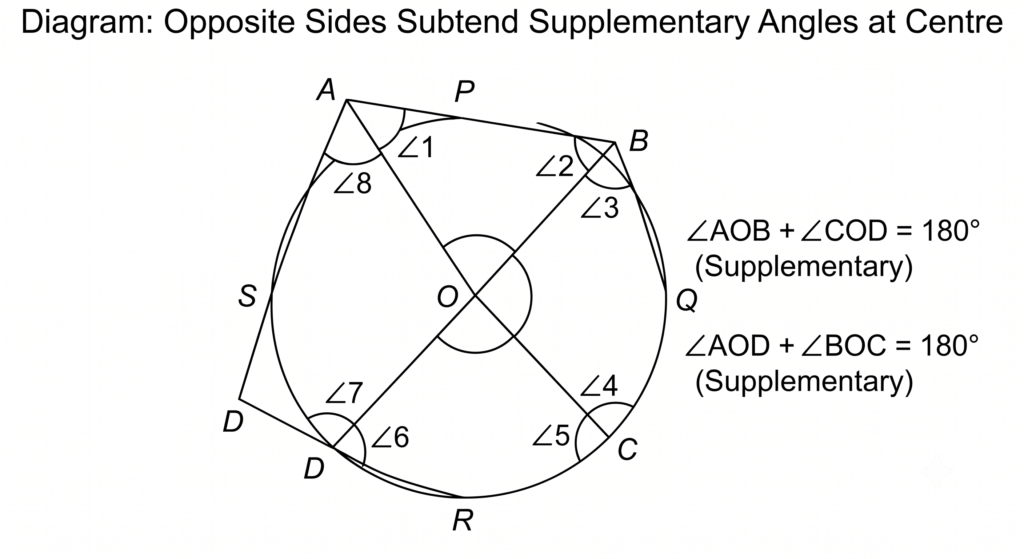
13. Prove that opposite sides of a quadrilateral circumscribing a circle subtend supplementary angles at the centre of the circle.
Soln:
Given:
Quadrilateral ABCD circumscribes a circle with centre O, touching sides AB, BC, CD, DA at P, Q, R, S respectively.
To Prove:
∠AOB + ∠COD = 180°
∠AOD + ∠BOC = 180°
Construction:
Join OP, OQ, OR, OS, OA, OB, OC, OD.
Proof:
In ΔOAP and ΔOAS:
AP = AS (Tangents from external point A)
OP = OS (Radii)
OA = OA (Common)
∴ ΔOAP ≅ ΔOAS (SSS criterion)
⇒ ∠POA = ∠SOA (Let ∠1 = ∠8)
Similarly:
∠POB = ∠QOB (∠2 = ∠3)
∠QOC = ∠ROC (∠4 = ∠5)
∠ROD = ∠SOD (∠6 = ∠7)
Sum of all angles at centre O = 360°:
∠1 + ∠2 + ∠3 + ∠4 + ∠5 + ∠6 + ∠7 + ∠8 = 360°
2(∠2 + ∠3 + ∠6 + ∠7) = 360° ⇒ 2(∠AOB + ∠COD) = 360°
∠AOB + ∠COD = 180°
Similarly,
∠AOD + ∠BOC = 180°
Hence proved.
Class 10 Circles Theorem 10.2 Step by Step Solutions Assam Board
14. What is the maximum number of parallel tangents to a circle can have on a diamenter?
Answer: 2
15. In figure 10.19 AP and BP are the tangents from an external point P to a circle with centre O such that PA = 5cm and ∠APB = 60°. Find the length of the chord AB.
Soln:

Given:
PA and PB are tangents from point P.
PA = 5 cm
∠APB = 60°
Since tangents from an external point to a circle are equal:
PA = PB = 5 cm
In ΔPAB:
PA = PB ⇒ ∠PAB = ∠PBA (Angles opposite to equal sides are equal)
In ΔPAB:
∠APB + ∠PAB + ∠PBA = 180°
60° + 2∠PAB = 180°
2∠PAB = 120°
∠PAB = 60°
Thus, ∠PAB = ∠PBA = ∠APB = 60°
Therefore, ΔPAB is an equilateral triangle.
AB = PA = 5 cm
Length of chord AB = 5 cm.
SEBA Class 10 Maths Ex 10.2 Question Answer
16. In figure 10.20, OT is a radius and PT is a tangent to the circle. If OT = 12cm and PT = 16cm, find PQ.
Soln:

Given:
OT = 12 cm (radius)
PT = 16 cm (tangent)
Since radius is perpendicular to the tangent at the point of contact:
∠OTP = 90°
In right-angled triangle OTP, by Pythagoras theorem:
OP² = OT² + PT²
OP² = 12² + 16²
OP² = 144 + 256 = 400
OP = √400 = 20 cm
Since O, Q, P lie on the line segment OP and Q is on the circle:
OQ = radius = OT = 12 cm
PQ = OP – OQ
PQ = 20 – 12 = 8 cm
PQ = 8 cm.
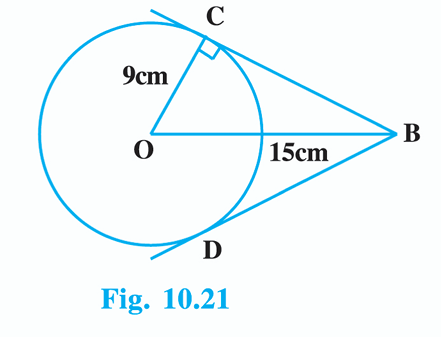
17. In the figure 10.21 if OC = 9cm and OB = 15cm then BC + BD is equal to
A) 12 cm
B) 24 cm
C) 27 cm
D) 30 cm
Soln:
Given:
OC = 9 cm (radius)
OB = 15 cm
BC and BD are tangents from external point B.
Since OC ⊥ BC:
In right-angled triangle OCB, by Pythagoras theorem:
OB² = OC² + BC²
15² = 9² + BC²
225 = 81 + BC²
BC² = 225 – 81 = 144
BC = √144 = 12 cm
Tangents from an external point are equal:
BD = BC = 12 cm
BC + BD = 12 + 12 = 24 cm
Correct Option: B) 24 cm
18. Which of the following statement is true or false?
P) Two tangents drawn from an external point to a circle subtend equal angles at the centre of the circle. Q) Two tangents drawn from an external point P to a circle are equally inclined to the segment joining the centre to the point P.
A) P is true, Q is false
B) P is false, Q is true
C) Both P and Q are true
D) Both P and Q are false
Statement P: Two tangents drawn from an external point to a circle subtend equal angles at the centre of the circle.
- This is TRUE (by congruence of triangles formed with radii and center line).
Statement Q: Two tangents drawn from an external point P to a circle are equally inclined to the segment joining the centre to the point P.
- This is TRUE (by CPCT from the same congruence).
Correct Option: C) Both P and Q are true
19. From the figure 10.22 match the column if the lengths of side AB, BC, CA are 12cm, 8cm and 10cm respectively.
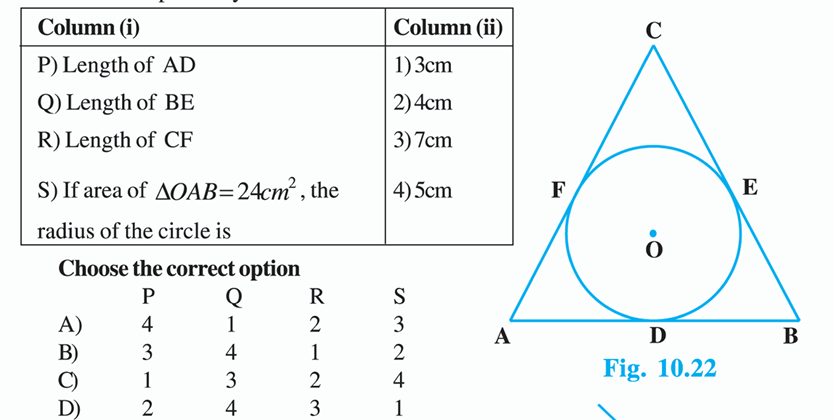
Soln:
Given:
AB = 12 cm, BC = 8 cm, CA = 10 cm
Let AD = AF = x
Let BD = BE = y
Let CE = CF = z
x + y = AB = 12 …(1)
y + z = BC = 8 …(2)
x + z = CA = 10 …(3)
Adding (1), (2), and (3):
2(x + y + z) = 12 + 8 + 10 = 30
x + y + z = 15
P) Length of AD = x = (x + y + z) – (y + z) = 15 – 8 = 7 cm → 3)
Q) Length of BE = y = (x + y + z) – (x + z) = 15 – 10 = 5 cm → 4)
R) Length of CF = z = (x + y + z) – (x + y) = 15 – 12 = 3 cm → 1)
S) Area of ΔOAB = (1/2) × AB × r = 24
(1/2) × 12 × r = 24
6r = 24
r = 4 cm → 2)
Matching: P → 3, Q → 4, R → 1, S → 2
Correct Option: B) 3 4 1 2
20. In figure 10.23 angles are jumbled links o their measure in the statements P to S
P) Measure of ∠ORP
Q) Measure of ∠RQP
R) Measure of ∠ORQ
S) Measure of ∠ROQ
Choose the option that represents the correct decreasing sequence of measure of the angles:
A) P, Q, R, S
B) S, P, Q, R
C) Q, R, P, S
D) R, S, Q, P
Soln:

Given:
PR and PQ are tangents from point P to the circle with centre O.
∠RPQ = 30°
Calculation of angles:
Tangents from an external point are perpendicular to the radius:
∠ORP = 90° (P = 90°) ∠OQP = 90°
In quadrilateral OQPR:
∠ROQ = 180° – ∠RPQ = 180° – 30° = 150° (S = 150°)
In ΔPQR:
PR = PQ ⇒ ∠PRQ = ∠PQR
∠PRQ + ∠PQR + 30° = 180°
2∠PQR = 150°
∠RQP = 75° (Q = 75°)
In right-angled triangle ORP:
∠ORQ = ∠ORP – ∠PRQ = 90° – 75° = 15° (R = 15°)
Values:
S = 150°
P = 90°
Q = 75°
R = 15°
Decreasing order: S > P > Q > R
Correct Option: B) S, P, Q, R
SEBA HSLC Class 10 Maths Chapter 10 Exercise 10.2 Solved PDF
21. In figure 10.24, PQ and PR are tangents to a circle with centre at O. ACB is another tangent touching the circle at C. If PQ = 12cm and BP = 8cm then the length of BC is
A) 2 cm
B) 4 cm
C) 6 cm
D) 8 cm
Soln:
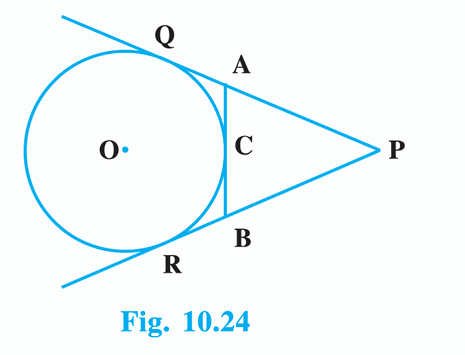
Given:
PQ and PR are tangents from point P.
PQ = 12 cm
BP = 8 cm
Tangents from point P are equal:
PR = PQ = 12 cm
From the figure, point B lies on PR:
PR = PB + BR
12 = 8 + BR
BR = 4 cm
Since BC and BR are tangents from point B to the circle:
BC = BR = 4 cm
Correct Option: B) 4 cm
22. A round clock is fitted inside a triangular glass frame as shown in figure 10.25. It is given that BP = 6cm, CP = 8cm and AQ = 3cm
Soln:

Given:
BP = 6 cm, CP = 8 cm, AQ = 3 cm
Tangents drawn from external points to the circle are equal:
AR = AQ = 3 cm
BR = BP = 6 cm
(i) The length of AR is
A) 3 cm
B) 6 cm
C) 8 cm
D) 9 cm
The length of AR:
AR = AQ = 3 cm
Correct Option: A) 3 cm
(ii) The length of AC is
A) 6 cm
B) 8 cm
C) 9 cm
D) 11 cm
The length of AR:
AR = AQ = 3 cm
Correct Option: A) 3 cm
(ii) The length of AC:
AC = AQ + CQ
AC = 3 + 8 = 11 cm
Correct Option: D) 11 cm
(iii) The perimeter of the triangle ABC is
A) 17 cm
B) 34 cm
C) 38 cm
D) 42 cm
The perimeter of triangle ABC:
Perimeter = AB + BC + CA
AB = AR + BR = 3 + 6 = 9 cm
BC = BP + CP = 6 + 8 = 14 cm
CA = AQ + CQ = 3 + 8 = 11 cm
Perimeter = 9 + 14 + 11 = 34 cm
Correct Option: B) 34 cm
(iv) If the radius of the circle is 4cm, then area of ΔOBC is
A) 12cm²
B) 18cm²
C) 24cm²
D) 28cm²
Area of ΔOBC:
Base BC = BP + CP = 6 + 8 = 14 cm
Height = Radius (r) = 4 cm (since OP ⊥ BC)
Area of ΔOBC = (1/2) × Base × Height
Area of ΔOBC = (1/2) × 14 × 4 = 28 cm²
Correct Option: D) 28cm²
⭕ HSLC Class 10 Maths Exercise 10.2 Notice: This page features the complete, step-by-step SEBA Class 10 Mathematics Chapter 10 (Circles) Exercise 10.2 Official Textual Solutions updated for the 2026–27 academic session. Formatted according to the strict HSLC board marking scheme, every numerical problem and geometric proof applying Theorem 10.2 (tangents from an external point) is worked out with labeled geometric figures, clear “Given / To Prove / Construction / Proof” headings, Heron’s formula integrations, and step-by-step algebraic simplification to ensure you score full marks in your 3-mark, 4-mark, and 5-mark board exam questions.
💡 Master SEBA Class 10 Circles:
- Having difficulty proving Question 8 (AB + CD = AD + BC), proving that opposite sides of a quadrilateral circumscribing a circle subtend supplementary angles at the centre (Question 13), or calculating sides AB and AC in Question 12? Drop your question in the comments section below!
- Bookmark this page for quick theorem revision and diagram verification before your unit evaluations, pre-board exams, and the final HSLC examinations.
- Share this link with your classmates and WhatsApp study groups to make Class 10 Geometry proofs straightforward and easy to score!