Looking for accurate SEBA Class 9 Maths Chapter 5 Exercise 5.1 (Introduction to Euclid’s Geometry) textual solutions for the 2026–27 academic year? Access step-by-step solutions for Euclid’s axioms, postulates, true/false statement justifications, and geometric proofs designed to help you score top marks in your annual exams.
EXERCISE 5.1
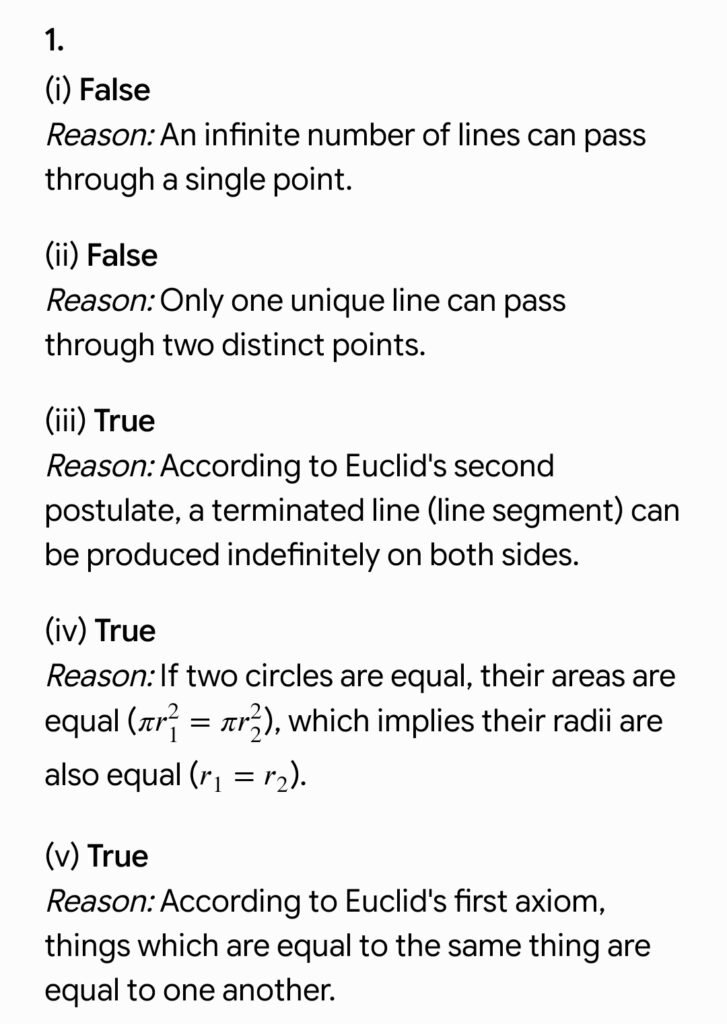
1. Which of the following statements are true and which are false? Give reasons for your answers.
(i) Only one line can pass through a single point.
(ii) There are an infinite number of lines which pass through two distinct points.
(iii) A terminated line can be produced indefinitely on both the sides.
(iv) If two circles are equal, then their radii are equal.
(v) In Fig. 5.9, if AB = PQ and PQ = XY, then AB = XY.[Image Description for Fig. 5.9: Three separate horizontal-ish line segments labeled AB, PQ, and XY.]
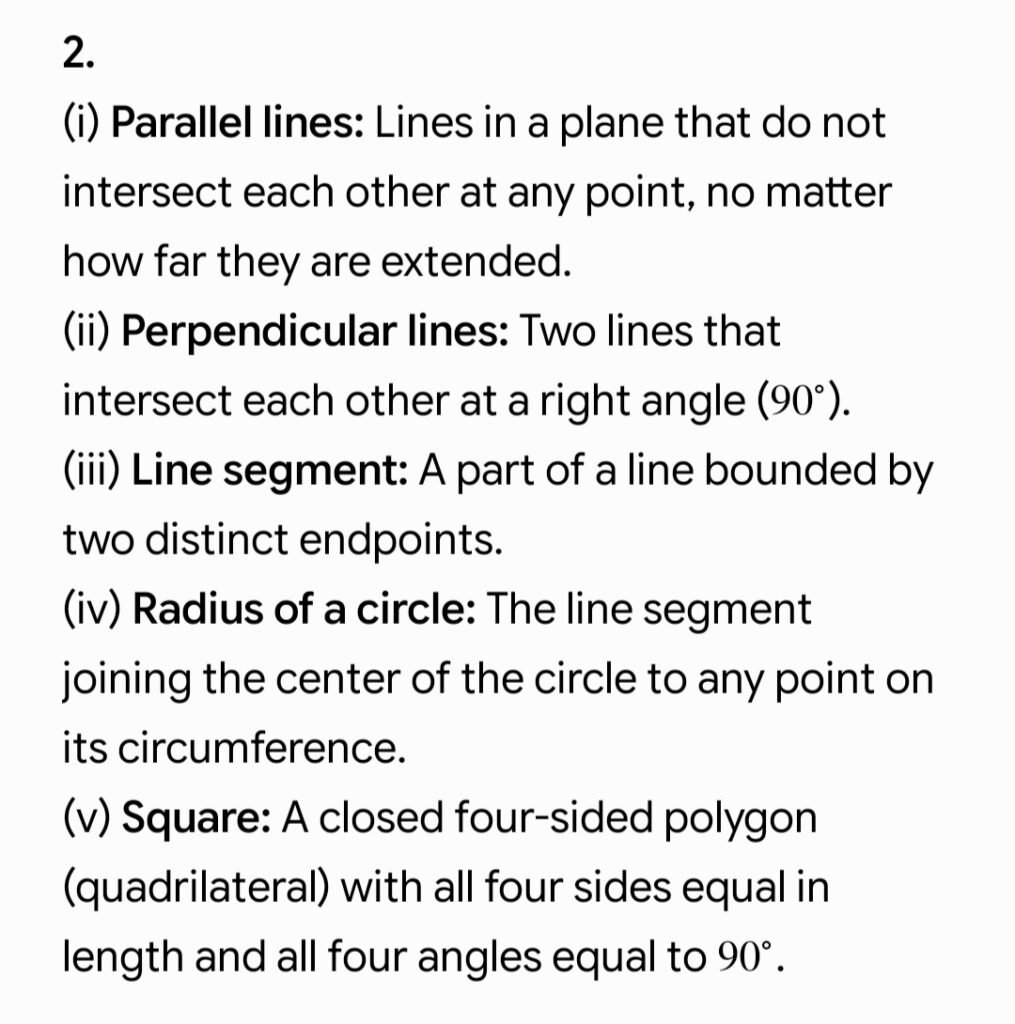
2. Give a definition for each of the following terms. Are there other terms that need to be defined first? What are they, and how might you define them?
(i) parallel lines
(ii) perpendicular lines
iii) line segment
(iv) radius of a circle
(v) square
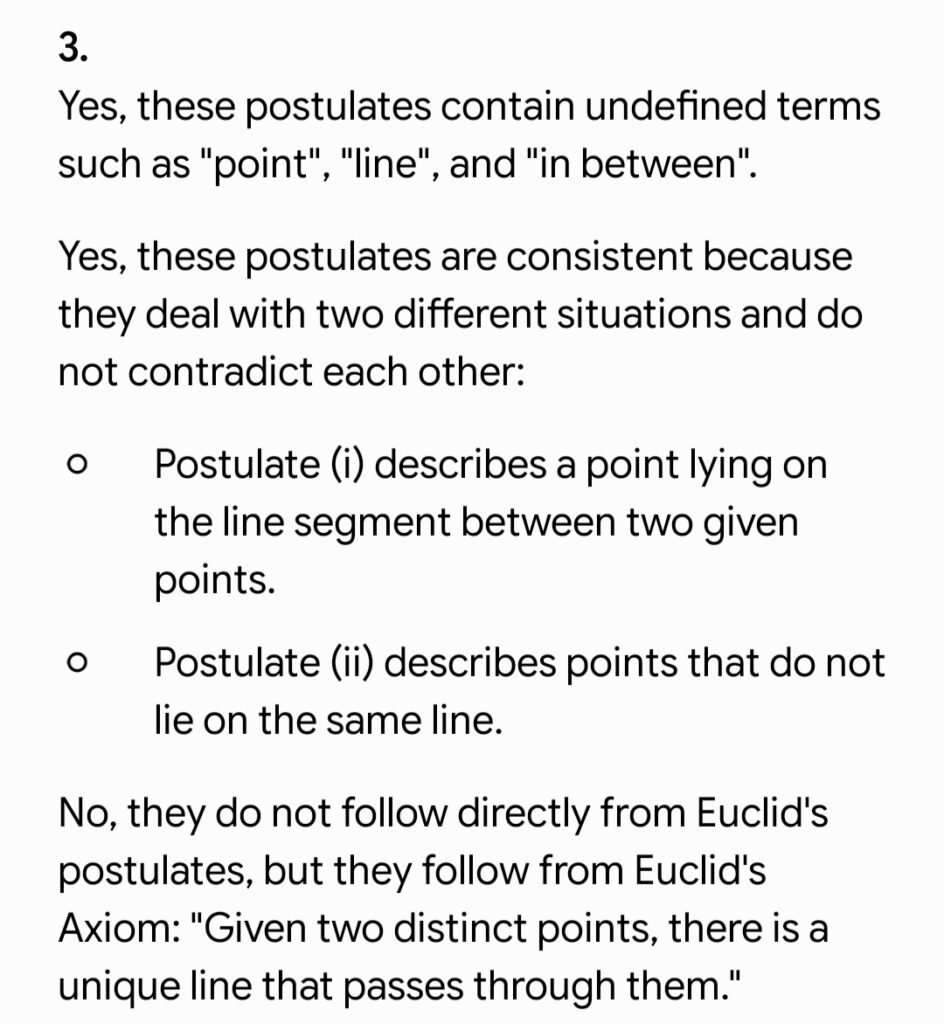
3. Consider two ‘postulates’ given below:
(i) Given any two distinct points A and B, there exists a third point C which is in between A and B.
(ii) There exist at least three points that are not on the same line.Do these postulates contain any undefined terms? Are these postulates consistent? Do they follow from Euclid’s postulates? Explain.
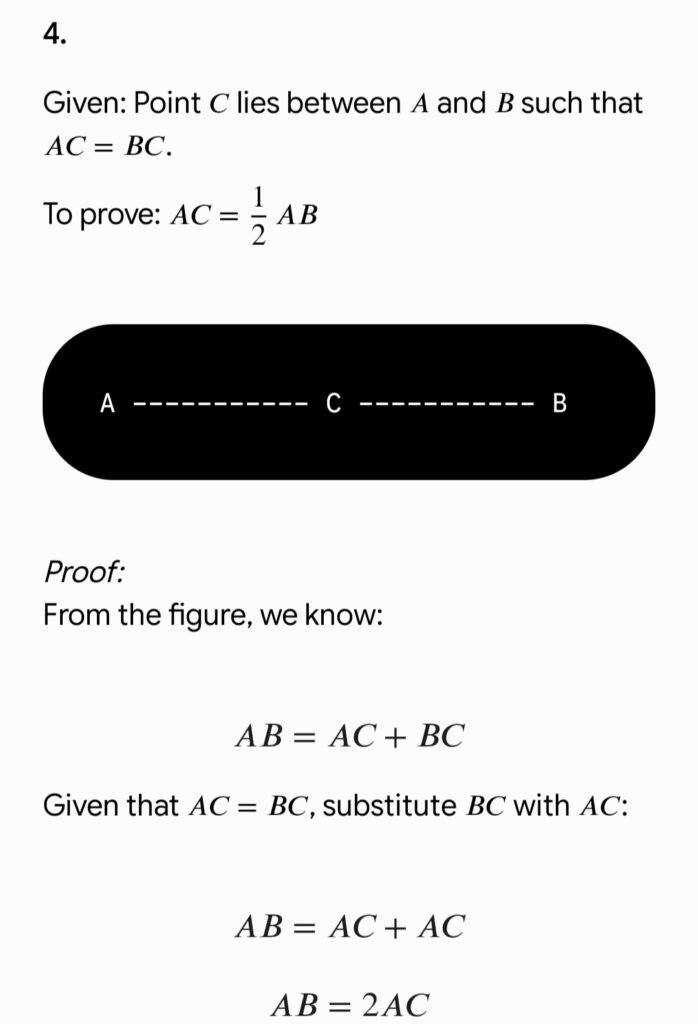
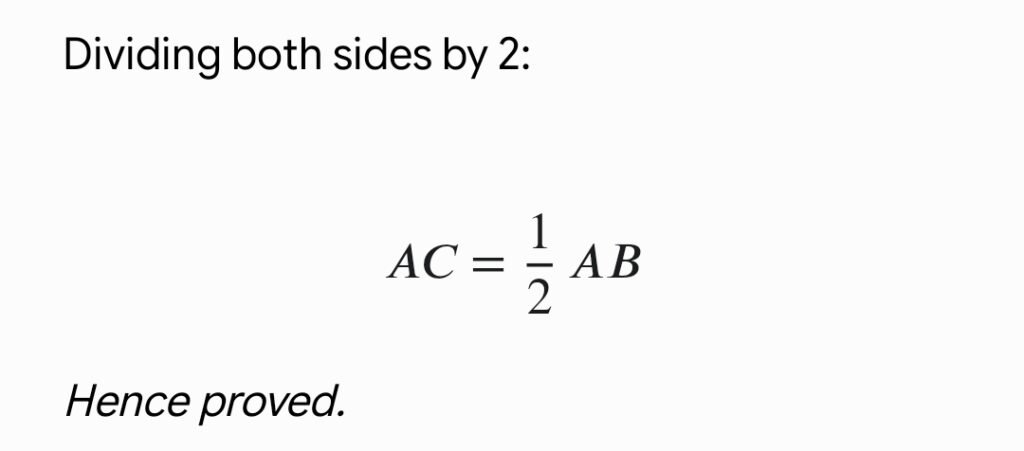
4. If a point C lies between two points A and B such that AC = BC, then prove that AC = \frac{1}{2}AB. Explain by drawing the figure.
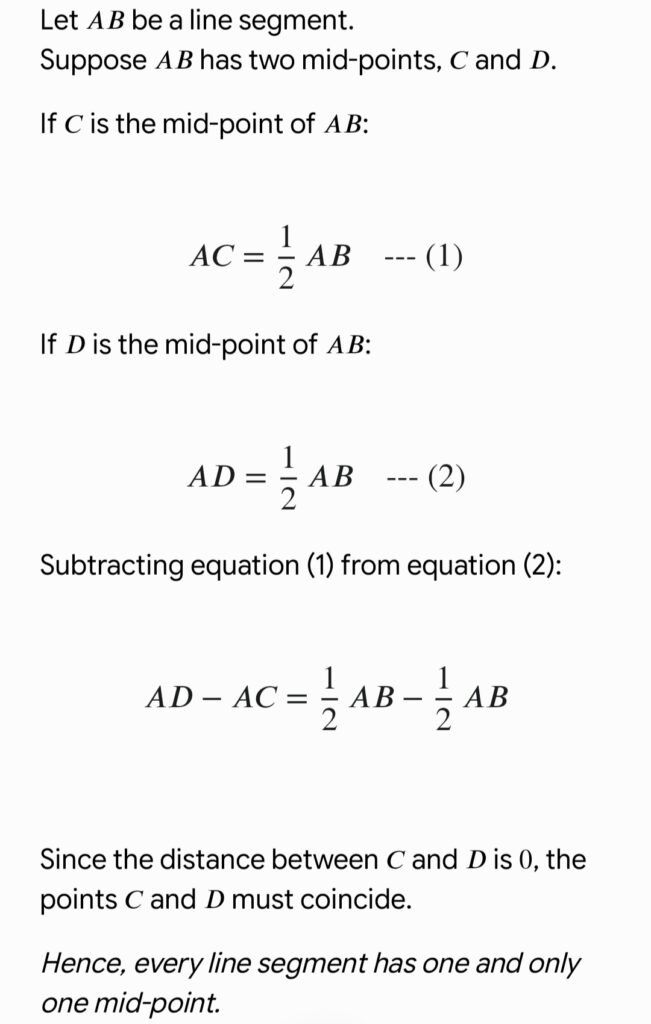
5. In Question 4, point C is called a mid-point of line segment AB. Prove that every line segment has one and only one mid-point.
SEBA Class 9 Maths Chapter 5.1 Solutions
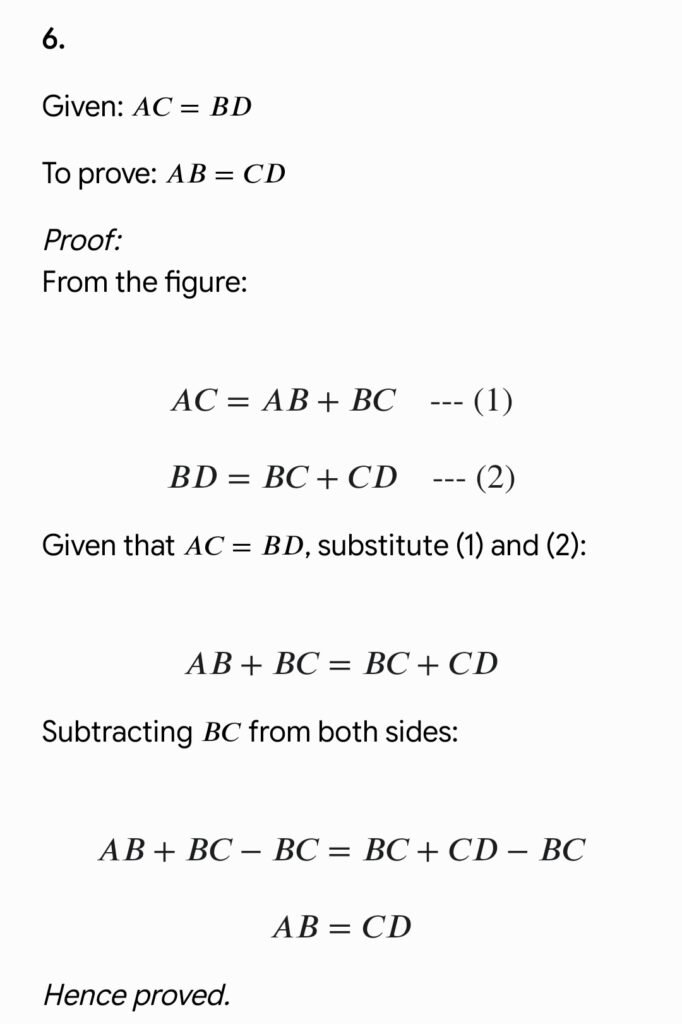
6. In Fig. 5.10, if AC = BD, then prove that AB = CD.[Image Description for Fig. 5.10: A single straight line segment with points A, B, C, D marked in order from left to right.]
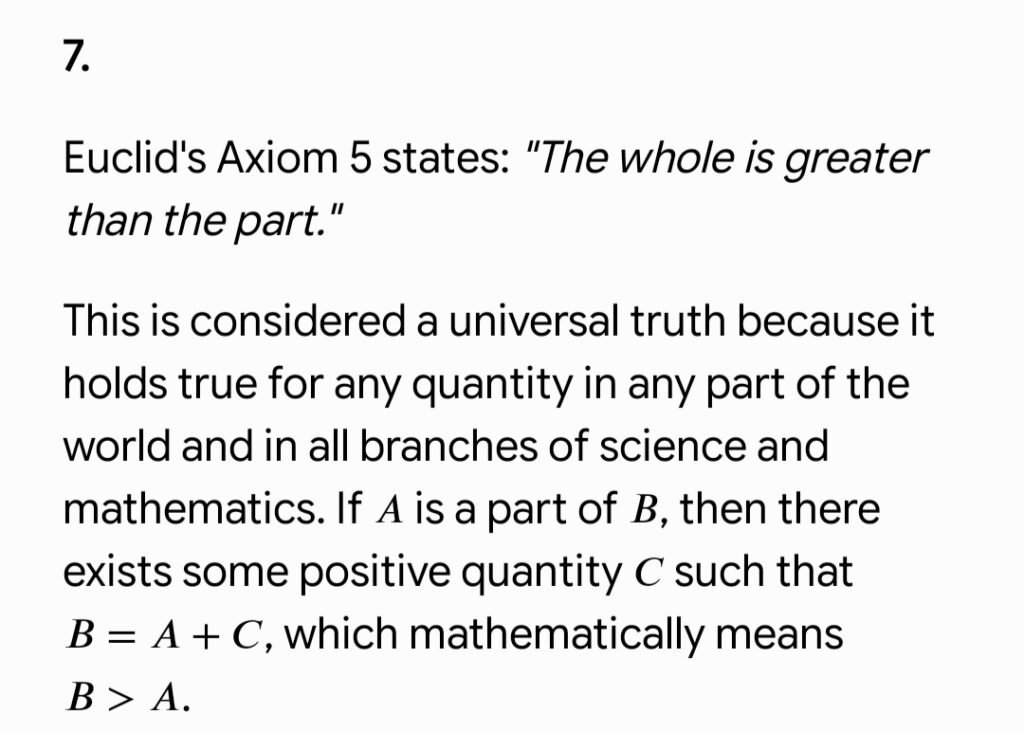
7. Why is Axiom 5, in the list of Euclid’s axioms, considered a ‘universal truth’? (Note that the question is not about the fifth postulate.)
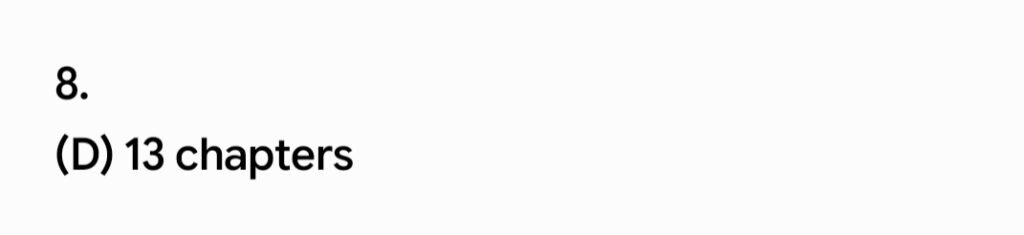
8. In how many chapters Euclids divided his famous “The Elements”?(A) 9 chapters
(B) 11 chapters
(C) 12 chapters
(D) 13 chapters
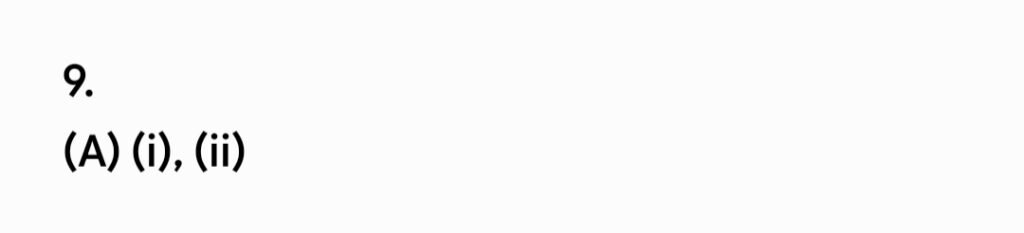
9. Which of the following are correct for the shapes of altars used for household rituals and public worship in ancient India?
(i) Square and circles.
(ii) Triangles and rectangles
(iii) Trapeziums
(iv) Pyramids
(A) (i), (ii)
(B) (ii), (iii)
(C) (i), (ii), (iii)
(D) (ii), (iii), (iv)
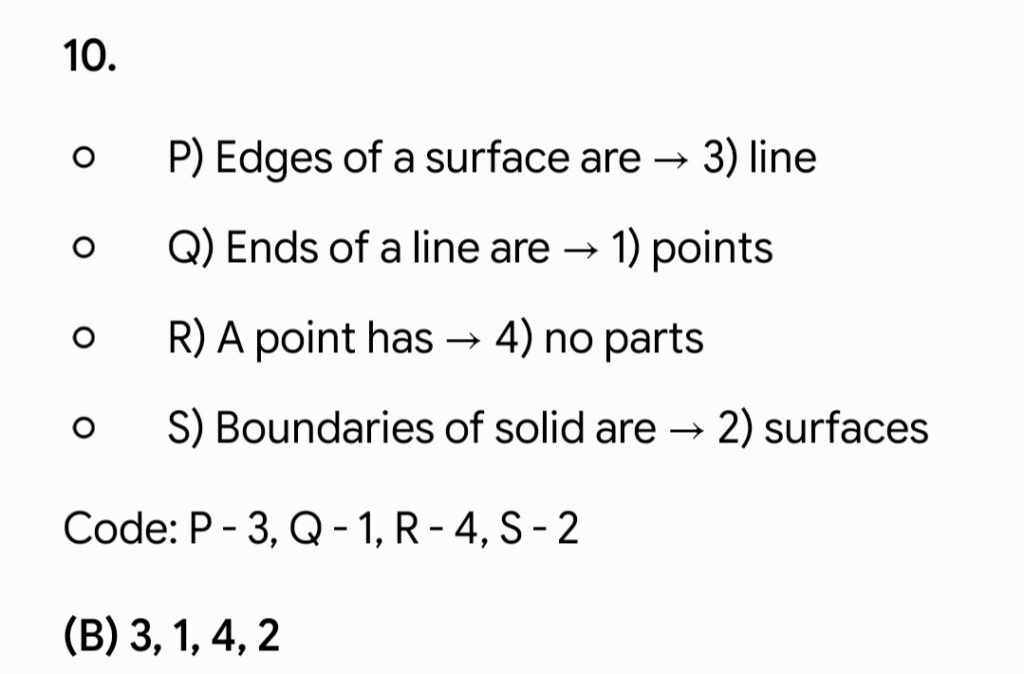
10.Match the columns
| Column-I | Column-II |
| P) The edges of a surface are | 1) points |
| Q) The ends of a line are | 2) surfaces |
| R) A point has | 3) lines |
| S) The boundaries of a solid are | 4) no parts |
Options Table
| Options | P | Q | R | S |
| A | 1 | 2 | 3 | 4 |
| B | 3 | 1 | 4 | 2 |
| C | 2 | 4 | 3 | 1 |
| D | 4 | 3 | 1 | 2 |
Class 9 Maths Chapter 5 Exercise 5.1 Question Answer SEBA 2026-27
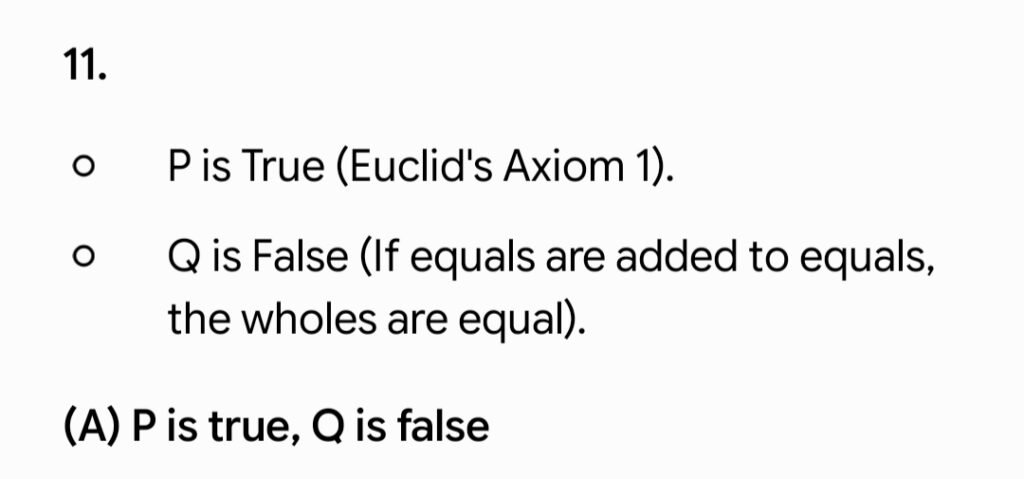
11. Which of the following statements is true or false?P) Things which are equal to the same thing are equal to one another.Q) If equals are added to equals, the whole are unequal.
(A) P is true, Q is false
(B) P is false, Q is true
(C) Both P and Q are true
(D) Both P and Q are false
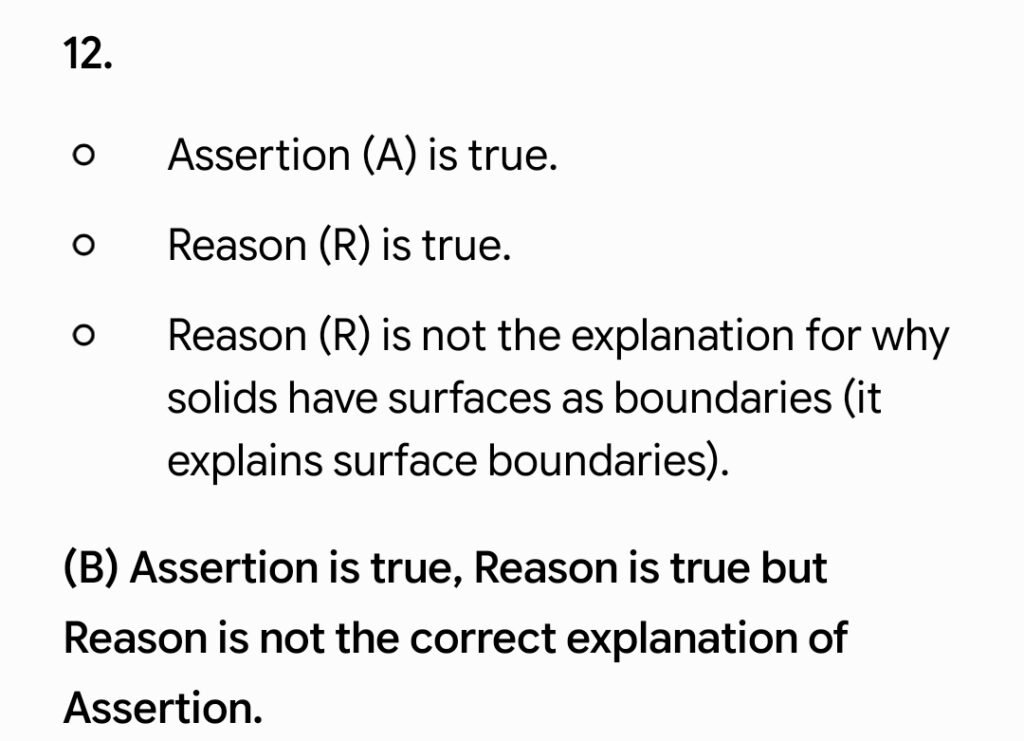
12. In this questions, there is a statement of assertion (A) followed by a statement of reason (R).Choose the correct option from the given alternatives.
Assertion (A) : The boundaries of the solids are surfaces.
Reason (R) : The boundaries of the surfaces are lines or curves.
(A) Assertion is true, Reason is true and Reason is the correct explanation of Assertion.
(B) Assertion is true, Reason is true but Reason is not the correct explanation of Assertion.
(C) Assertion is true, Reason is false.
(D) Assertion is false, Reason is true.
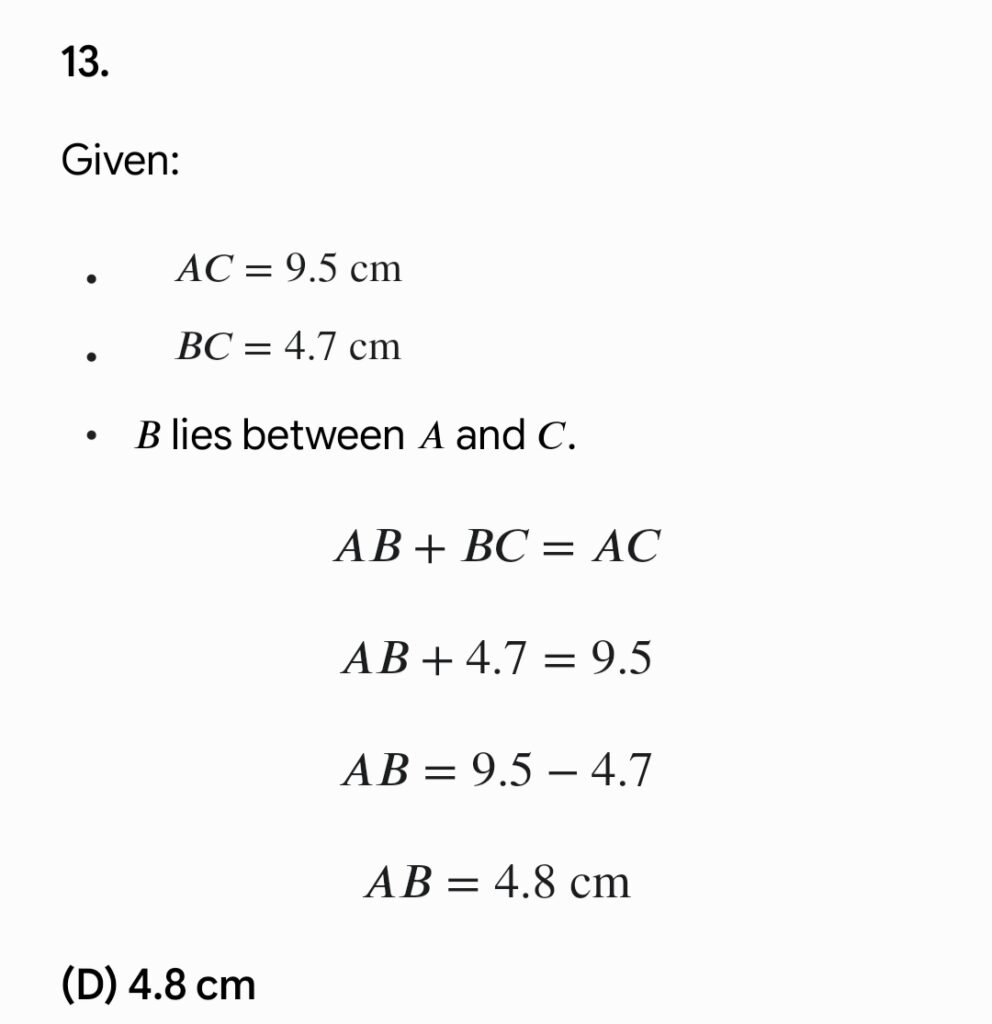
13. A, B and C are three points on a straight line and B lies between A and C. If AC = 9.5 cm, BC = 4.7 cm, what is the length of AB?
(A) 14.2 cm
(B) 5 cm
(C) 5.8 cm
(D) 4.8 cm
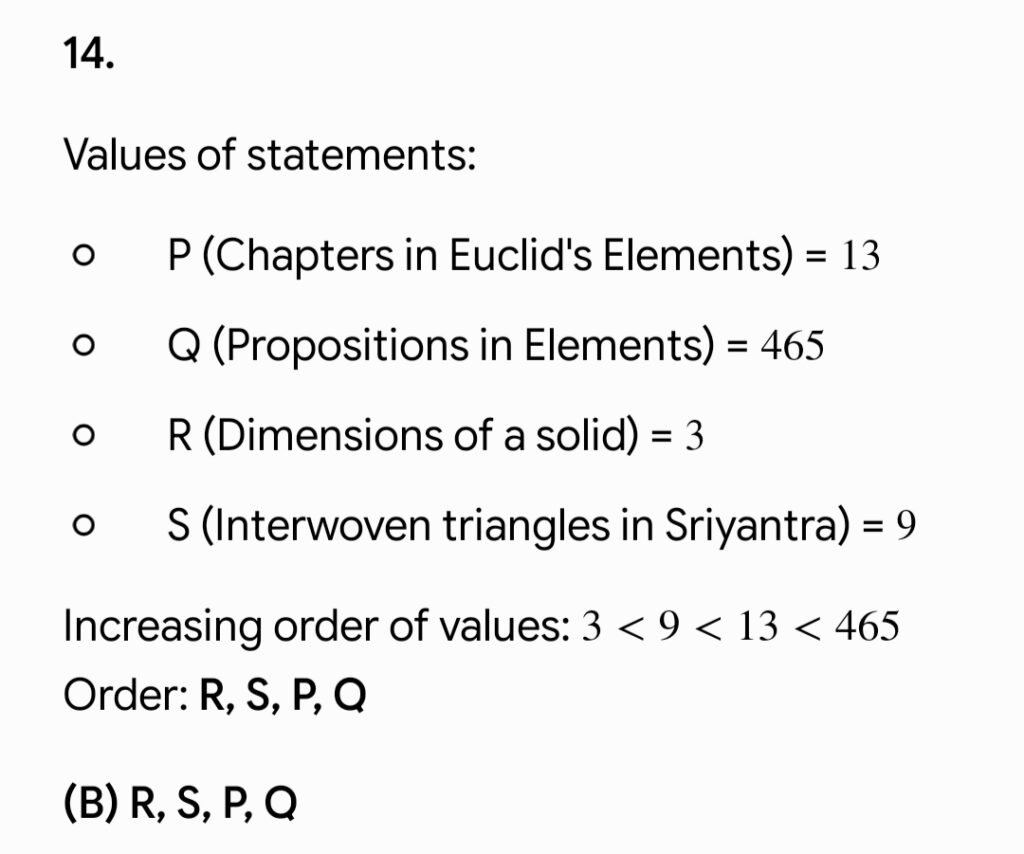
14. The following statements from P to S form a jumbled links of the information–P : The no. of chapters that Euclid divided his famous treatise the book “The Elements”.Q : The total number of propositions in the book ” the Elements”.R : The no. of dimensions a solid hasS : The number of interwoven isosceles triangles in Sriyantra (in the Atharvaveda)Choose the option that represents the correct increasing order of numbers.
A) S, P, R, Q
B) R, S, P, Q
C) P, R, Q, S
D) Q, P, S, R
SEBA Class 9 Maths Chapter 5 Ex 5.1 Notes
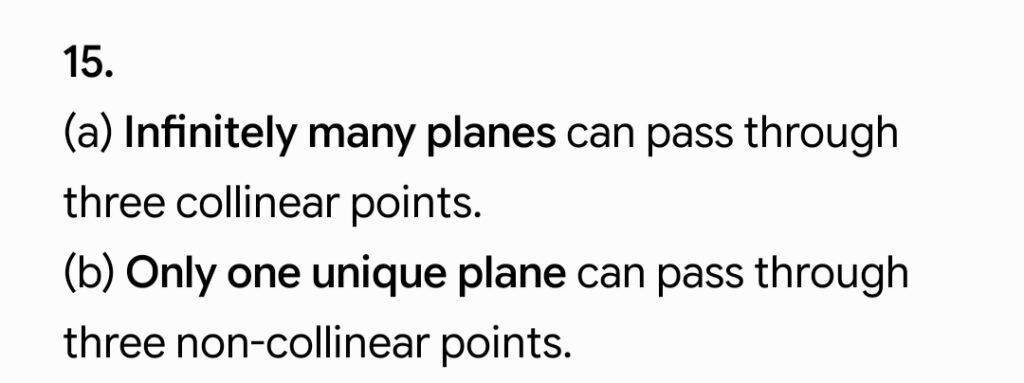
15. How many planes can be made to pass through three distinct points if
(a) The points are collinear?
(b) The points are non-collinear?Case base
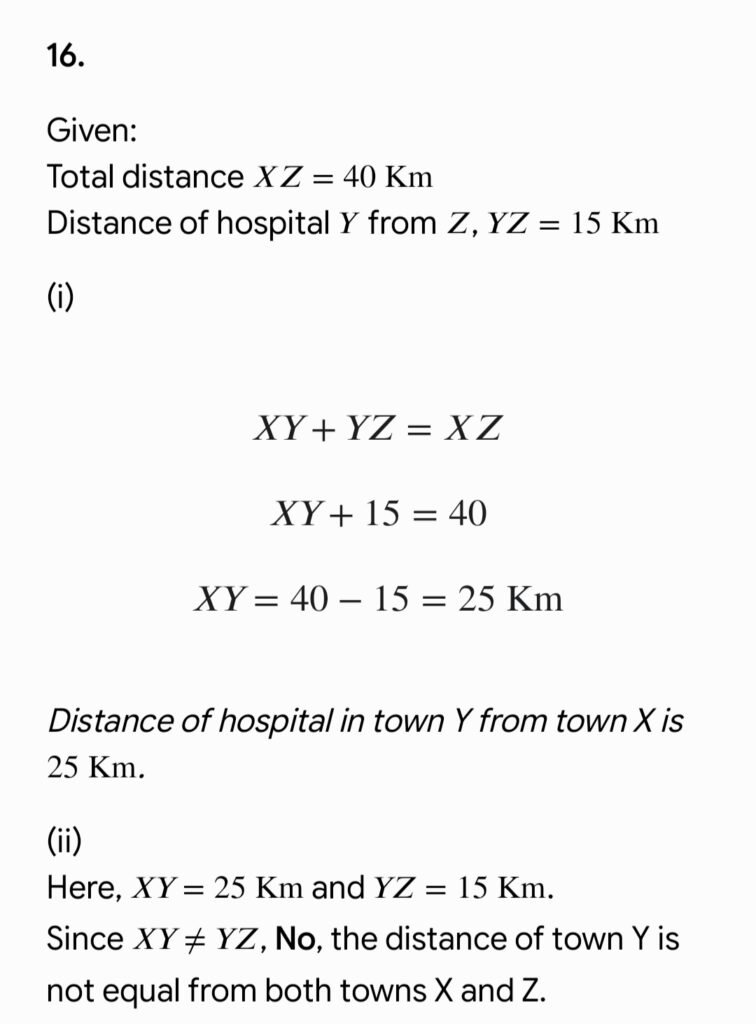
16. For the health and well being, state government opens hospitals all over Assam. The two towns X and Z are located along a straight road in such a way that the distance between X and Z is 40 Km. The government opens a hospital Y between the towns X and Z such that it is 15 Km apart from Z.
(i) What is the distance of hospital in town Y from the town X?
(ii) Is the distance of the town Y equal from both the towns X and Z?
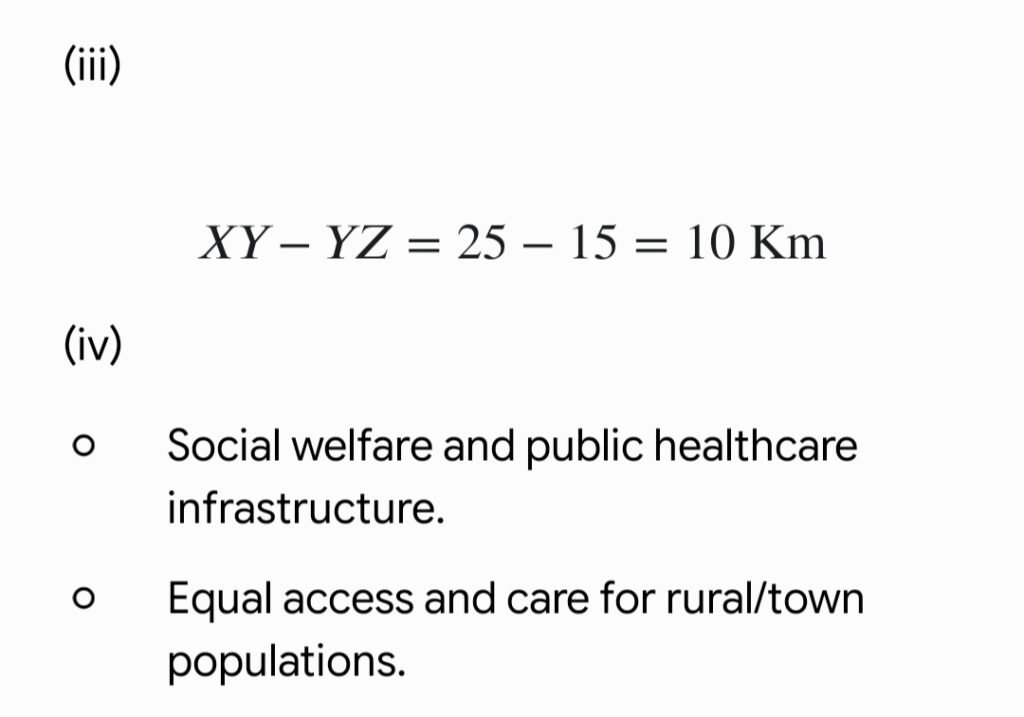
(iii) Find XY – YZ
(iv) What values are shown by the government?
Class 9 Maths Chapter 5 Exercise 5.1 Answers
📐 Updated Exercise 5.1 Solutions Notice: This page features complete, step-by-step SEBA Class 9 Maths Chapter 5 (Introduction to Euclid’s Geometry) Exercise 5.1 Solutions updated for the 2026–27 academic session. All axiom definitions, step-by-step geometric proofs, and statement justifications strictly follow the latest revised Assam Board (SEBA) textbook.
📐 Updated Exercise 5.1 Solutions Notice: This page features complete, step-by-step SEBA Class 9 Maths Chapter 5 (Introduction to Euclid’s Geometry) Exercise 5.1 Solutions updated for the 2026–27 academic session. All axiom definitions, step-by-step geometric proofs, and statement justifications strictly follow the latest revised Assam Board (SEBA) textbook.