Looking for complete, step-by-step textbook solutions for SEBA Class 10 Mathematics Chapter 12 (Surface Areas and Volumes – Exercise 12.2) for the 2026–27 academic session? Access verified solutions to all 8 textual questions based on the volume of combinations of solids. Master classic high-weightage HSLC problems, including a solid cone standing on a hemisphere in terms of pi, Rachel’s engineering model (cylinder with two attached cones), the gulab jamun sugar syrup calculation (30% syrup by volume), an inverted conical vessel with dropped lead shots causing one-fourth water displacement, an iron pole composed of two cylinders finding total mass using density 8 g/cm³ (or 8 grams per cubic centimeter), a solid cylinder containing a cone and hemisphere, and the spherical glass vessel (surmounted by a cylindrical neck) checking for a volume of 345 cm³ (or 345 cubic centimeters), structured strictly for Assam Board HSLC examinations.
EXERCISE 12.2
Unless stated otherwise, take π = 22/7.
1. A solid is in the shape of a cone standing on a hemisphere with both their radii being equal to 1 cm and the height of the cone is equal to its radius. Find the volume of the solid in terms of π.
Soln:
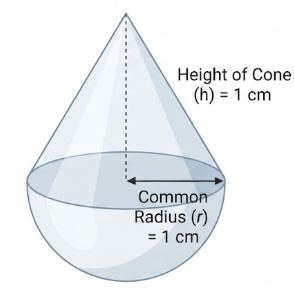
Given:
Radius of hemisphere and cone (r) = 1 cm
Height of cone (h) = r = 1 cm
Volume of solid = Volume of cone + Volume of hemisphere
= (1/3)πr²h + (2/3)πr³
= (1/3)πr²(h + 2r)
= (1/3)π(1)²[1 + 2(1)]
= (1/3)π(1)(3)
= π cm³
Answer: The volume of the solid is π cm³.
2. Rachel, an engineering student, was asked to make a model shaped like a cylinder with two cones attached at its two ends by using a thin aluminium sheet. The diameter of the model is 3 cm and its length is 12 cm. If each cone has a height of 2 cm, find the volume of air contained in the model that Rachel made. (Assume the outer and inner dimensions of the model to be nearly the same.)
Soln:

Given:
Diameter of model = 3 cm => Radius (r) = 3 / 2 = 1.5 cm
Total length of model = 12 cm
Height of each conical part (h₁) = 2 cm
Height of cylindrical part (h₂) = Total length – 2 × (Height of cone)
h₂ = 12 – 2(2) = 12 – 4 = 8 cm
Volume of air inside the model = Volume of cylinder + 2 × (Volume of cone)
= πr²h₂ + 2 × [(1/3)πr²h₁]
= πr²[h₂ + (2/3)h₁]
= (22/7) × (1.5)² × [8 + (2/3) × 2]
= (22/7) × 2.25 × [8 + 4/3]
= (22/7) × (9/4) × (28/3)
= 22 × (3/4) × 4
= 66 cm³
Answer: The volume of air contained in the model is 66 cm³.
3. A gulab jamun, contains sugar syrup up to about 30% of its volume. Find approximately how much syrup would be found in 45 gulab jamuns, each shaped like a cylinder with two hemispherical ends with length 5 cm and diameter 2.8 cm (see Fig. 12.15).
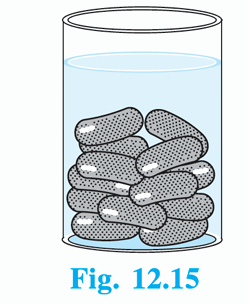
Soln: Given:
Total length of each gulab jamun = 5 cm
Diameter = 2.8 cm => Radius of hemisphere and cylinder (r) = 2.8 / 2 = 1.4 cm
Length of cylindrical part (h) = Total length – 2 × (Radius of hemisphere)
h = 5 – 2(1.4) = 5 – 2.8 = 2.2 cm
Volume of 1 gulab jamun = Volume of cylinder + 2 × (Volume of hemisphere)
= πr²h + 2 × [(2/3)πr³]
= πr²[h + (4/3)r]
= (22/7) × (1.4)² × [2.2 + (4/3) × 1.4]
= (22/7) × 1.96 × [2.2 + 5.6/3]
= 22 × 0.28 × [(6.6 + 5.6)/3]
= 6.16 × (12.2 / 3)
= 75.152 / 3 cm³
Total volume of 45 gulab jamuns = 45 × (75.152 / 3)
= 15 × 75.152
= 1127.28 cm³
Quantity of sugar syrup = 30% of total volume
= (30 / 100) × 1127.28
= 0.30 × 1127.28
= 338.184 cm³ ≈ 338 cm³
Answer: The quantity of sugar syrup found in 45 gulab jamuns is approximately 338 cm³.
SEBA Class 10 Maths Exercise 12.2 Solutions
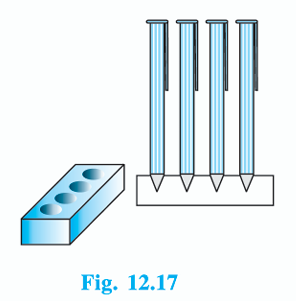
4. A pen stand made of wood is in the shape of a cuboid with four conical depressions to hold pens. The dimensions of the cuboid are 15 cm by 10 cm by 3.5 cm. The radius of each of the depressions is 0.5 cm and the depth is 1.4 cm. Find the volume of wood in the entire stand (see Fig. 12.16).

Soln: Given:
Dimensions of cuboid: Length (l) = 15 cm, Breadth (b) = 10 cm, Height (h) = 3.5 cm
Volume of cuboid = l × b × h
= 15 × 10 × 3.5
= 525 cm³
For each conical depression: Radius (r) = 0.5 cm, Depth (h₁) = 1.4 cm
Volume of 4 conical depressions = 4 × [(1/3)πr²h₁]
= 4 × (1/3) × (22/7) × (0.5)² × 1.4
= 4 × (1/3) × (22/7) × 0.25 × 1.4
= 4 × (1/3) × 22 × 0.25 × 0.2
= 4.4 / 3
≈ 1.47 cm³
Volume of wood in the entire stand = Volume of cuboid – Volume of 4 conical depressions
= 525 – 1.47
= 523.53 cm³
Answer: The volume of wood in the entire stand is 523.53 cm³.
5. A vessel is in the form of an inverted cone. Its height is 8 cm and the radius of its top, which is open, is 5 cm. It is filled with water up to the brim. When lead shots, each of which is a sphere of radius 0.5 cm are dropped into the vessel, one-fourth of the water flows out. Find the number of lead shots dropped in the vessel.
Soln:
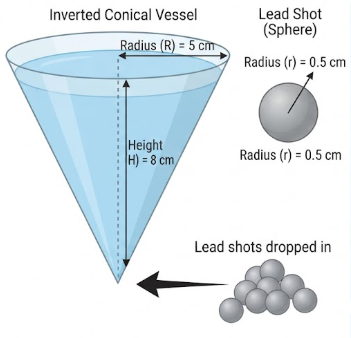
Given:
For inverted conical vessel:
Radius (R) = 5 cm, Height (H) = 8 cm
Volume of water in cone = (1/3)πR²H
= (1/3)π × (5)² × 8
= 200π / 3 cm³
Volume of water flown out = (1/4) × Volume of cone
= (1/4) × (200π / 3)
= 50π / 3 cm³
For spherical lead shots:
Radius of each spherical shot (r) = 0.5 cm
Volume of 1 lead shot = (4/3)πr³
= (4/3)π × (0.5)³
= (4/3)π × 0.125
= 0.5π / 3 cm³
= π / 6 cm³
Number of lead shots = (Volume of water flown out) / (Volume of 1 lead shot)
= (50π / 3) / (0.5π / 3)
= 50 / 0.5
= 100
Answer: The number of lead shots dropped into the vessel is 100.
SEBA HSLC Class 10 Maths Chapter 12 Exercise 12.2 Solved PDF
6. A solid iron pole consists of a cylinder of height 220 cm and base diameter 24 cm, which is surmounted by another cylinder of height 60 cm and radius 8 cm. Find the mass of the pole, given that 1 cm³ of iron has approximately 8g mass. (Use π = 3.14)
Soln:
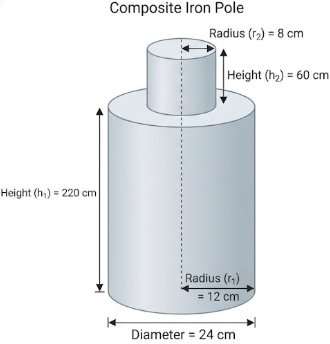
Given:
For bottom large cylinder:
Height (h₁) = 220 cm
Diameter = 24 cm => Radius (r₁) = 24 / 2 = 12 cm
For top small cylinder:
Height (h₂) = 60 cm, Radius (r₂) = 8 cm Density of iron = 8 g/cm³ Take π = 3.14
Volume of solid iron pole = Volume of large cylinder + Volume of small cylinder
= πr₁²h₁ + πr₂²h₂
= π[(r₁²h₁) + (r₂²h₂)]
= 3.14 × [(12)² × 220 + (8)² × 60]
= 3.14 × [144 × 220 + 64 × 60]
= 3.14 × [31680 + 3840]
= 3.14 × 35520
= 111532.8 cm³
Mass of the pole = Volume × Density
= 111532.8 × 8 g
= 892262.4 g
= 892262.4 / 1000 kg
= 892.26 kg
Answer: The mass of the pole is 892.26 kg.
Class 10 Maths Chapter 12.2 Surface Areas and Volumes SEBA 2026-27
7. A solid consisting of a right circular cone of height 120 cm and radius 60 cm standing on a hemisphere of radius 60 cm is placed upright in a right circular cylinder full of water such that it touches the bottom. Find the volume of water left in the cylinder, if the radius of the cylinder is 60 cm and its height is 180 cm.
Soln:

Given:
Radius of cylinder, cone, and hemisphere (r) = 60 cm
Height of cylindrical vessel (H) = 180 cm
Height of conical part (h) = 120 cm
Volume of water originally in cylinder = πr²H
= (22/7) × (60)² × 180
= π × 3600 × 180
= 648000π cm³
Volume of solid = Volume of cone + Volume of hemisphere
= (1/3)πr²h + (2/3)πr³
= (1/3)π(60)²(120) + (2/3)π(60)³
= π × 3600 × 40 + π × 216000 × (2/3)
= 144000π + 144000π
= 288000π cm³
Volume of water left in the cylinder = Volume of cylinder – Volume of solid
= 648000π – 288000π
= 360000π cm³
= 360000 × (22/7)
= 7920000 / 7
= 1131428.57 cm³
In m³:
= 1131428.57 / 1000000
≈ 1.131 m³
Answer: The volume of water left in the cylinder is 1.131 m³ (or 1131428.57 cm³).
8. A spherical glass vessel has a cylindrical neck 8 cm long, 2 cm in diameter; the diameter of the spherical part is 8.5 cm. By measuring the amount of water it holds, a child finds its volume to be 345 cm³. Check whether she is correct, taking the above as the inside measurements, and π = 3.14.
Soln:

Given:
For cylindrical neck: Height (h) = 8 cm
Diameter = 2 cm => Radius (r₁) = 2 / 2 = 1 cm
For spherical part:
Diameter = 8.5 cm => Radius (r₂) = 8.5 / 2 = 4.25 cm
Take π = 3.14
Volume of spherical glass vessel = Volume of cylinder + Volume of sphere
= πr₁²h + (4/3)πr₂³
= π[r₁²h + (4/3)r₂³]
= 3.14 × [(1)² × 8 + (4/3) × (4.25)³]
= 3.14 × [8 + (4/3) × 76.7656]
= 3.14 × [8 + 102.354]
= 3.14 × 110.354
= 346.51 cm³
The child’s measured volume = 345 cm³ Since 346.51 cm³ ≠ 345 cm³, she is incorrect.
Answer: She is incorrect; the correct volume is 346.51 cm³.
9. A cylinder and a cone have equal radii and equal heights. Which of the following are true?
i) Volume of cone = volume of cylinder
ii) Volume of cone = 1/3 × volume of cylinder
iii) Curved surface area of cone = curved surface area of cylinder
iv) Total surface area of cylinder > Total surface area of cone.
Choose the correct option.
a) (i) and (ii)
b) (ii) and (iv)
c) (ii) and (iii)
d) (iii) and (iv)
Soln: Let radius = r and height = h for both cylinder and cone.
Statement (i): Volume of cone = (1/3)πr²h ≠ πr²h. (False)
Statement (ii): Volume of cone = (1/3) × (Volume of cylinder). (True)
Statement (iii): CSA of cone = πrl, CSA of cylinder = 2πrh. Since l = √(r² + h²), πrl ≠ 2πrh in general. (False) Statement (iv): TSA of cylinder = 2πr(r + h) = 2πr² + 2πrh. TSA of cone = πr(r + l) = πr² + πrl.
Since 2πr² > πr² and 2h > √(r² + h²), TSA of cylinder > TSA of cone. (True)
Statements (ii) and (iv) are true.
Answer: b) (ii) and (iv)
SEBA Class 10 Maths Ex 12.2 Question Answer
10. Two statements are given below. Statement (i): The surface area of a cube increases four times when its edge is doubled. Statement (ii): Volume is conserved when a solid is melted and reshaped into a different solid. Choose the correct alternative a) Both st (i) and st (ii) are true b) Both st (i) and st (ii) are false c) St (i) is true but st (ii) is false d) St (i) is false but st (ii) is true.
Soln: Statement (i):
Surface area of a cube of edge ‘a’ is S₁ = 6a².
When the edge is doubled, new edge = 2a.
New surface area S₂ = 6(2a)² = 6(4a²) = 4(6a²) = 4S₁.
Thus, surface area increases four times. (True)
Statement (ii):
When a solid is melted and recast into another solid shape, its volume remains conserved. (True)
Both statement (i) and statement (ii) are true.
Answer: a) Both st (i) and st (ii) are true
11. Surface areas of a cone, cylinder and sphere are found to be numerically equal, which of the following is the correct increasing order of their volumes?
a) sphere < cone < cylinder
b) cone < cylinder < sphere
c) cylinder < sphere < cone
d) cone < sphere < cylinder
Soln: By the isoperimetric property of 3D solids, among solids of equal surface area, a sphere encloses the maximum volume. Between a cylinder and a cone of equal surface area, a cylinder encloses more volume than a cone.
Therefore, for equal surface area:
Volume of cone < Volume of cylinder < Volume of sphere
Answer: b) cone < cylinder < sphere
Class 10 Volume of Combination of Solids Gulab Jamun Lead Shots Solutions
12. A pen stand made of wood is in the shape of a cuboid with four conical depression to hold pens. The dimensions of the cuboid are 15 cm by 10 cm by 3.5 cm. The diameter of each of the conical depression is 1 cm and the depth is 1.4 cm (Fig. 12.17) Based on the above information answer the following questions:
(i) The volume of the cuboid is
(A) 225 cm³
(B) 550 cm³
(C) 525 cm³
(D) 625 cm³
Soln: Given:
Dimensions of cuboid = 15 cm × 10 cm × 3.5 cm
Diameter of each conical depression = 1 cm => Radius (r) = 0.5 cm = 1/2 cm
Depth (h) = 1.4 cm = 7/5 cm
Volume of the cuboid = l × b × h
= 15 × 10 × 3.5
= 525 cm³
Answer: (C) 525 cm³
(ii) The volume of each conical depression is
(A) 11/30 cm³
(B) 11/15 cm³
(C) 11/60 cm³
(D) 30/11 cm³
Soln: Volume of each conical depression = (1/3)πr²h
= (1/3) × (22/7) × (1/2)² × (1.4)
= (1/3) × (22/7) × (1/4) × (7/5)
= 22 / (3 × 4 × 5)
= 11 / 30 cm³
Answer: (A) 11/30 cm³
(iii) The volume of the wood in the stand is
(A) 525 cm³
(B) 523.53 cm³
(C) 532.53 cm³
(D) 523.5 cm³
Soln: Volume of wood in the stand = Volume of cuboid – 4 × (Volume of conical depression)
= 525 – 4 × (11/30)
= 525 – 44/30
= 525 – 1.47
= 523.53 cm³ Answer: (B) 523.53 cm³
(iv) The surface area of the cuboid is
A) 450 cm²
B) 575 cm²
C) 457 cm²
D) 475 cm²
Soln: Surface area of the cuboid = 2(lb + bh + hl)
= 2(15 × 10 + 10 × 3.5 + 15 × 3.5)
= 2(150 + 35 + 52.5)
= 2(237.5)
= 475 cm²
Answer: D) 475 cm²
(v) The surface area of four conical cavities is
A) 8.28 cm²
B) 9.28 cm²
C) 9.82 cm²
D) 9.18 cm²
Soln: Slant height of conical cavity (l) = √(r² + h²)
l = √((0.5)² + (1.4)²)
l = √(0.25 + 1.96)
l = √2.21 ≈ 1.48 cm
Surface area of 4 conical cavities = 4 × πrl
= 4 × (22/7) × 0.5 × 1.48
= 2 × (22/7) × 1.48 ≈ 9.28 cm²
Answer: B) 9.28 cm²
🧊 HSLC Class 10 Maths Exercise 12.2 Notice: This page features the complete, step-by-step SEBA Class 10 Mathematics Chapter 12 (Surface Areas and Volumes) Exercise 12.2 Official Textual Solutions updated for the 2026–27 academic session. Formatted according to the strict HSLC board marking criteria, every numerical problem—from simple sums combining cones and hemispheres (1/3)πr²h + (2/3)πr³ to complex multi-step application problems like the gulab jamun syrup percentage, water displacement by spherical lead shots, and mass-density calculations—is worked out with labeled geometric figures, clear formula substitutions, and complete arithmetic steps to help you secure full marks in your board examinations.
💡 Master SEBA Class 10 Volume & Mensuration:
- Having trouble setting up the ratio of displaced water for the lead shots problem in Question 5, finding the total mass of the compound iron pole in Question 6, or checking if the student’s measurement of $345\text{ cm}^3$ for the spherical vessel with a cylindrical neck in Question 8 is correct? Leave your query in the comments section below!
- Bookmark this page for step-by-step verification and formula review before your unit evaluations, pre-board examinations, and the upcoming HSLC examinations.
- Share this link with your classmates and WhatsApp study groups to make Class 10 Mathematics volume problems simple, visual, and high-scoring!