Looking for complete, step-by-step textbook solutions for SEBA Class 10 Mathematics Chapter 9 (Some Applications of Trigonometry / Heights and Distances – Exercise 9.1) for the 2026–27 academic session? Access verified solutions to all 16 textual questions with labeled geometric figures, line-of-sight analysis, angle of elevation and angle of depression setups, circus artist rope climbing, broken tree touching the ground, contractor slides for children, shadow of a tower, multi-storeyed building comparisons, two poles of equal heights on either side of an 80m road, speed of the aeroplane, and exam-oriented model solutions designed strictly according to the Assam Board (SEBA) HSLC blueprint.
EXERCISE 9
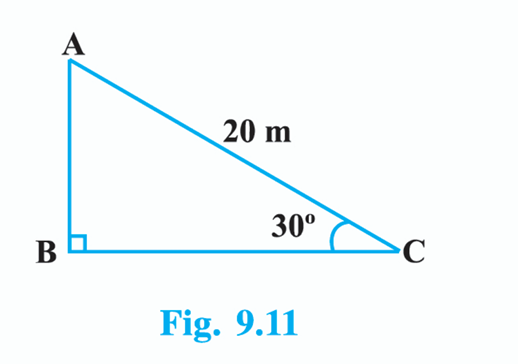
1. A circus artist is climbing a 20 m long rope, which is tightly stretched and tied from the top of a vertical pole to the ground. Find the height of the pole, if the angle made by the rope with the ground level is 30° (see Fig. 9.11).
Soln:
Let AB be the vertical pole and AC be the rope tightly stretched and tied to the ground.
Given:
Length of the rope (AC) = 20 m
Angle made by the rope with ground level, ∠ACB = 30°
∠ABC = 90°
In right-angled triangle ABC:
sin 30° = AB / AC
1/2 = AB / 20
AB = 20 / 2
AB = 10 m
Answer:
The height of the pole is 10 m.
2. A tree breaks due to storm and the broken part bends so that the top of the tree touches the ground making an angle 30° with it. The distance between the foot of the tree to the point where the top touches the ground is 8 m. Find the height of the tree.
Soln:
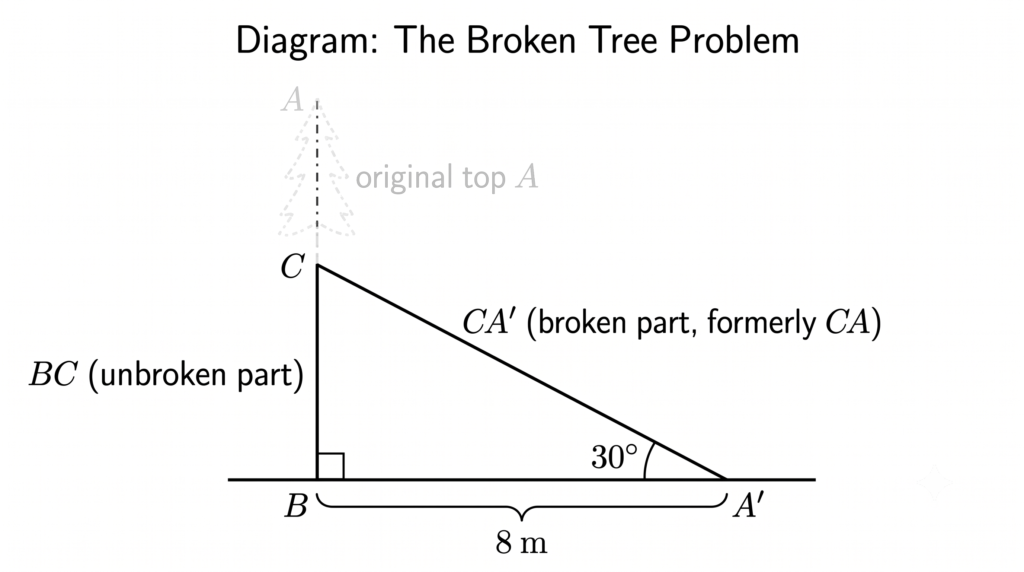
Let AB be the original tree and C be the point where it breaks.
Let A be the top of the tree, which touches the ground at point A’ after breaking.
Therefore:
Height of the unbroken vertical part = BC
Length of the broken part = CA’ = CA
Total height of the tree = BC + CA’
Given:
Distance from the foot of the tree to where the top touches the ground, A’B = 8 m
Angle made by the top with the ground, ∠CA’B = 30°
∠CBA’ = 90°
In right-angled triangle CBA’:
tan 30° = BC / A’B
1/√3 = BC / 8
BC = 8 / √3 m
Also,
cos 30° = A’B / CA’
√3 / 2 = 8 / CA’
CA’ = (8 × 2) / √3
CA’ = 16 / √3 m
Total height of the tree = BC + CA’
= 8/√3 + 16/√3
= 24 / √3
= (24 × √3) / (√3 × √3)
= 24√3 / 3
= 8√3 m
Answer:
The height of the tree is 8√3 m.
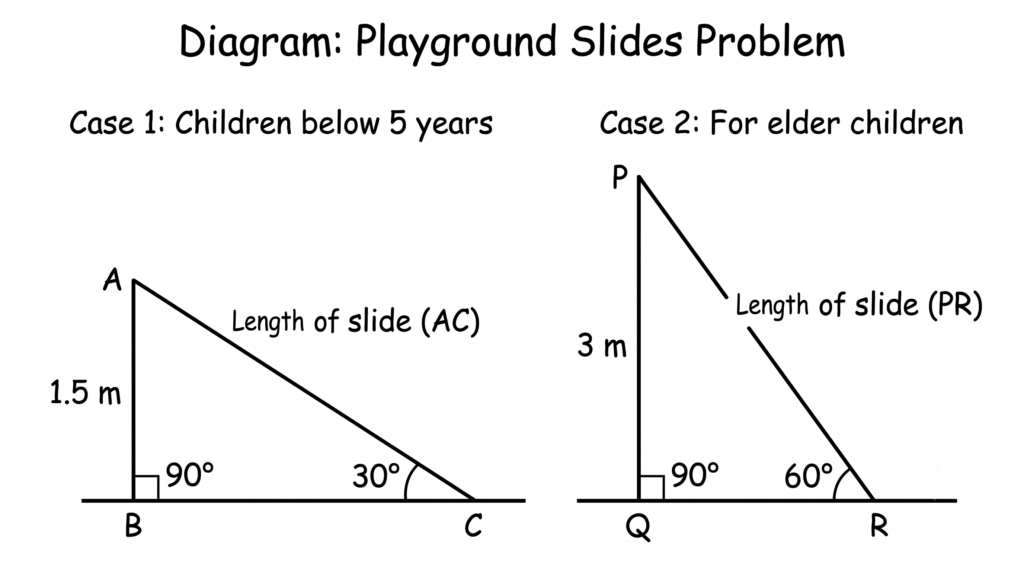
3. A contractor plans to install two slides for the children to play in a park. For the children below the age of 5 years, she prefers to have a slide whose top is at a height of 1.5 m, and is inclined at an angle of 30° to the ground, whereas for elder children, she wants to have a steep slide at a height of 3m, and inclined at an angle of 60° to the ground. What should be the length of the slide in each case?
Soln:
Case 1: For children below 5 years
Let the slide be represented by hypotenuse AC and vertical height by AB.
Given:
Height of slide (AB) = 1.5 m
Angle of inclination, ∠ACB = 30°
∠ABC = 90°
In right-angled triangle ABC:
sin 30° = AB / AC
1/2 = 1.5 / AC
AC = 1.5 × 2
AC = 3 m
Case 2: For elder children
Let the slide be represented by hypotenuse PR and vertical height by PQ.
Given:
Height of slide (PQ) = 3 m
Angle of inclination, ∠PRQ = 60°
∠PQR = 90°
In right-angled triangle PQR:
sin 60° = PQ / PR
√3 / 2 = 3 / PR
PR = (3 × 2) / √3
PR = 6 / √3
PR = (6 × √3) / (√3 × √3)
PR = 6√3 / 3
PR = 2√3 m
Answer:
Length of the slide for children below 5 years = 3 m
Length of the slide for elder children = 2√3 m
4. The angle of elevation of the top of a tower from a point on the ground, which is 30 m away from the foot of the tower, is 30°. Find the height of the tower.
Soln:
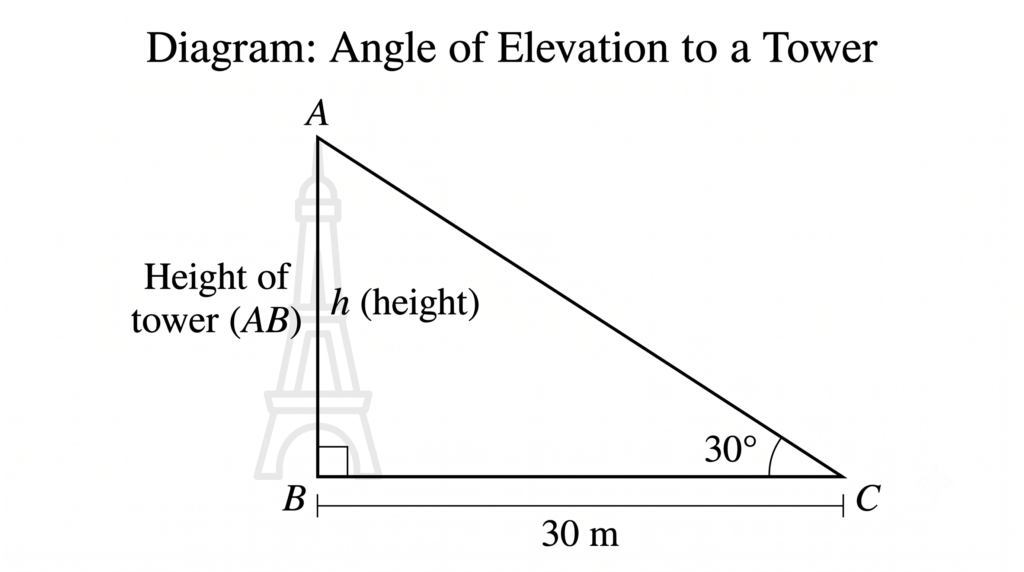
Let AB be the tower of height h and C be the point on the ground.
Given:
Distance from the foot of the tower (BC) = 30 m
Angle of elevation of the top of the tower, ∠ACB = 30°
∠ABC = 90°
In right-angled triangle ABC:
tan 30° = AB / BC
1/√3 = AB / 30
AB = 30 / √3
AB = (30 × √3) / (√3 × √3)
AB = 30√3 / 3
AB = 10√3 m
Answer:
The height of the tower is 10√3 m.
5. A kite is flying at a height of 60 m above the ground. The string attached to the kite is temporarily tied to a point on the ground. The inclination of the string with the ground is 60°. Find the length of the string, assuming that there is no slack in the string.
Soln:
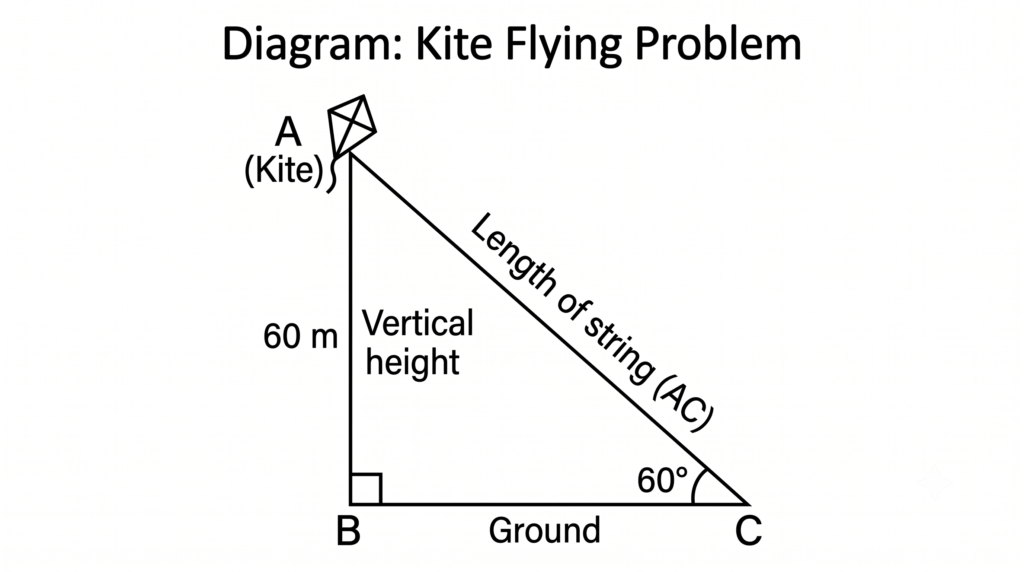
Let K be the kite and AC be the string attached to the ground at point C.
Let AB be the vertical height of the kite above the ground.
Given:
Height of the kite (AB) = 60 m
Angle of inclination of the string, ∠ACB = 60°
∠ABC = 90°
In right-angled triangle ABC:
sin 60° = AB / AC
√3 / 2 = 60 / AC
AC = (60 × 2) / √3
AC = 120 / √3
AC = (120 × √3) / (√3 × √3)
AC = 120√3 / 3
AC = 40√3 m
Answer:
The length of the string is 40√3 m.
SEBA Class 10 Maths Chapter 9 Solutions
6. A 1.5 m tall boy is standing at some distance from a 30 m tall building. The angle of elevation from his eyes to the top of the building increases from 30° to 60° as he walks towards the building. Find the distance he walked towards the building.
Soln:
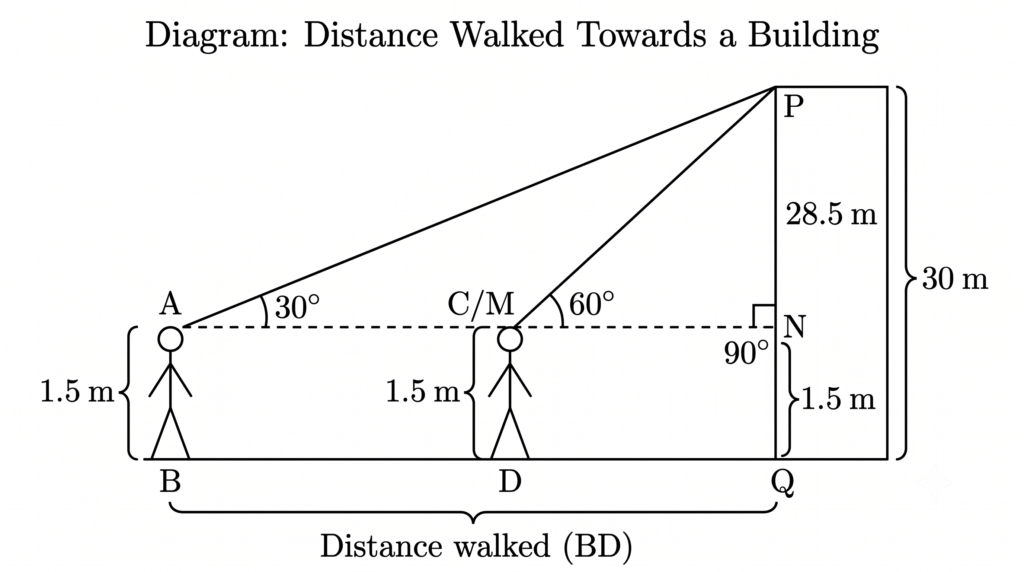
Let the height of the building be PQ = 30 m.
Let the boy be initially at position AB and after walking at position CD, where AB = CD = 1.5 m.
Let the horizontal line of sight be AMN, meeting the building PQ at N.
Therefore:
QN = CD = AB = 1.5 m
PN = PQ – QN = 30 – 1.5 = 28.5 m
Given:
Initial angle of elevation, ∠PAN = 30°
Final angle of elevation, ∠PMN = 60°
Distance walked by the boy = BD = AM
In right-angled triangle PMN:
tan 60° = PN / MN
√3 = 28.5 / MN
MN = 28.5 / √3 m
In right-angled triangle PAN:
tan 30° = PN / AN
1/√3 = 28.5 / AN
AN = 28.5√3 m
Distance walked (AM) = AN – MN
AM = 28.5√3 – (28.5 / √3)
AM = (28.5 × 3 – 28.5) / √3
AM = 28.5 × (3 – 1) / √3
AM = 57 / √3
AM = (57 × √3) / (√3 × √3)
AM = 57√3 / 3
AM = 19√3 m
Answer:
The distance walked towards the building is 19√3 m.
7. From a point on the ground, the angles of elevation of the bottom and the top of a transmission tower fixed at the top of a 20 m high building are 45° and 60° respectively. Find the height of the tower.
Soln:
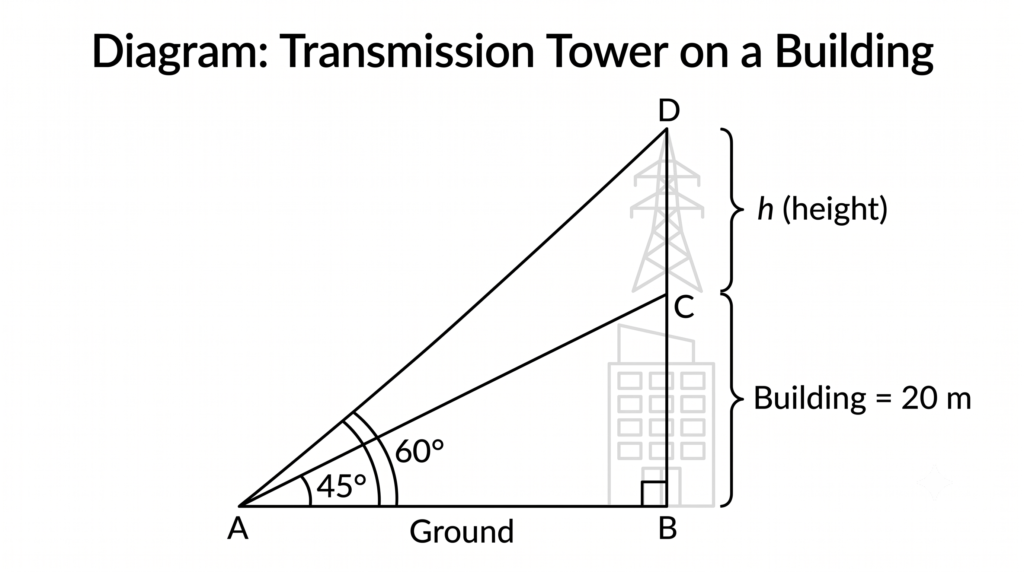
Let BC be the building of height 20 m and CD be the transmission tower of height h fixed on top of it.
Let A be the point on the ground.
Given:
Height of the building (BC) = 20 m
Angle of elevation of the bottom of the tower, ∠BAC = 45°
Angle of elevation of the top of the tower, ∠BAD = 60°
∠B = 90°
In right-angled triangle ABC:
tan 45° = BC / AB
1 = 20 / AB
AB = 20 m
In right-angled triangle ABD:
tan 60° = BD / AB
√3 = (BC + CD) / 20
√3 = (20 + h) / 20
20 + h = 20√3
h = 20√3 – 20
h = 20(√3 – 1) m
Answer:
The height of the transmission tower is 20(√3 – 1) m.
8. A statue, 1.6 m tall, stands on the top of a pedestal. From a point on the ground, the angle of elevation of the top of the statue is 60° and from the same point the angle of elevation of the top of the pedestal is 45°. Find the height of the pedestal.
Soln:
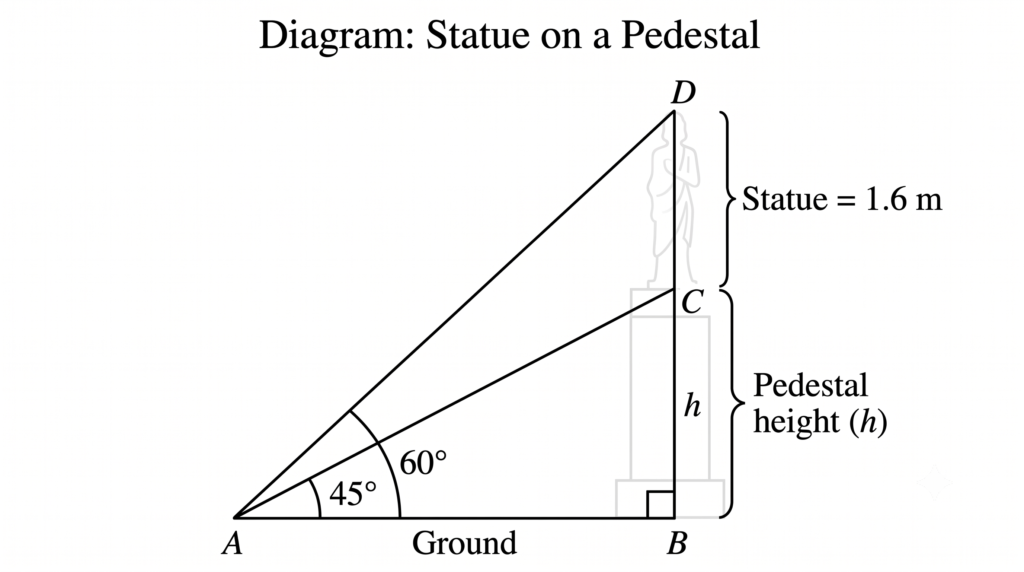
Let BC be the pedestal of height h and CD be the statue of height 1.6 m standing on it.
Let A be the point on the ground.
Given:
Height of statue (CD) = 1.6 m
Angle of elevation of the top of the pedestal, ∠BAC = 45°
Angle of elevation of the top of the statue, ∠BAD = 60°
∠B = 90°
In right-angled triangle ABC:
tan 45° = BC / AB
1 = h / AB
AB = h
In right-angled triangle ABD:
tan 60° = BD / AB
√3 = (BC + CD) / AB
√3 = (h + 1.6) / h
h√3 = h + 1.6
h√3 – h = 1.6
h(√3 – 1) = 1.6
h = 1.6 / (√3 – 1)
h = [1.6 × (√3 + 1)] / [(√3 – 1)(√3 + 1)]
h = [1.6 × (√3 + 1)] / (3 – 1)
h = [1.6 × (√3 + 1)] / 2
h = 0.8(√3 + 1) m
Answer:
The height of the pedestal is 0.8(√3 + 1) m.
9. The angle of elevation of the top of a building from the foot of the tower is 30° and the angle of elevation of the top of the tower from the foot of the building is 60°. If the tower is 50 m high, find the height of the building.
Soln:
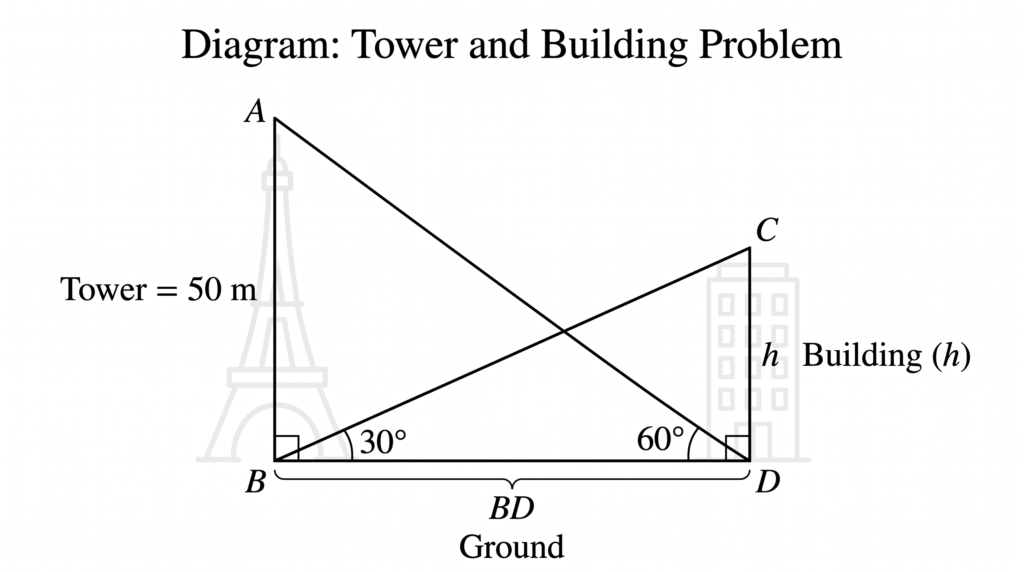
Let AB be the tower of height 50 m and CD be the building of height h.
Let the distance between their bases be BD.
Given:
Height of tower (AB) = 50 m
Angle of elevation of top of building from foot of tower, ∠CBD = 30°
Angle of elevation of top of tower from foot of building, ∠ADB = 60°
∠ABD = 90°, ∠CDB = 90°
In right-angled triangle ABD:
tan 60° = AB / BD
√3 = 50 / BD
BD = 50 / √3 m
In right-angled triangle CDB:
tan 30° = CD / BD
1/√3 = h / BD
h = BD / √3
Substituting BD = 50 / √3:
h = (50 / √3) / √3
h = 50 / 3
h = 16(2/3) m (or 16.67 m)
Answer:
The height of the building is 50/3 m (or 16⅔ m).
10. Two poles of equal heights are standing opposite each other on either side of the road, which is 80 m wide. From a point between them on the road, the angles of elevation of the top of the poles are 60° and 30°, respectively. Find the height of the poles and the distances of the point from the poles.
Soln:
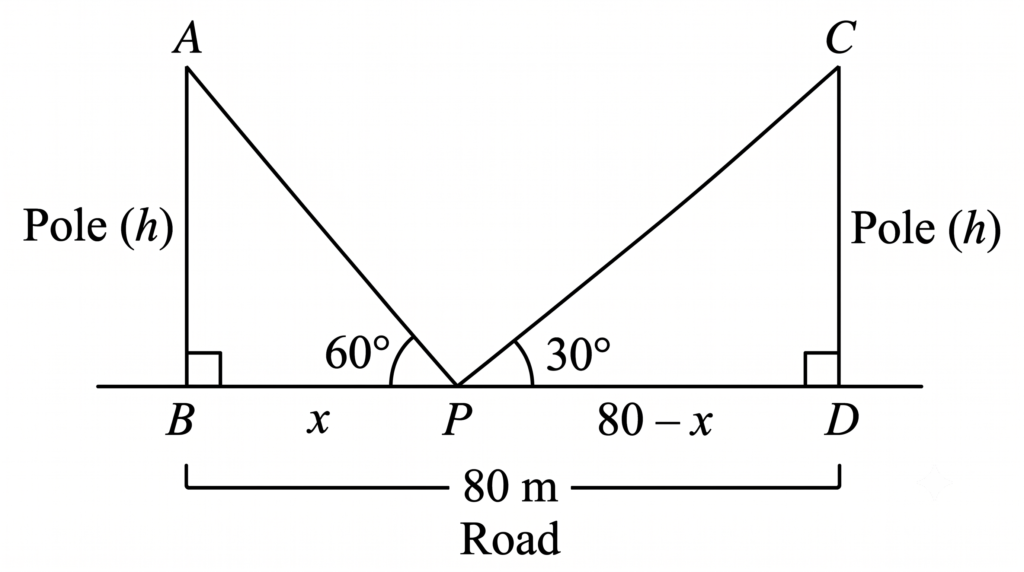
Let AB and CD be the two poles of equal height h standing on opposite sides of road BD.
Given:
Width of road (BD) = 80 m
Let P be the point on the road such that BP = x and PD = 80 – x.
Angles of elevation: ∠APB = 60° and ∠CPD = 30°
∠B = 90°, ∠D = 90°
In right-angled triangle ABP:
tan 60° = AB / BP
√3 = h / x
h = x√3 … (Equation 1)
In right-angled triangle CDP:
tan 30° = CD / PD
1/√3 = h / (80 – x)
h = (80 – x) / √3 … (Equation 2)
Equating Equation 1 and Equation 2:
x√3 = (80 – x) / √3
3x = 80 – x
4x = 80
x = 20 m
Distance BP = 20 m
Distance PD = 80 – 20 = 60 m
From Equation 1:
h = 20√3 m
Answer:
Height of each pole = 20√3 m
Distances of the point from the poles = 20 m and 60 m
Class 10 Maths Chapter 9 Some Applications of Trigonometry SEBA 2026-27
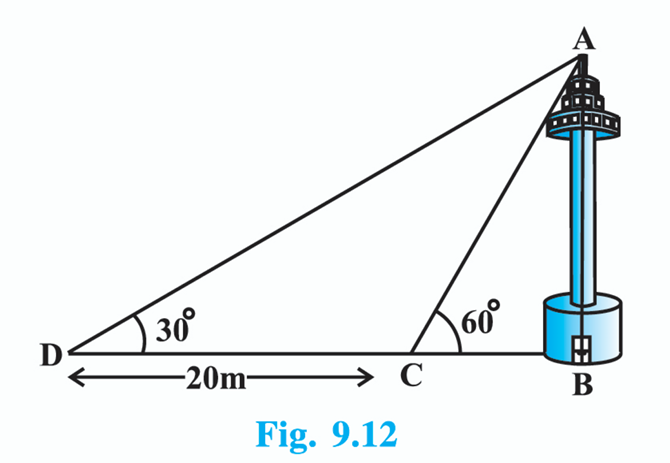
11. A TV tower stands vertically on a bank of a canal. From a point on the other bank directly opposite the tower, the angle of elevation of the top of the tower is 60°. From another point 20 m away from this point on the line joining this point to the foot of the tower, the angle of elevation of the top of the tower is 30° (see Fig. 9.12). Find the height of the tower and the width of the canal.
Soln:
Let AB be the TV tower of height h standing on bank B of the canal.
Let BC be the width of the canal, denoted by x.
Let D be the point 20 m away from C, so CD = 20 m and BD = x + 20.
Given:
∠ACB = 60°
∠ADB = 30°
∠B = 90°
In right-angled triangle ABC:
tan 60° = AB / BC
√3 = h / x
h = x√3 … (Equation 1)
In right-angled triangle ABD:
tan 30° = AB / BD
1/√3 = h / (x + 20)
h = (x + 20) / √3 … (Equation 2)
Equating Equation 1 and Equation 2:
x√3 = (x + 20) / √3
3x = x + 20
2x = 20
x = 10 m
From Equation 1:
h = 10√3 m
Answer:
Height of the tower = 10√3 m
Width of the canal = 10 m
12. From the top of a 7 m high building, the angle of elevation of the top of a cable tower is 60° and the angle of depression of its foot is 45°. Determine the height of the tower.
Soln:
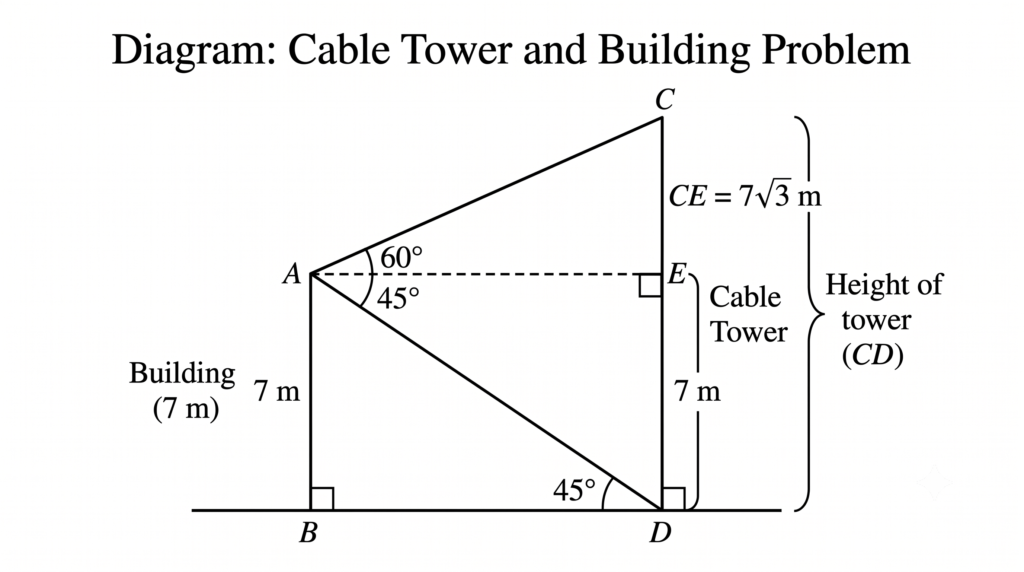
Let AB be the building of height 7 m and CD be the cable tower.
From top of building A, draw a horizontal line AE perpendicular to CD at E.
Therefore:
AB = ED = 7 m
AE = BD Total height of tower (CD) = CE + ED = CE + 7
Given:
Angle of elevation of the top of the tower, ∠CAE = 60°
Angle of depression of the foot of the tower, ∠EAD = ∠ADB = 45°
∠ABD = 90°, ∠CED = 90°
In right-angled triangle ABD:
tan 45° = AB / BD
1 = 7 / BD
BD = 7 m
Therefore, AE = BD = 7 m
In right-angled triangle CEA:
tan 60° = CE / AE
√3 = CE / 7
CE = 7√3 m
Total height of the tower (CD):
CD = CE + ED
CD = 7√3 + 7
CD = 7(√3 + 1) m
Answer:
The height of the cable tower is 7(√3 + 1) m.
13. As observed from the top of a 75 m high lighthouse from the sea-level, the angles of depression of two ships are 30° and 45°. If one ship is exactly behind the other on the same side of the lighthouse, find the distance between the two ships.
Soln:
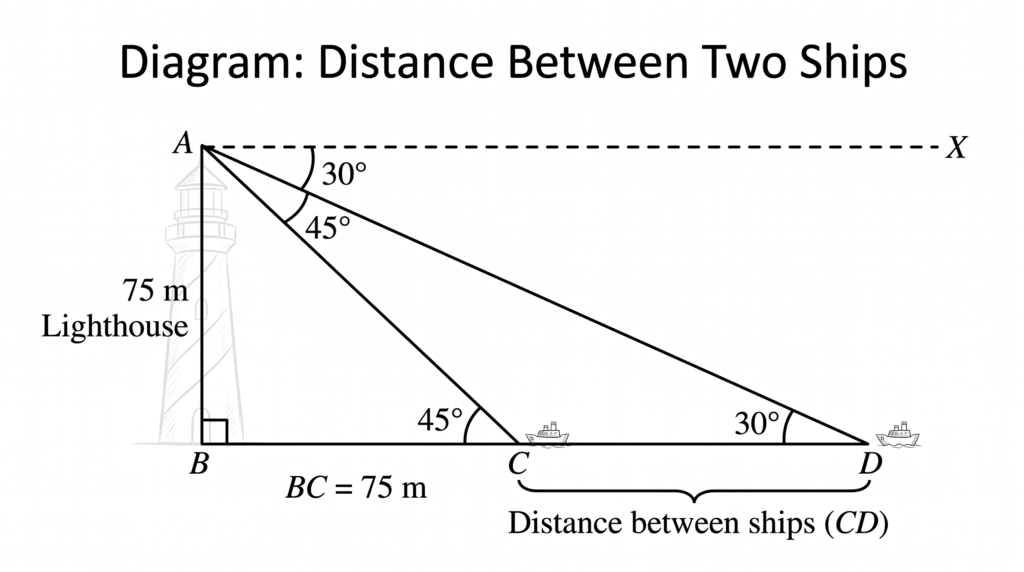
Let AB be the lighthouse of height 75 m.
Let C and D be the positions of the two ships in line with the base B.
Given:
Height of lighthouse (AB) = 75 m
Angles of depression from the top A to ships C and D are 45° and 30° respectively.
By alternate interior angles: ∠ACB = 45° ∠ADB = 30° ∠B = 90°
In right-angled triangle ABC:
tan 45° = AB / BC
1 = 75 / BC
BC = 75 m
In right-angled triangle ABD:
tan 30° = AB / BD
1/√3 = 75 / BD
BD = 75√3 m
Distance between the two ships (CD):
CD = BD – BC
CD = 75√3 – 75
CD = 75(√3 – 1) m
Answer:
The distance between the two ships is 75(√3 – 1) m.
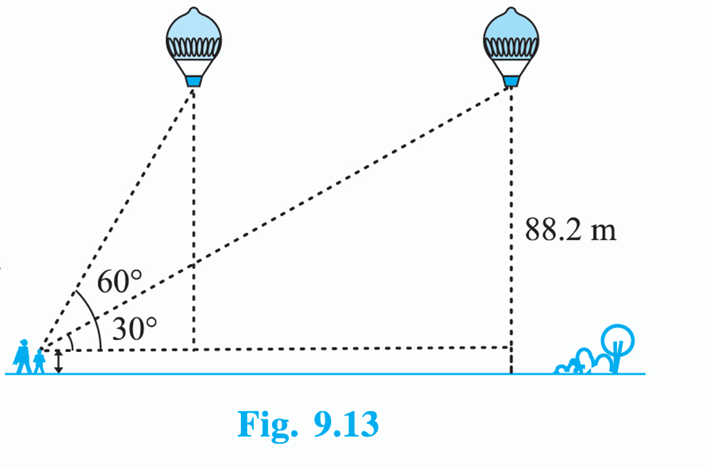
14. A 1.2 m tall girl spots a balloon moving with the wind in a horizontal line at a height of 88.2 m from the ground. The angle of elevation of the balloon from the eyes of the girl at any instant is 60°. After some time, the angle of elevation reduces to 30° (see Fig. 9.13). Find the distance travelled by the balloon during the interval.
Soln:
Let the height of the girl be 1.2 m.
Height of the balloon from the ground = 88.2 m
Height of the balloon above the girl’s eye level (h):
h = 88.2 – 1.2 = 87 m
Let A and B be the two positions of the balloon, and let O be the eye of the girl.
Let horizontal projections from eye level to vertical lines of balloon positions be C and D.
So, AC = BD = 87 m.
Given:
Initial angle of elevation, ∠AOC = 60°
Subsequent angle of elevation, ∠BOD = 30°
In right-angled triangle ACO:
tan 60° = AC / OC
√3 = 87 / OC
OC = 87 / √3
OC = (87 × √3) / 3
OC = 29√3 m
In right-angled triangle BDO:
tan 30° = BD / OD
1/√3 = 87 / OD
OD = 87√3 m
Distance travelled by the balloon = CD = OD – OC
CD = 87√3 – 29√3
CD = 58√3 m
Answer:
The distance travelled by the balloon during the interval is 58√3 m.
15. A straight highway leads to the foot of a tower. A man standing at the top of the tower observes a car at an angle of depression of 30°, which is approaching the foot of the tower with a uniform speed. Six seconds later, the angle of depression of the car is found to be 60°. Find the time taken by the car to reach the foot of the tower from this point.
Soln:
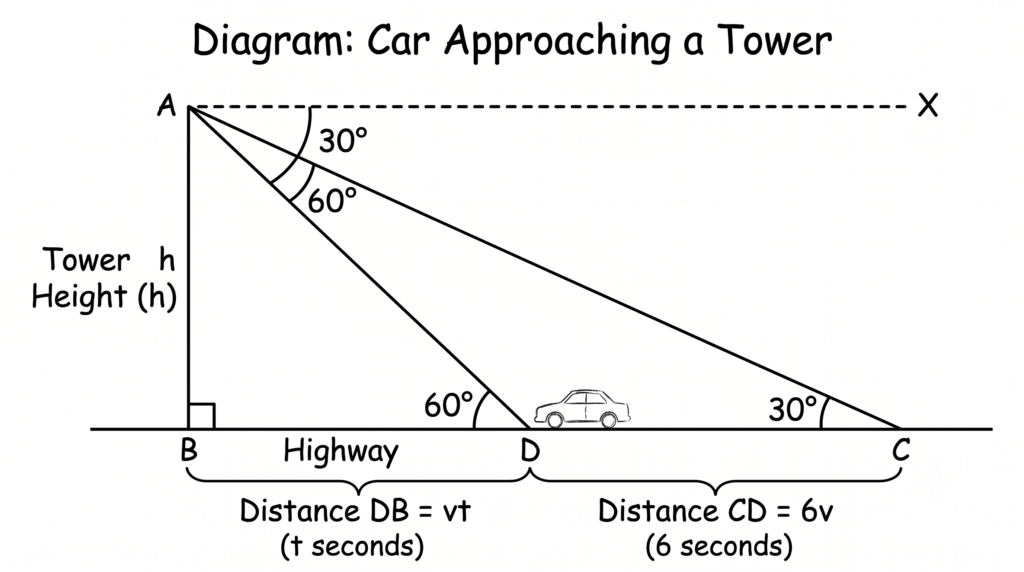
Let AB be the tower of height h.
Let C be the initial position of the car and D be the position 6 seconds later.
Let the uniform speed of the car be v m/s.
Distance travelled in 6 seconds, CD = 6v.
Let the time taken from D to base B be t seconds.
Distance DB = v × t.
Total distance CB = CD + DB = 6v + vt = v(6 + t).
Given:
Angle of depression at C = 30° ⇒ ∠ACB = 30°
Angle of depression at D = 60° ⇒ ∠ADB = 60°
∠B = 90°
In right-angled triangle ABD:
tan 60° = AB / DB
√3 = h / (vt)
h = vt√3 … (Equation 1)
In right-angled triangle ABC:
tan 30° = AB / CB
1/√3 = h / [v(6 + t)]
h = [v(6 + t)] / √3 … (Equation 2)
Equating Equation 1 and Equation 2:
vt√3 = [v(6 + t)] / √3
3vt = v(6 + t)
Since speed v ≠ 0:
3t = 6 + t
2t = 6
t = 3 seconds
Answer:
The time taken by the car to reach the foot of the tower from this point is 3 seconds.
SEBA Class 10 Maths Heights and Distances Exercise 9.1 Question Answer
16. The angles of elevation of the top of a tower from two points at a distance of 4 m and 9 m from the base of the tower and in the same straight line with it are complementary. Prove that the height of the tower is 6 m.
Soln:
Let AB be the tower of height h.
Let C and D be two points on the same straight line from the base B.
Given: BC = 4 m BD = 9 m The angles of elevation are complementary.
Let ∠ACB = θ, then ∠ADB = 90° – θ.
∠B = 90°
In right-angled triangle ABC:
tan θ = AB / BC
tan θ = h / 4 … (Equation 1)
In right-angled triangle ABD:
tan (90° – θ) = AB / BD
cot θ = h / 9 … (Equation 2)
Multiplying Equation 1 and Equation 2:
tan θ × cot θ = (h / 4) × (h / 9)
1 = h² / 36
h² = 36
h = √36
h = 6 m (since height cannot be negative)
Hence proved that the height of the tower is 6 m.
17. A lighthouse stands tall on a cliff by the sea, watching over ships that pass by. One day a ship is seen approaching the shore and from the top of the lighthouse, the angles of depression of the ship are observed to be 30° and 45° as it moves from point P to point Q. The height of the lighthouse is 50 metres. (Fig. 9.14)
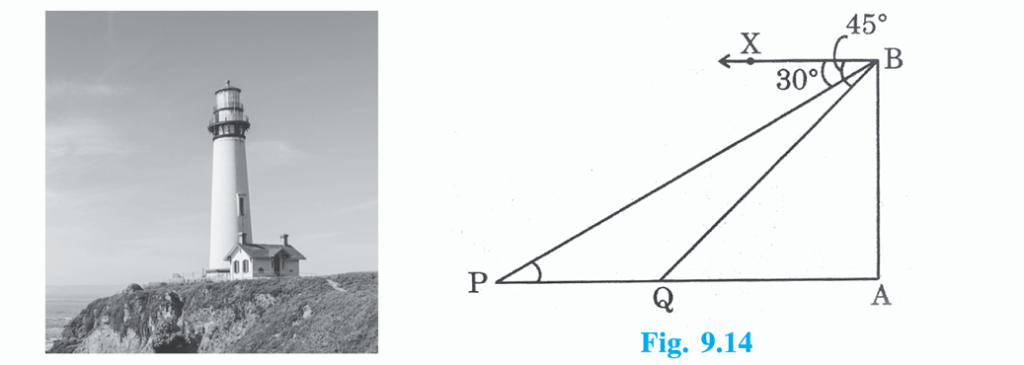
Based on the information given above, answer the following questions:
Soln:
Given:
Height of the lighthouse (AB) = 50 m
Angles of depression to P and Q are 30° and 45° respectively.
Therefore, ∠APB = 30° and ∠AQB = 45° (alternate angles).
∠A = 90°
(i) Find the distance of the ship from the base of the lighthouse when it is at point Q where the angle of depression is 45°
Soln:
In right-angled triangle BAQ:
tan 45° = AB / QA
1 = 50 / QA
QA = 50 m
Answer: The distance of the ship from the base of the lighthouse at point Q is 50 m.
(ii) Find the measures of ∠PBA and ∠QBA
Soln:
In right-angled triangle PAB:
∠PAB = 90°, ∠APB = 30°
Sum of angles of triangle:
∠PBA = 180° – (90° + 30°)
∠PBA = 60°
In right-angled triangle QAB:
∠QAB = 90°, ∠AQB = 45°
Sum of angles of triangle:
∠QBA = 180° – (90° + 45°)
∠QBA = 45°
Answer: ∠PBA = 60° ∠QBA = 45°
(iii) Find the distance travelled by the ship between points P and Q.
Soln:
In right-angled triangle PAB:
tan 30° = AB / PA
1/√3 = 50 / PA
PA = 50√3 m
Distance PQ = PA – QA
PQ = 50√3 – 50
PQ = 50(√3 – 1) m
Using √3 ≈ 1.732:
PQ = 50(1.732 – 1) = 50 × 0.732 = 36.6 m
Answer: The distance travelled between P and Q is 50(√3 – 1) m (or 36.6 m).
(iv) If the ship continues moving towards the shore and takes 10 minutes to travel from Q to A, calculate the speed of the ship in km/h, from Q to A
Soln:
Distance from Q to A = QA = 50 m = 50 / 1000 km = 0.05 km
Time taken (t) = 10 minutes = 10 / 60 hour = 1/6 hour
Speed = Distance / Time
Speed = 0.05 / (1/6)
Speed = 0.05 × 6
Speed = 0.3 km/h
Answer: The speed of the ship from Q to A is 0.3 km/h.
18. A 30 m long rope is tightly stretched and tied from the top of pole to the ground. If the rope makes an angle of 60° with the ground, the height of the pole is :
(a) 10√3m
(b) 30√3m
(c) 15m
(d) 15√3m
Soln:
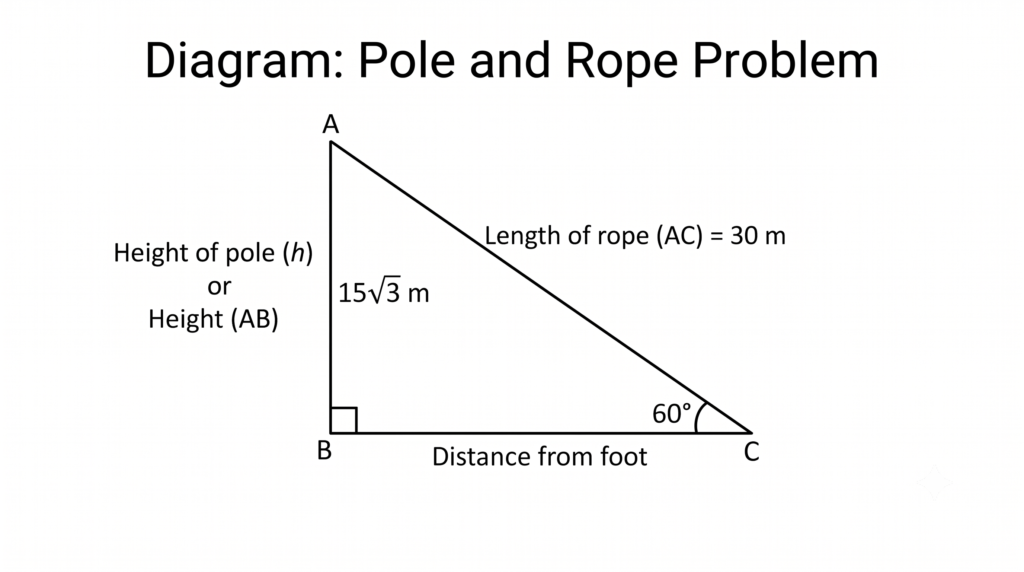
Let AB be the height of the pole and AC be the length of the rope.
Given:
AC = 30 m Angle with ground, θ = 60°
sin 60° = AB / AC
√3 / 2 = AB / 30
AB = (30 × √3) / 2
AB = 15√3 m
Correct Option: (d) 15√3 m
19. If a pole 6 m high casts a shadow 2√3 m long on the ground then sun’s elevation is
(a) 60°
(b) 45°
(c) 30°
(d) 90°
Soln:
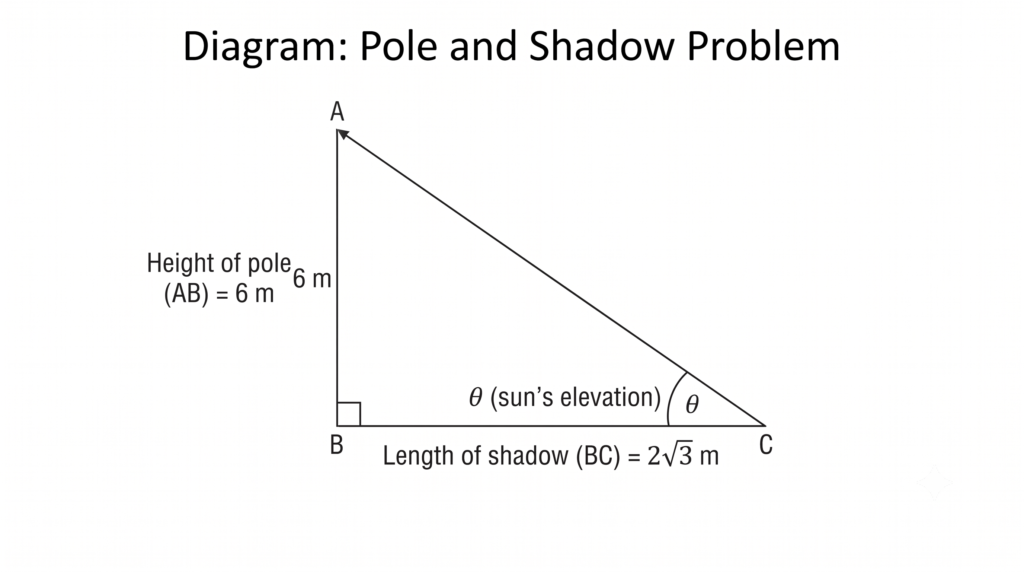
Let height of the pole AB = 6 m
Length of shadow BC = 2√3 m
Let sun’s elevation be θ.
tan θ = AB / BC
tan θ = 6 / (2√3)
tan θ = 3 / √3
tan θ = √3
θ = 60°
Correct Option: (a) 60°
20. The angles of elevation of a tower from two points at a distance of a and b (a > b) from its foot and in the same straight line from it are 30° and 60°, then the height of the tower is
(a) √(a+b)
(b) √(a-b)
(c) √(ab)
(d) √(a/b)
Soln:
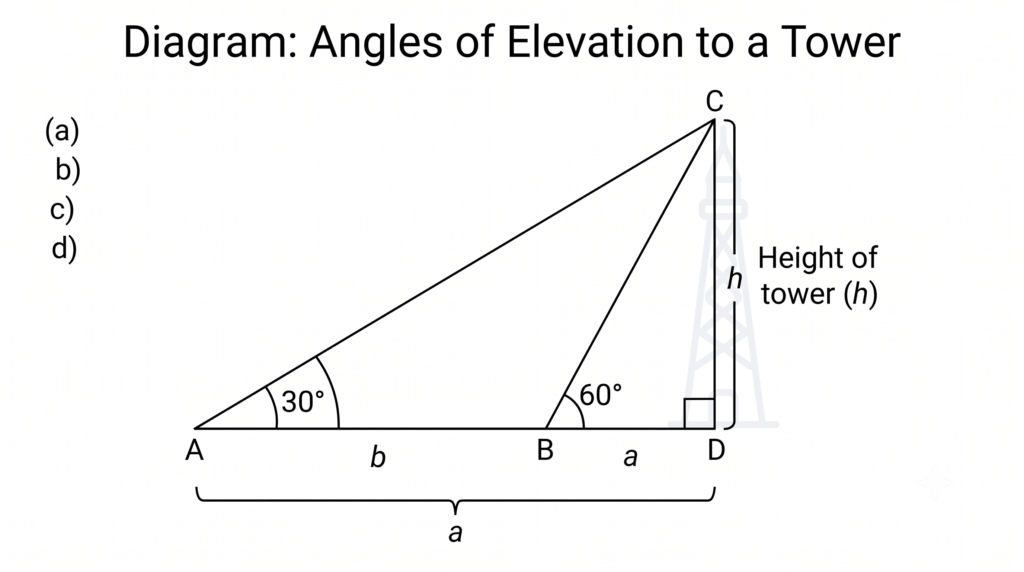
Let the height of the tower be h.
Distances from the foot of the tower are a and b (a > b).
Angles of elevation are 30° and 60°.
Since the point farther away has a smaller angle of elevation:
tan 30° = h / a ⇒ 1/√3 = h / a ⇒ h = a / √3
tan 60° = h / b ⇒ √3 = h / b ⇒ h = b√3
Multiplying both expressions:
h × h = (a / √3) × (b√3)
h² = ab
h = √ab
Correct Option: (c) √ab
SEBA HSLC Class 10 Maths Chapter 9 Solved Textual Questions PDF
21. In the following question a statement of assertion (A) is followed by a statement of reason (R).
Assertion (A) : A ladder leaning against a wall, stands at a horizontal distance of 6m from the wall. If the height of the wall up to which the ladder reaches is 8 m, then the length of the ladder is 10m.
Reason (R) : The ladder makes an angle of 60° with the ground.
Choose the correct option from the given alternatives.
(a) Both Assertion (A) and Reason (R) are true and Reason (R) is the correct explanation of the Assertion (A).
(b) Both Assertion (A) and Reason (R) are true, but Reason (R) is not the correct explanation of the Assertion (A).
(c) Assertion (A) is true, but Reason (R) is false.
(d) Assertion (A) is false, but Reason (R) is true.
Soln:
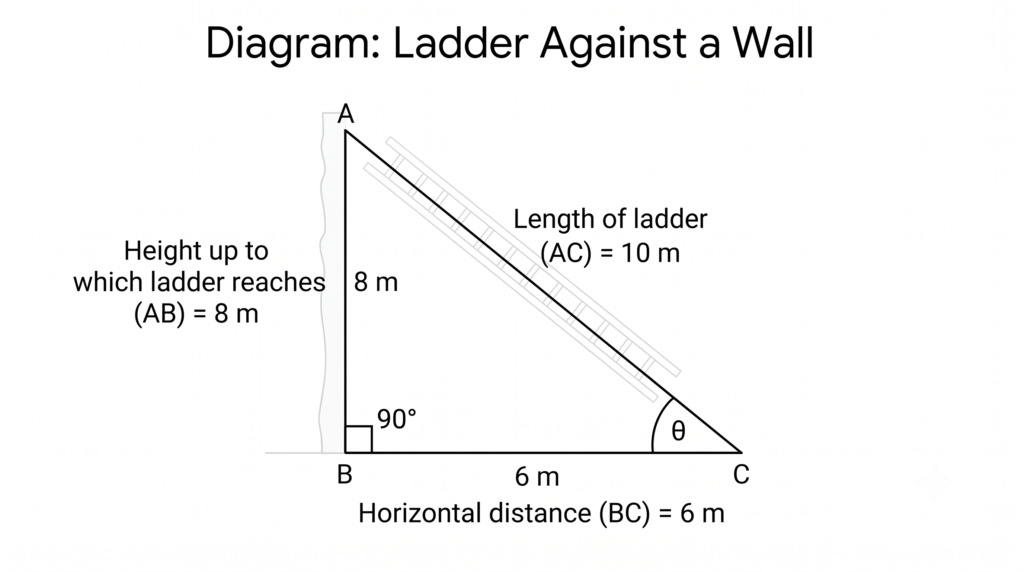
Assertion (A): Horizontal distance (Base) = 6 m
Height on the wall (Perpendicular) = 8 m
Length of the ladder (Hypotenuse) = √(6² + 8²)
= √(36 + 64)
= √100
= 10 m
Assertion (A) is TRUE.
Reason (R): If angle with ground is θ:
tan θ = Perpendicular / Base = 8 / 6 = 4/3 ≠ tan 60° (which is √3 ≈ 1.732)
Therefore, θ ≠ 60°. Reason (R) is FALSE.
Correct Option: (c) Assertion (A) is true, but Reason (R) is false.
22. Statement (i) : If the angle of elevation of the top a tower from a point on the ground 100 m away from the foot of the tower is 30° then height of the tower is 100√3m.
Statement (ii) : If the length of the shadow of a vertical pole is equal to its height then the angle of elevation of Sun’s altitude is 45°.
Choose the correct alternatives
(a) Both the statements (i) and (ii) are correct.
(b) Both the statements (i) and (ii) are incorrect.
(c) Statement (i) is correct but statement (ii) in incorrect.
(d) Statement (i) is incorrect but statement (ii) is correct.
Soln:
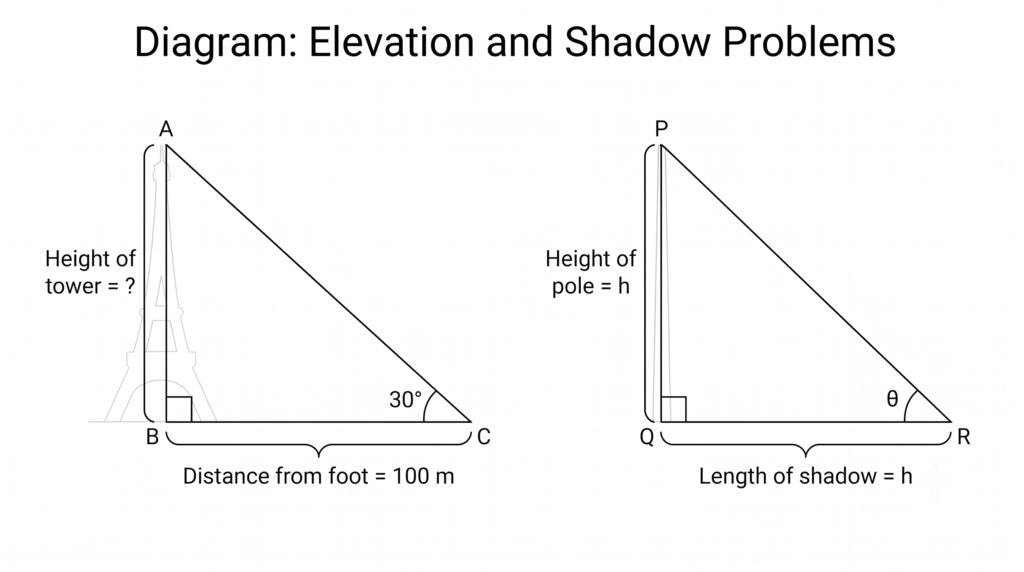
Statement (i): Distance from foot = 100 m
Angle of elevation = 30°
tan 30° = Height / 100
1/√3 = Height / 100
Height = 100 / √3
m ≠ 100√3 m
Statement (i) is INCORRECT.
Statement (ii): Length of shadow = Height of pole
tan θ = Height / Shadow = 1 θ = 45°
Statement (ii) is CORRECT.
Correct Option: (d) Statement (i) is incorrect but statement (ii) is correct.
📐 HSLC Class 10 Maths Chapter 9 Notice: This page features the complete, step-by-step SEBA Class 10 Mathematics Chapter 9 (Some Applications of Trigonometry) Exercise 9.1 Official Textual Solutions updated for the 2026–27 academic session. Formatted according to the standard HSLC board evaluation format, every solution is worked out with clean geometric diagrams, explicit right-triangle selections (triangle ABC, triangle ABD), standard trigonometric ratios (tan 30 degrees, tan 45 degrees, tan 60 degrees), and exact rationalized radical values (square root of 3 ≈ 1.732)—covering broken trees, two poles on road sides, lighthouse ships, and cloud reflections—to ensure you secure full marks in your board examinations.
💡 Master SEBA Class 10 Heights and Distances:
- Having trouble setting up the simultaneous trigonometric equations for Question 10 (two poles of equal heights across an 80m road) or Question 15 (a straight highway leading to the foot of a tower with moving cars)? Drop your question in the comments section below!
- Bookmark this page for quick step-by-step diagram verification and formula review before your unit tests, pre-board exams, and the upcoming HSLC examinations.
- Share this link with your classmates and WhatsApp study groups to make Class 10 Trigonometry problem solving fast, visual, and accurate!