Looking for comprehensive PGDCA (Post Graduate Diploma in Computer Applications) notes on Software Applications for the 2026–27 academic session? Access complete theory explanations, real-world use cases, short notes, long analytical answers, objective MCQs, and exam-oriented solutions covering office productivity tools (Word Processing, Spreadsheets, Presentations), enterprise software applications (ERP, CRM, Billing and Accounting Systems), Web-based and Cloud applications, Multimedia software, and Database application environments tailored for university diploma exams.
Software Applications
Introduction to Modern Software Applications
Software Applications power modern business operations, communication networks, digital education platforms, and personal productivity workflows across the globe.
Major Real-World Domains
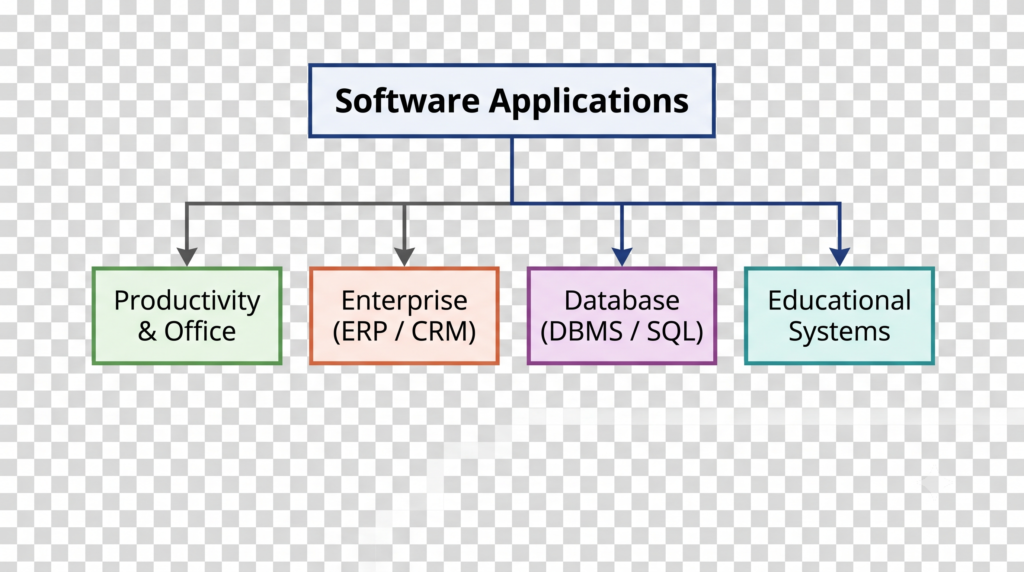
1. Enterprise Software Systems
Large-scale organizational platforms designed to coordinate multi-department operations:
- Enterprise Resource Planning (ERP): Integrated tracking for inventory, finance, and logistics (e.g., SAP, Tally).
- Customer Relationship Management (CRM): Manages client leads, support requests, and sales pipelines (e.g., Salesforce).
2. Database Management Systems (DBMS)
Software engines built to securely store, search, update, and manage large structured data sets:
- Relational Systems (RDBMS): MySQL, PostgreSQL, Oracle DB.
- NoSQL Systems: MongoDB, Cassandra.
PGDCA Software Applications Notes
3. Educational & E-Learning Platforms
Platforms designed for academic delivery, course distribution, and interactive training:
- Learning Management Systems (LMS): Moodle, Google Classroom.
- Interactive Training: Simulation tools, online exam systems.
Key Summary
Modern applications transform basic hardware into specialized tools capable of handling complex financial, educational, and communication tasks across interconnected networks.
Here are 5 short-answer questions and answers (worth 2 to 3 marks each) for all 10 modules, formatted as ready-to-publish WordPress content.
Question and Answer
Q1: What is an Enterprise Resource Planning (ERP) system? (2 Marks)
Answer: An ERP system is enterprise software that integrates core business processes—including inventory, finance, human resources, manufacturing, and supply chain management—into a single unified system (e.g., SAP, Tally Prime).
PGDCA Office Productivity and Business Tools Solutions 2026-27
Q2: Differentiate between Relational (RDBMS) and NoSQL databases with examples. (3 Marks)
Answer:
- Relational Database (RDBMS): Stores data in structured tables using rows, columns, and defined schemas, queried using SQL (e.g., MySQL, PostgreSQL).
- NoSQL Database: Stores data in non-tabular formats such as JSON documents, key-value pairs, or graphs, allowing flexible schema designs (e.g., MongoDB).
Q3: What is a Learning Management System (LMS)? Mention one common feature. (2 Marks)
Answer: An LMS is a software platform designed to manage, deliver, track, and assess educational courses and training programs online (e.g., Google Classroom, Moodle).
- Feature: Automated assignment submissions, grading pipelines, and course material distribution.
PGDCA Enterprise and Web Applications Important Questions
Q4: Explain the role of CRM (Customer Relationship Management) software. (2 Marks)
Answer: CRM software helps businesses track and manage customer interactions, organize lead sales pipelines, automate customer support workflows, and store historical client communication data (e.g., Salesforce).
Q5: What is the main difference between general productivity apps and specialized industry applications? (3 Marks)
Answer:
- General Productivity Apps: Designed for common everyday tasks performed across all industries, such as writing letters, building spreadsheets, or sending emails (e.g., MS Word, Gmail).
- Specialized Industry Applications: Engineered with tools tailored for narrow professional fields, such as 3D structural modeling in architecture or medical imaging diagnostics in healthcare (e.g., AutoCAD, PACS imaging tools).
Software Applications PGDCA Syllabus Question Answer
💼 PGDCA Exam Preparation Notice: This page provides curated PGDCA (Post Graduate Diploma in Computer Applications) Software Applications Study Material & Solutions updated for the 2026–27 academic session. This complete guide features functional software application classification trees, standalone vs. cloud-native application architectures, enterprise software workflow models, productivity tool evaluations, and high-yield exam questions designed to help you secure top marks in your semester examinations.
💡 Master PGDCA Software Applications & Applied Computing:
- Need clarification on enterprise ERP modules, desktop vs. SaaS web application architecture, or database integration in modern office suites? Drop your query in the comments section below!
- Save and bookmark this study guide for quick revision right before your semester examinations.
- Share this link with your fellow PGDCA batchmates and study groups to help everyone master applied computer software!