Looking for accurate SEBA Class 9 Maths Revision Chapter 1 (R-1) textual solutions for the 2026–27 academic year? Access complete step-by-step solutions covering fundamental arithmetic review, prime factorization, HCF and LCM calculations, simplification of algebraic expressions, fraction operations, and percentage problems to build a strong foundation for Class 9 mathematics.
Exercise – R-1
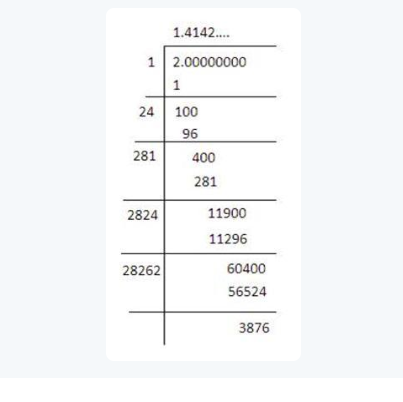
1. Find the value of √2 upto two decimal places using square root.

2. Write two irrational numbers whose sum and product are rational.
soln: Let two irrational numbers be 2 + √3 and 2 – √3.
Sum:
= (2 + √3) + (2 – √3)
= 2 + 2
= 4 (Rational)
Product:
= (2 + √3)(2 – √3)
= (2)² – (√3)²
= 4 – 3
= 1 (Rational)
3. Write all integers between -5 and 5 with the help of number line.
soln: Integers between -5 and 5:
<—|—|—|—|—|—|—|—|—|—|—|—>
-5 -4 -3 -2 -1 0 1 2 3 4 5
The integers lying between -5 and 5 are: -4, -3, -2, -1, 0, 1, 2, 3, 4
4. In the property of indices aᵐ ÷ aⁿ = aᵐ⁻ⁿ, taking m = n, show that a⁰ = 1
soln: Given property:
aᵐ ÷ aⁿ = aᵐ⁻ⁿ
Putting m = n:
aⁿ ÷ aⁿ = aⁿ⁻ⁿ
aⁿ / aⁿ = a⁰
1 = a⁰
∴ a⁰ = 1
5. In the property of indices aᵐ ÷ aⁿ = aᵐ⁻ⁿ, taking m = 0, show that a⁻ⁿ = 1/aⁿ
soln: Given property:
aᵐ ÷ aⁿ = aᵐ⁻ⁿ
Putting m = 0:
a⁰ ÷ aⁿ = a⁰⁻ⁿ
a⁰ / aⁿ = a⁻ⁿ
1 / aⁿ = a⁻ⁿ [∵ a⁰ = 1]
∴ a⁻ⁿ = 1 / aⁿ
SEBA Class 9 Maths Revision 1 Solutions
6. Find LCM and HCF of the following pairs of numbers using prime factorisation method.
(i) 321, 396
soln: Prime factorisation:
321 = 3 × 10⁷
396 = 2² × 3² × 11
HCF = 3
LCM = 2² × 3² × 11 × 107
LCM = 4 × 9 × 11 × 107
LCM = 42372
(ii) 455, 42
soln: Prime factorisation:
455 = 5 × 7 × 13
42 = 2 × 3 × 7
HCF = 7
LCM = 2 × 3 × 5 × 7 × 13
LCM = 2730
(iii) 408, 170
soln: Prime factorisation:
408 = 2³ × 3 × 17
170 = 2 × 5 × 17
HCF = 2 × 17 = 34
LCM = 2³ × 3 × 5 × 17
LCM = 8 × 3 × 5 × 17
LCM = 2040
7. Write two rational numbers between 2/11 and 1/6
soln: Given fractions: 2/11 and 1/6
LCM of denominators 11 and 6 = 66
2/11 = (2×6)/(11×6) = 12/66
1/6 = (1×11)/(6×11) = 11/66
Multiply numerators and denominators by 3:
12/66 = (12×3)/(66×3) = 36/198
11/66 = (11×3)/(66×3) = 33/198
Two rational numbers between 33/198 and 36/198 are:
34/198, 35/198
= 17/99, 35/198
8. Simplify √10 × √5 and find its approximate value taking √2 = 1.41.
soln: √10 × √5
= √(10×5)
= √50
= √(25×2)
= 5√2
Given √2 = 1.41:
= 5 × 1.41
= 7.05
Class 9 Maths Revision Chapter 1 Question Answer SEBA 2026-27
9. Express in p/q form
(i) 0.81 with 81 recurring (0.81 dot)
soln: 0.81 with 81 recurring
Let x = 0.818181… —(1)
100x = 81.8181… —(2)
Subtracting (1) from (2):
99x = 81
x = 81/99
x = 9/11
(ii) 0.18 with 8 recurring
soln: 0.18 with 8 recurring
Let x = 0.1888… —(1)
10x = 1.888… —(2)
100x = 18.888… —(3)
Subtracting (2) from (3):
90x = 17
x = 17/90
(iii) 2.47 with 7 recurring
soln: 2.47 with 7 recurring
Let x = 2.4777… —(1)
10x = 24.777… —(2)
100x = 247.777… —(3)
Subtracting (2) from (3):
90x = 223
x = 223/90
(iv) 2.4431 with 31 recurring
soln: 2.4431 with 31 recurring
Let x = 2.44313131… —(1)
100x = 244.313131… —(2)
10000x = 24431.313131… —(3)
Subtracting (2) from (3):
9900x = 24187
x = 24187/9900
10. Simplify :
(i) (√3 – √2)²
= (√3)² – 2(√3)(√2) + (√2)²
= 3 – 2√6 + 2
= 5 – 2√6
(ii) (2√3 + √5)(2√3 – √5)
= (2√3)² – (√5)²
= (4×3) – 5
= 12 – 5
= 7
(iii) (8 + √3) × (2 + √3)
= 8(2 + √3) + √3(2 + √3)
= 16 + 8√3 + 2√3 + 3
= 19 + 10√3
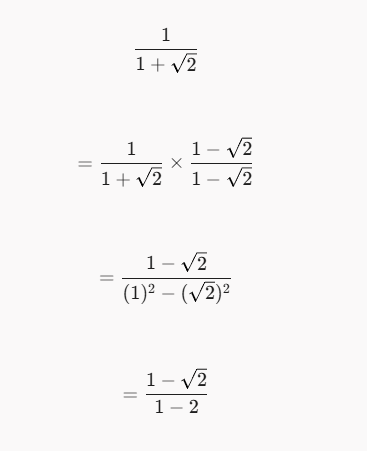
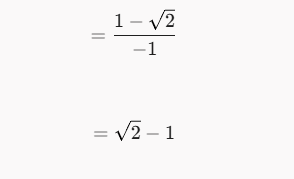
(iv) 1/(1 + √2)
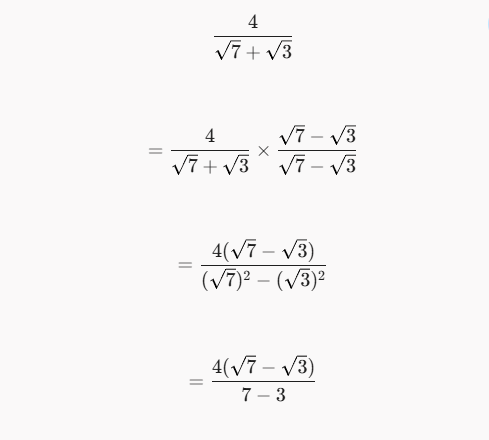
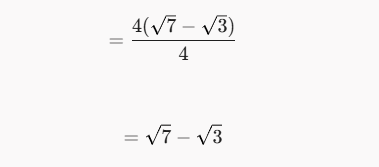
(v) 4/(√7 + √3)
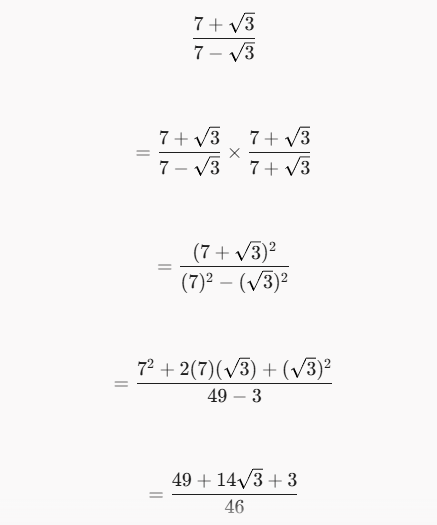
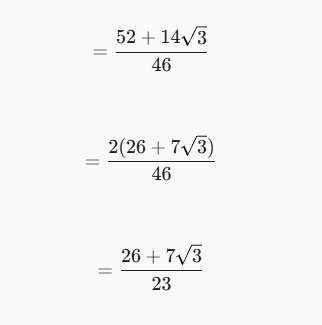
(vi) (7 + √3)/(7 – √3)
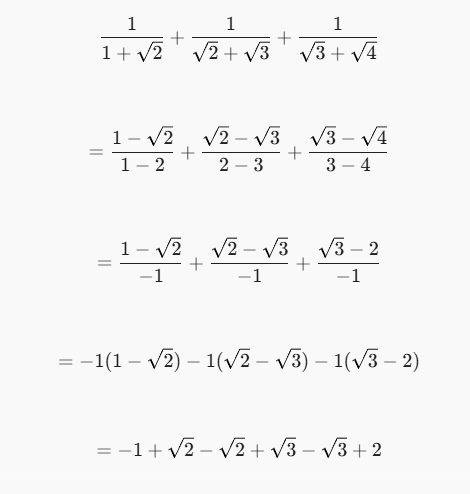
(vii) 1/(1 + √2) + 1/(√2 + √3) + 1/(√3 + √4)
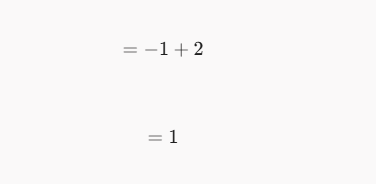
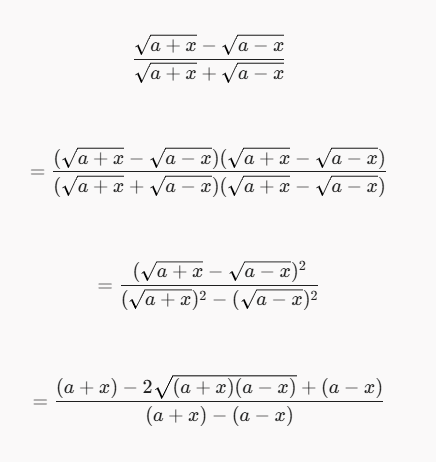
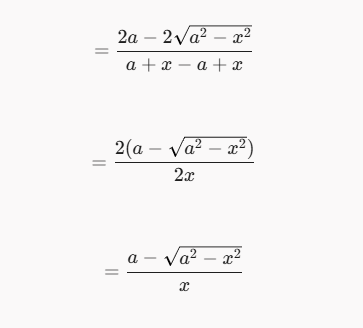
(viii) (√(a+x) – √(a-x)) / (√(a+x) + √(a-x))
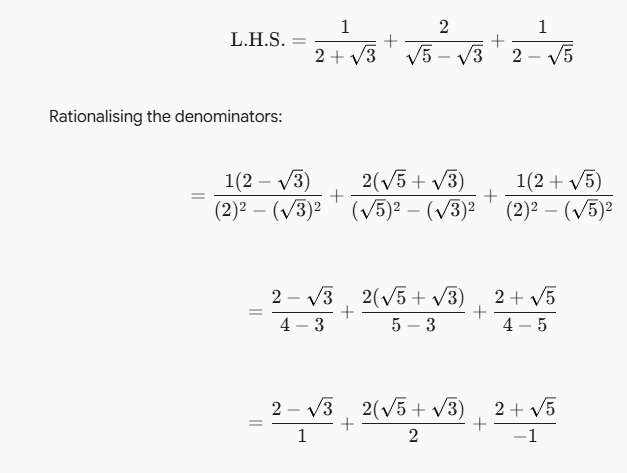
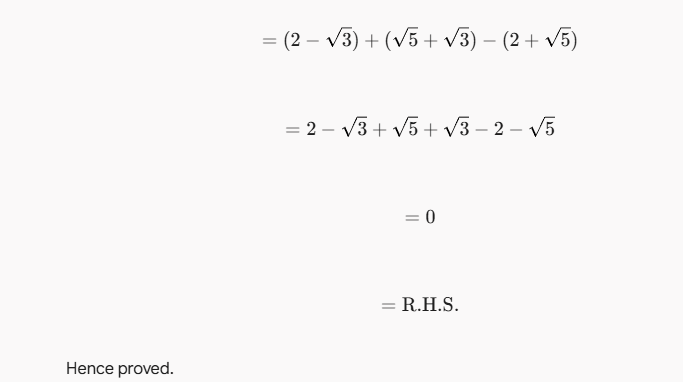
11. Prove that : 1/(2 + √3) + 2/(√5 – √3) + 1/(2 – √5) = 0
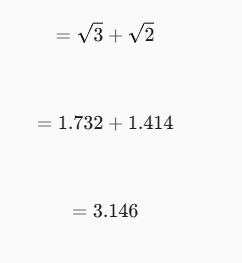
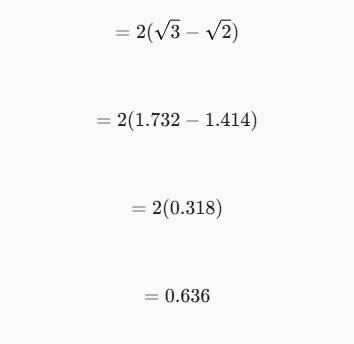
12. Taking √3 = 1.732, √2 = 1.414, find the approximate values of the following.
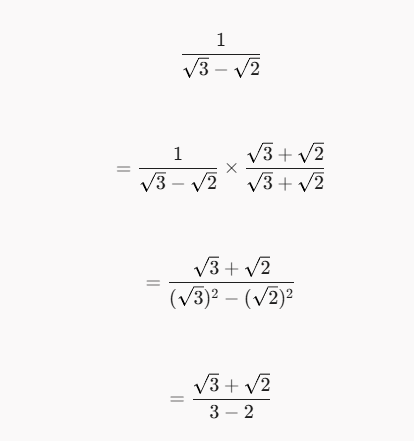
(i) 1/(√3 – √2)
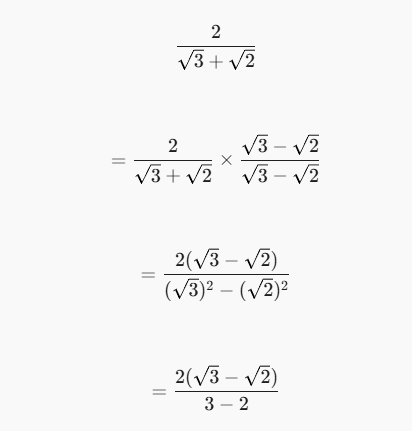
(ii) 2/(√3 + √2)
Class 9 Maths R-1 Solutions SEBA Board
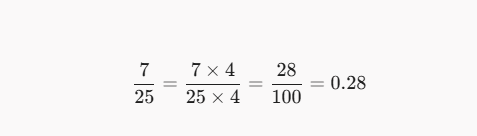
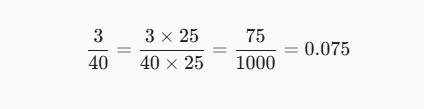
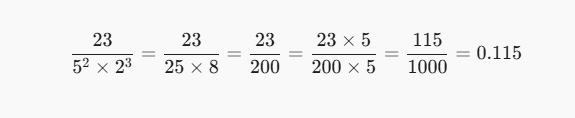
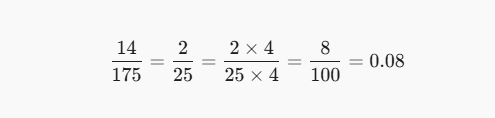
13. Without doing actual division, express the following rational numbers in decimal. [For example : 2/25 = (2 × 4)/(25 × 4) = 4/100 = 0.04]
(i) 7/25
(ii) 3/40
(iii) 3/100

(iv) 23/(5² × 2³)
(v) 14/175
14. Express the following percentages in fractions :
(i) 53%
53% = 53/100
(ii) 50%
50% = 50/100 = 1/2
(iii) (1/2)%
1/2% = (1/2)/100 = 1/200
(iv) 100%
100% = 100/100 = 1
(v) 0.01%
0.01% = 0.01/100 = 1/10000
15. Express the following fractions in percentages :
(i) 1/2
soln: 1/2 = (1/2 × 100)% = 50%
(ii) 50
soln: 50 = (50 × 100)% = 5000%
(iii) 1/4
soln: 1/4 = (1/4 × 100)% = 25%
(iv) 3/20
soln: 3/20 = (3/20 × 100)% = 15%
(v) 42/125
soln: 42/125 = (42/125 × 100)% = 168/5% = 33.6%
(vi) 0.25
soln: 0.25 = (0.25 × 100)% = 25%
(vii) 1.25
soln: 1.25 = (1.25 × 100)% = 125%
16. An object is sold at a profit of 10%. What is the ratio of its cost price to sale price?
soln: Let Cost Price (CP) = 100
Profit = 10%
Selling Price (SP) = 100 + 10 = 110
Ratio of CP to SP = CP/SP = 100/110 = 10/11
Therefore CP : SP = 10 : 11
SEBA Class 9 Maths Chapter R1 Textbook Answers
17. The cost price of 30 eggs is equal to the sale price of 20 eggs. What is the percentage of profit?
soln: Given:
CP of 30 eggs = SP of 20 eggs
Let CP of 1 egg = Re.1
CP of 20 eggs = Rs.20
SP of 20 eggs = CP of 30 eggs = Rs.30
Profit = SP – CP = 30 – 20 = Rs.10
Profit % = (Profit/CP × 100)%
Profit % = (10/20 × 100)% = 50%
18. The cost price of an object is Rs. 2100. What is the sale price if it is sold with a profit of 10%?
soln: CP = Rs.2100
Profit % = 10%
Profit = 10% of 2100 = 10/100 × 2100 = Rs.210
Selling Price (SP) = CP + Profit
SP = 2100 + 210 = Rs.2310
19. Lemons are sold with 20% profit after buying 4 in Re. 1. What is the sale price of 1 lemon?
soln: CP of 4 lemons = Re.1
CP of 1 lemon = Re.1/4 = Re.0.25
Profit % = 20%
SP of 1 lemon = CP × (1 + Profit%/100)
SP = 1/4 × (1 + 20/100)
SP = 1/4 × 6/5 = Re.3/10 = Re.0.30 (or 30 paise)
20. If an object is sold at Rs. 500, there is a loss of 5%. At what price it should be sold to gain a profit of 5%?
soln: When SP = Rs.500, Loss % = 5%
CP = SP × 100 / (100 – Loss%)
CP = 500 × 100 / (100 – 5) = 50000/95 = Rs.10000/19
To gain 5% profit:
New SP = CP × (100 + Gain%)/100
New SP = 10000/19 × 105/100
New SP = 100 × 105 / 19 = Rs.10500/19 ≈ Rs.552.63
Class 9 Maths Revision 1 HCF LCM and Fractions
21. To attract customers a businessman offers a series of discounts at 10%, 10% and 5% respectively. What is equivalent discount of these three discounts?
soln: Let Marked Price (MP) = 100
Successive discounts: d₁ = 10%, d₂ = 10%, d₃ = 5%
Selling Price = MP × (1 – d₁/100) × (1 – d₂/100) × (1 – d₃/100)
SP = 100 × (1 – 10/100) × (1 – 10/100) × (1 – 5/100)
SP = 100 × 90/100 × 90/100 × 95/100
SP = 90 × 90 × 95 / 10000 = 769500/10000 = 76.95
Equivalent Discount = MP – SP
Equivalent Discount = 100 – 76.95 = 23.05%
📐 Updated Solutions Notice: This page features complete, step-by-step SEBA Class 9 Mathematics Revision Chapter 1 (R-1) Textual Solutions updated for the 2026–27 academic session. All fundamental arithmetic operations, prime factorizations, HCF/LCM derivations, and basic algebraic simplifications strictly follow the latest revised Assam Board (SEBA) curriculum.
💡 Master Class 9 Foundation Concepts:
- Having difficulty refreshing fundamental arithmetic operations, LCM/HCF calculations, or fraction simplifications in Revision Chapter 1? Drop your questions in the comments section below!
- Save and bookmark this solution guide for quick reference before your initial unit tests and baseline assessments.
- Share this link with your classmates and WhatsApp study groups to help them build a rock-solid foundation in mathematics!