Looking for accurate SEBA Class 9 Maths Exercise 7.2 (Triangles) textual solutions for the 2026–27 academic year? Access complete step-by-step geometry proofs covering isosceles triangle properties, equal angles opposite to equal sides, and altitude congruence problems to score top marks in your annual exams.
EXERCISE 7.2
1. In an isosceles Δ ABC, with AB = AC, the bisectors of ∠B and ∠C intersect each other at O. Join A to O. Show that:
(i) OB = OC
Solution:
To prove: OB = OC
In Δ ABC,
AB = AC (Given)
∠ACB = ∠ABC (Opp. to equal sides are equal)
Dividing both sides by 2:
(1/2) ∠ACB = (1/2) ∠ABC
Since OB and OC bisect ∠B and ∠C respectively:
∠OCB = ∠OBC
In Δ OBC,
OB = OC (Sides opp. to equal ∠s are equal)
Hence proved.
(ii) AO bisects ∠A
To prove: AO bisects ∠A
In Δ ABO and Δ ACO,
AB = AC (Given)
OB = OC (Proved above)
AO = AO (Common)
By SSS criterion:
Δ ABO ≅ Δ ACO
Therefore,
∠BAO = ∠CAO (by CPCT)
Hence, AO bisects ∠A.
SEBA Class 9 Maths Exercise 7.2 Solutions
2. In Δ ABC, AD is the perpendicular bisector of BC (see Fig. 7.31). Show that Δ ABC is an isosceles Δ in which AB = AC.
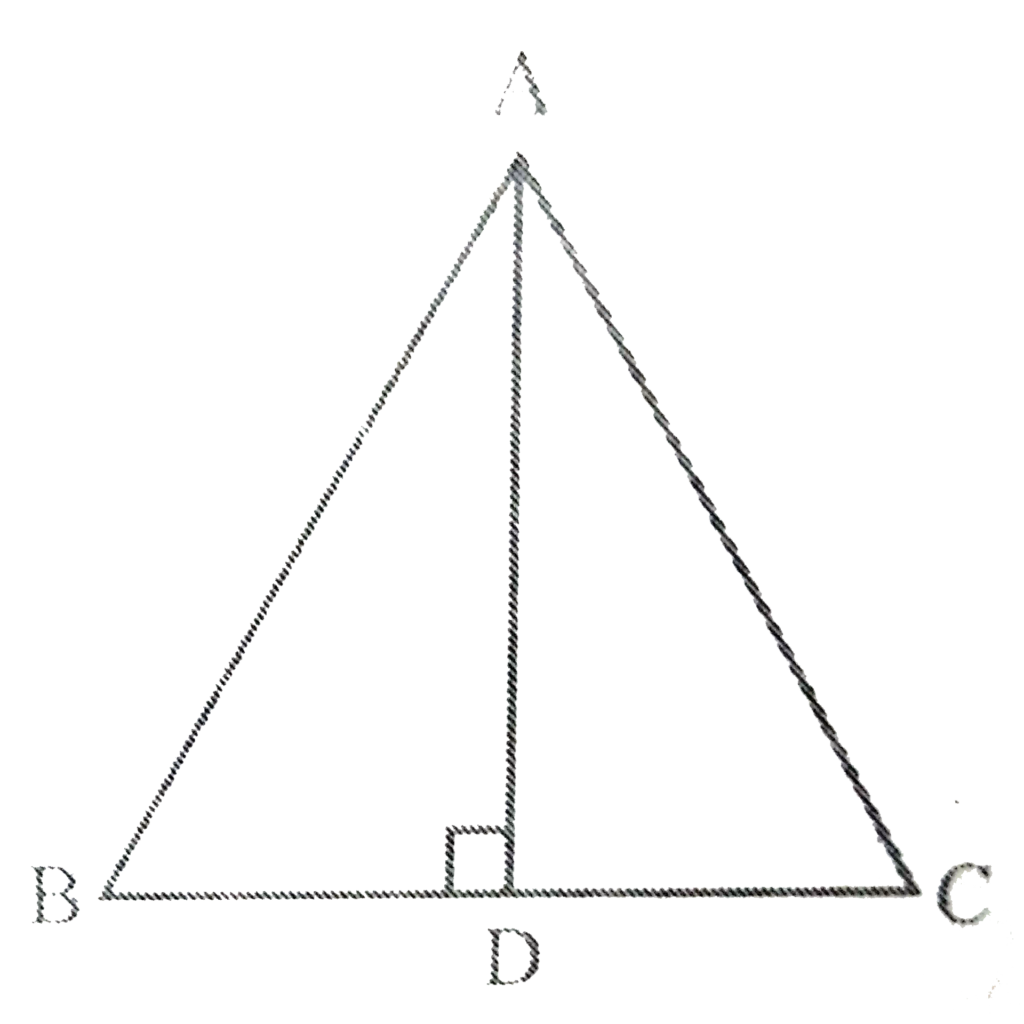
Solution:
In Δ ABD and Δ ACD,
BD = CD (AD bisects BC)
∠ADB = ∠ADC = 90° (AD perpendicular to BC)
AD = AD (Common)
By SAS criterion:
Δ ABD ≅ Δ ACD
Therefore,
AB = AC (by CPCT)
Hence, Δ ABC is isosceles.
3. ABC is an isosceles Δ in which altitudes BE and CF are drawn to equal sides AC and AB respectively (see Fig. 7.32). Show that these altitudes are equal.
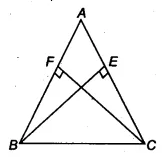
Solution:
In Δ ABE and Δ ACF,
∠AEB = ∠AFC = 90° (Given altitudes)
∠A = ∠A (Common)
AB = AC (Given)
By AAS criterion:
Δ ABE ≅ Δ ACF
Therefore,
BE = CF (by CPCT)
Hence, the altitudes are equal.
Class 9 Maths Chapter 7 Exercise 7.2 Question Answer SEBA 2026-27
4. ABC is a Δ in which altitudes BE and CF to sides AC and AB are equal (see Fig. 7.33). Show that
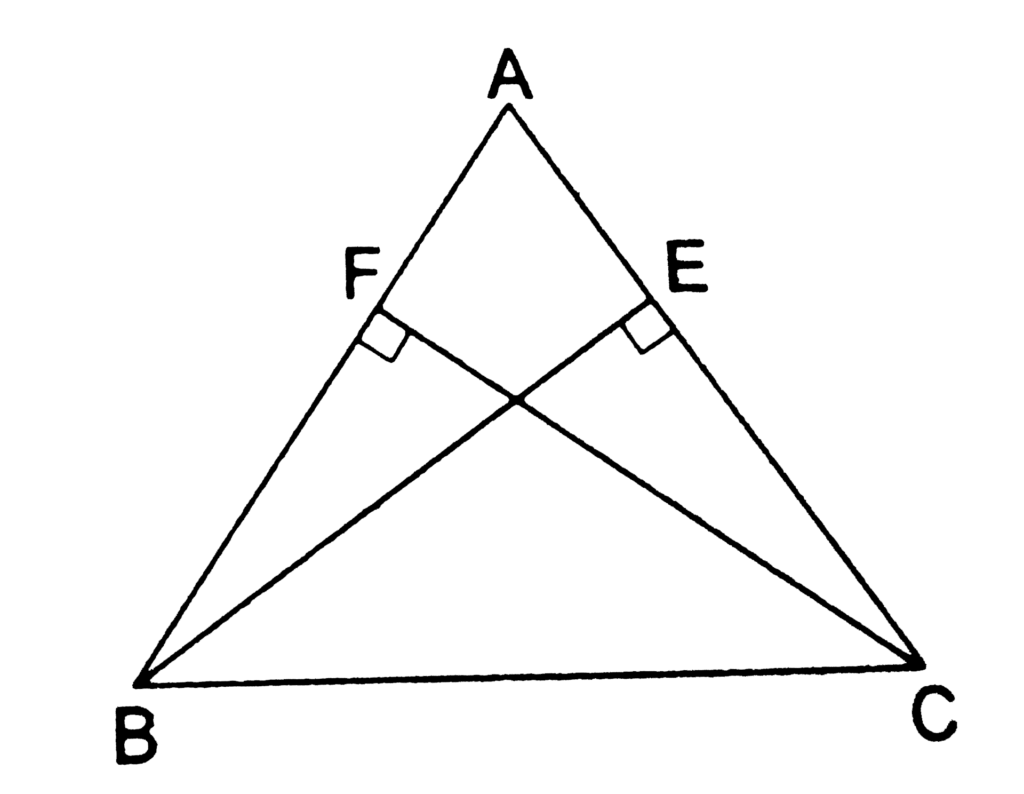
(i) Δ ABE ≅ Δ ACF
To prove: Δ ABE ≅ Δ ACF
In Δ ABE and Δ ACF,
∠AEB = ∠AFC = 90° (Given altitudes)
∠A = ∠A (Common)
BE = CF (Given)
By AAS criterion:
Δ ABE ≅ Δ ACF
Hence proved.
(ii) AB = AC, i.e., ABC is an isosceles Δ.
To prove: AB = AC
Since Δ ABE ≅ Δ ACF:
AB = AC (by CPCT)
Hence, Δ ABC is isosceles.
5. ABC and DBC are two isosceles Δ on the same base BC (see Fig. 7.34). Show that ∠ABD = ∠ACD.
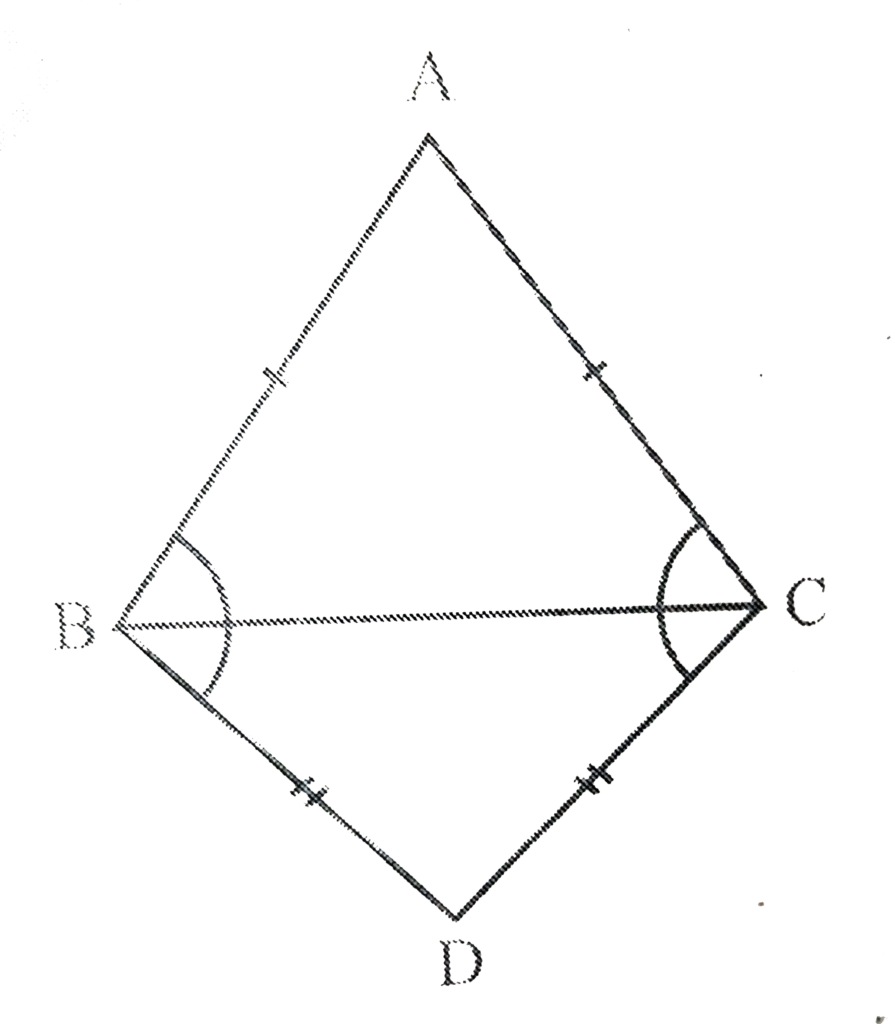
Solution:
In Δ ABC,
AB = AC (Given)
∠ABC = ∠ACB — (Eq 1) (Opp. to equal sides)
In Δ DBC,
DB = DC (Given)
∠DBC = ∠DCB — (Eq 2) (Opp. to equal sides)
Adding Eq 1 and Eq 2:
∠ABC + ∠DBC = ∠ACB + ∠DCB
∠ABD = ∠ACD
Hence proved.
Isosceles Triangles Class 9 SEBA Ex 7.2 Solutions
6. Δ ABC is an isosceles Δ in which AB = AC. Side BA is produced to D such that AD = AB (see Fig. 7.35). Show that ∠BCD is a right ∠.
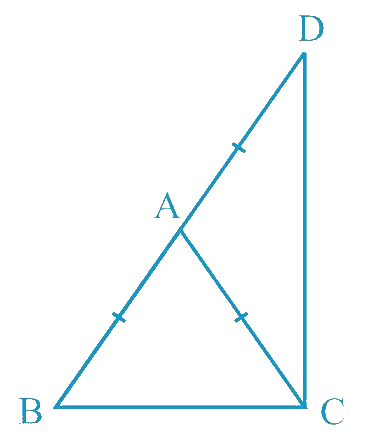
Solution:
In Δ ABC,
AB = AC (Given)
∠ACB = ∠ABC — (Eq 1)
Given, AD = AB, so AD = AC.
In Δ ACD,
AD = AC
∠ACD = ∠ADC — (Eq 2)
Adding Eq 1 and Eq 2:
∠ACB + ∠ACD = ∠ABC + ∠ADC
∠BCD = ∠ABC + ∠ADC
In Δ BCD,
∠BCD + ∠ABC + ∠ADC = 180° (Sum property)
∠BCD + ∠BCD = 180°
2 * ∠BCD = 180°
∠BCD = 90°
Hence proved.
7. ABC is a right Δ in which ∠A = 90° and AB = AC. Find ∠B and ∠C.
Solution:
In Δ ABC,
AB = AC (Given)
∠C = ∠B — (Eq 1) (Opp. to equal sides)
By sum property:
∠A + ∠B + ∠C = 180°
90° + ∠B + ∠B = 180° (Since ∠A = 90° and ∠C = ∠B)
2 * ∠B = 180° – 90°
2 * ∠B = 90°
∠B = 45°
From Eq 1:
∠C = 45°
Therefore, ∠B = 45° and ∠C = 45°.
SEBA Class 9 Maths Chapter 7 Exercise 7.2 Textbook Answers
8. Show that the ∠s of an equilateral Δ are 60° each.
Solution:
Let Δ ABC be equilateral.
AB = BC = CA
Taking AB = AC:
∠C = ∠B — (Eq 1) (Opp. to equal sides)
Taking BC = AC:
∠A = ∠B — (Eq 2) (Opp. to equal sides)
From Eq 1 and Eq 2:
∠A = ∠B = ∠C
In Δ ABC,
∠A + ∠B + ∠C = 180° (Sum property)
∠A + ∠A + ∠A = 180°
3 * ∠A = 180°
∠A = 60°
Therefore,
∠A = ∠B = ∠C = 60°
Hence, each = 60°.
9. P is a point on the bisector of ∠ABC. If the line through P, parallel to BA meets BC at Q. What type of Δ is BPQ (Fig. 7.36).
(A) Right Δ
(B) Equilateral Δ
(C) Isosceles Δ
(D) Scalene Δ
Solution:
Given BP is the bisector of ∠ABC:
∠ABP = ∠PBC — (Eq 1)
Given PQ parallel to BA with transversal BP:
∠BPQ = ∠ABP — (Eq 2) (Alternate interior)
From Eq 1 and Eq 2:
∠BPQ = ∠PBC
∠BPQ = ∠PBQ
In Δ BPQ:
PQ = BQ (Sides opp. to equal ∠s are equal)
Since two sides are equal, Δ BPQ is isosceles.
Correct Option: (C) Isosceles
10. Consider the statements P to S.
P. Measure of an acute ∠ of isosceles right Δ.
Q. Sum of the ∠s of a Δ.
R. The measure of the largest ∠ of a right Δ.
S. Measures of each ∠ of an equilateral Δ.
Choose the option that represents the correct increasing sequence for the measures of ∠s.
(A) R, Q, S, P
(B) Q, P, S, R
(C) P, S, R, Q
(D) S, R, Q, P
Solution:
Comparing the measures:
45° < 60° < 90° < 180°
P < S < R < Q
Increasing order: P, S, R, Q
Correct Option: (C) P, S, R, Q
Class 9 Maths Exercise 7.2 Triangles Proofs
📐 Updated Solutions Notice: This page features complete, step-by-step SEBA Class 9 Mathematics Chapter 7 (Triangles) Exercise 7.2 Textual Solutions updated for the 2026–27 academic session. All isosceles triangle property proofs, angle bisector applications, and step-by-step geometric derivations strictly follow the latest revised Assam Board (SEBA) curriculum.
💡 Master Class 9 Geometry Concepts:
- Having difficulty proving that angles opposite to equal sides of an isosceles triangle are equal in Exercise 7.2? Drop your questions in the comments section below!
- Save and bookmark this solution guide for quick reference before your unit tests, mid-term, and annual examinations.
- Share this link with your classmates and WhatsApp study groups to help them excel in mathematics!