Looking for accurate SEBA Class 10 Maths Chapter 3 Exercise 3.3 (Pair of Linear Equations in Two Variables) textual solutions for the 2026–27 academic year? Access step-by-step solutions for substitution method, elimination method, word problems, and linear system verification designed to help you score top marks in your HSLC board exams.
EXERCISE 3.3
1. Solve the following pair of linear equations by the elimination method and the substitution method:
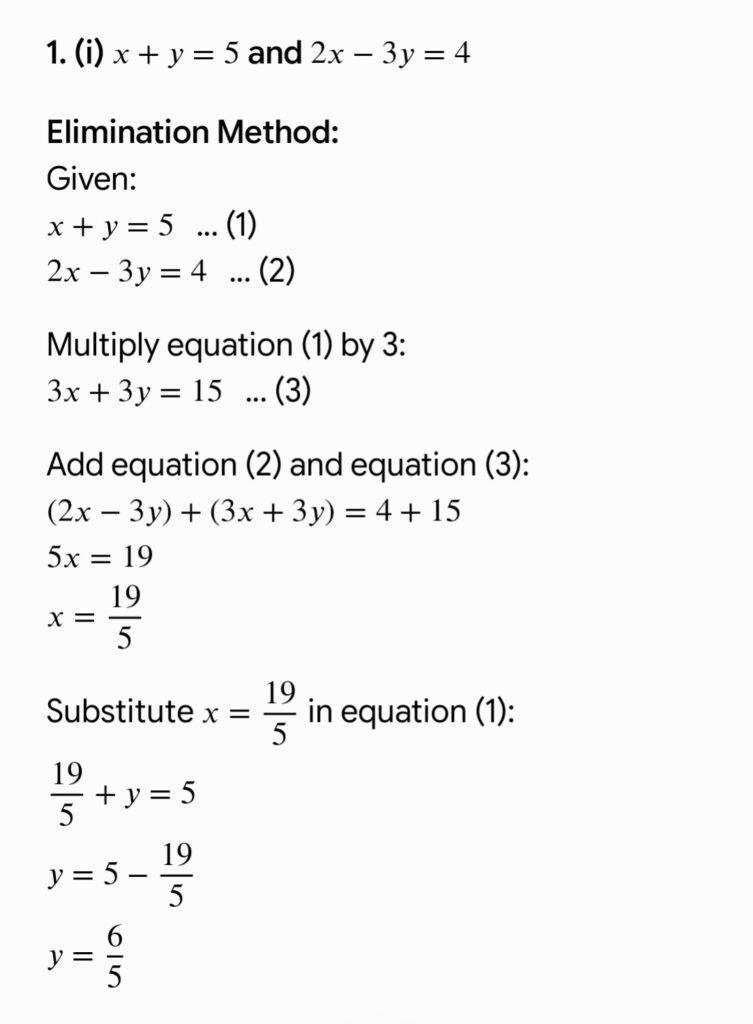
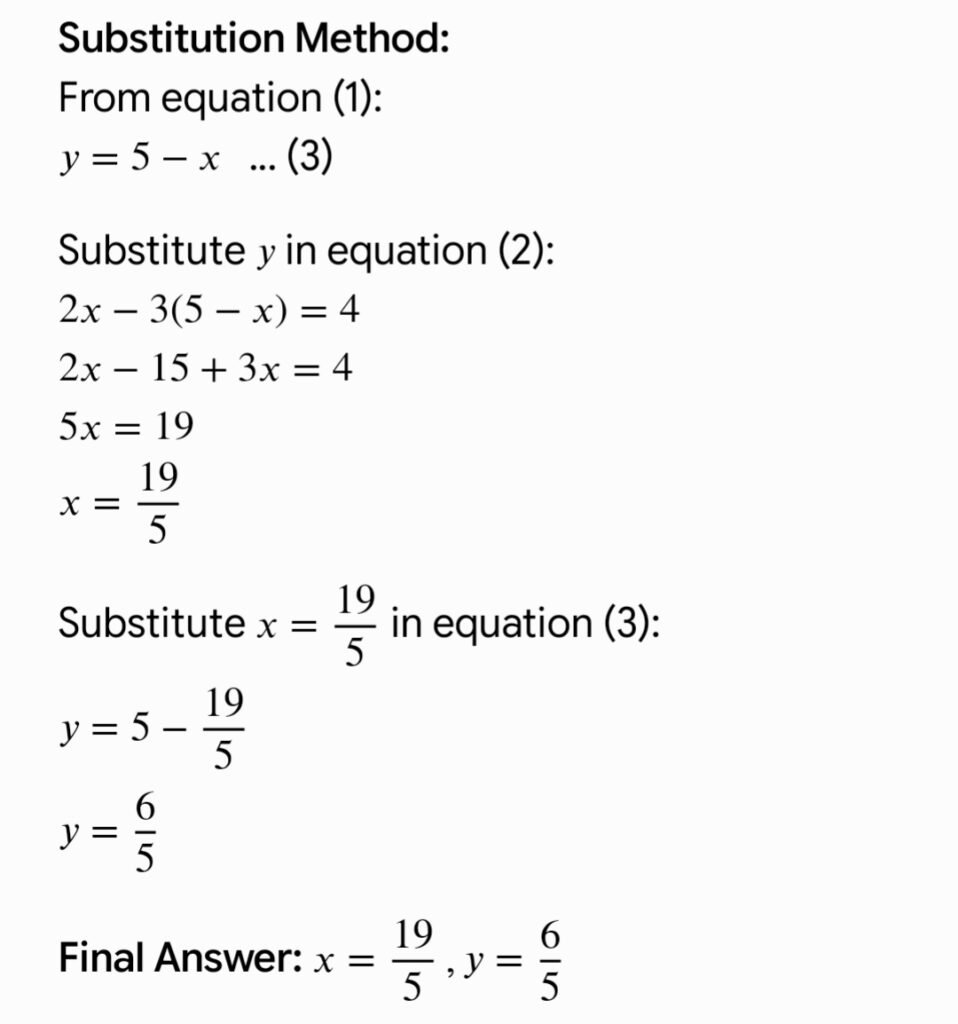
(i) x + y = 5 and 2x – 3y = 4
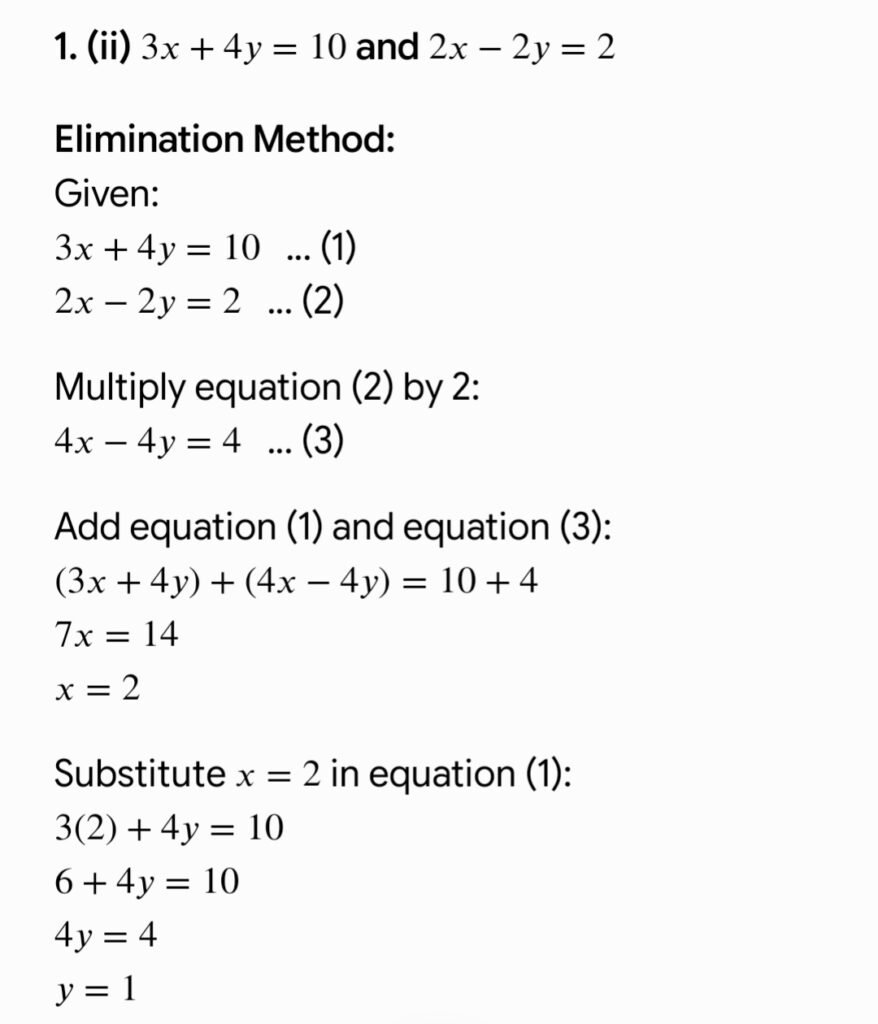
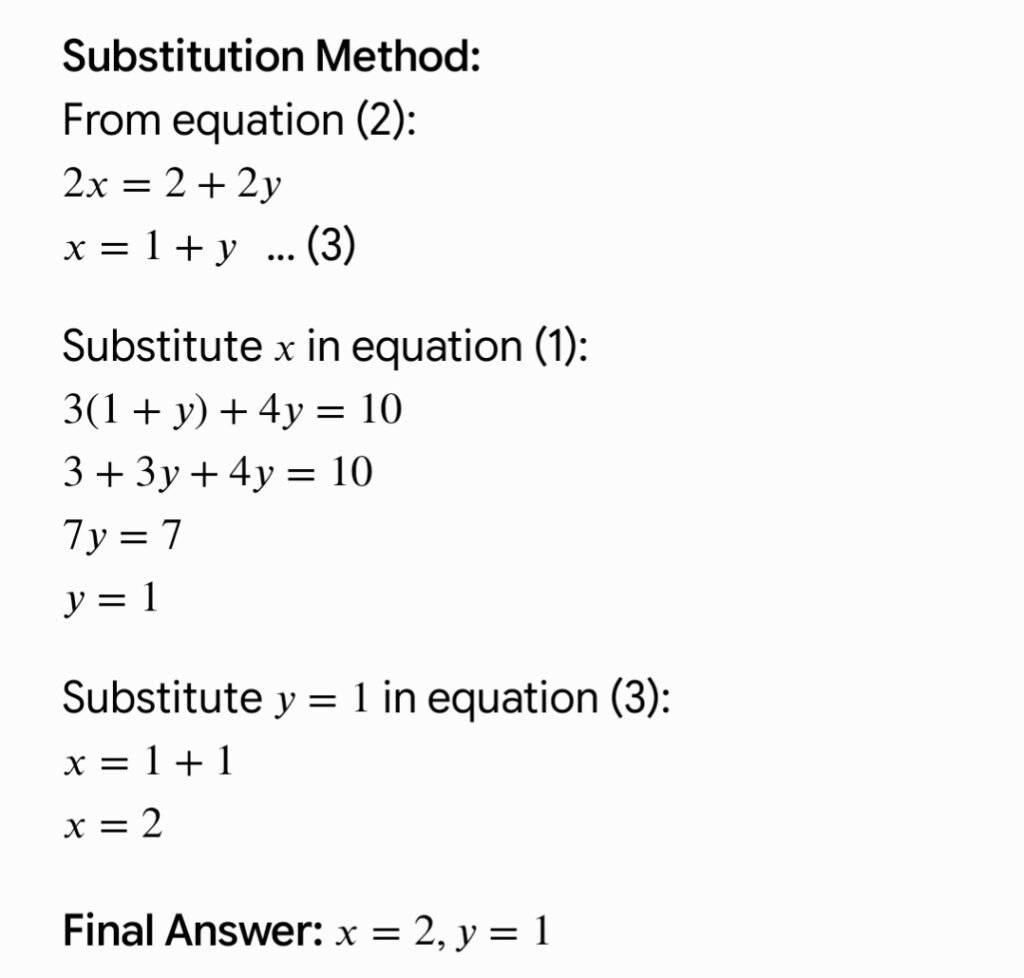
(ii) 3x + 4y = 10 and 2x – 2y = 2
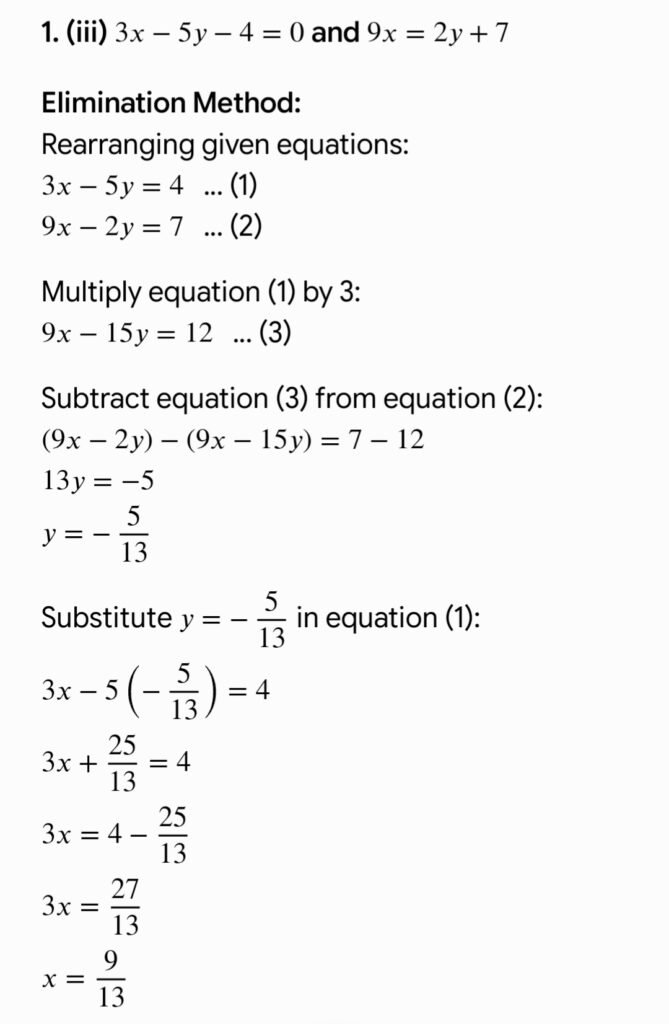
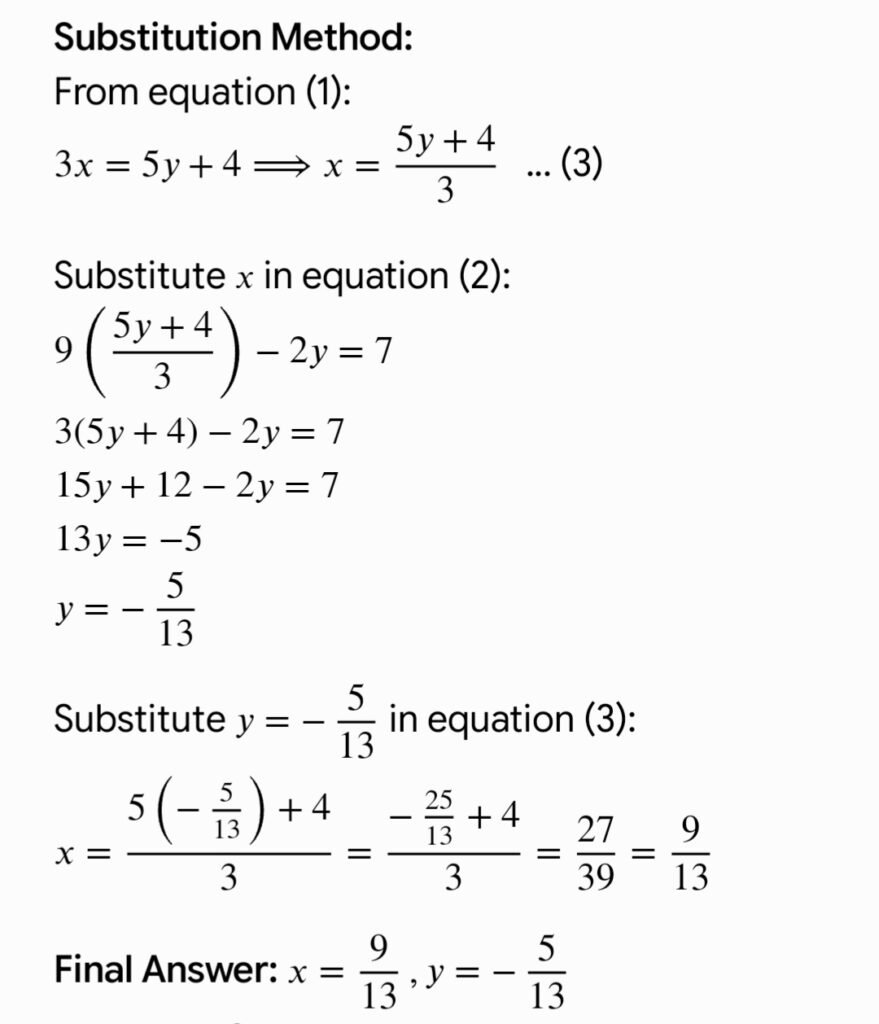
(iii) 3x – 5y – 4 = 0 and 9x = 2y + 7
(iv) x/2 + 2y/3 = -1 and x – y/3 = 3
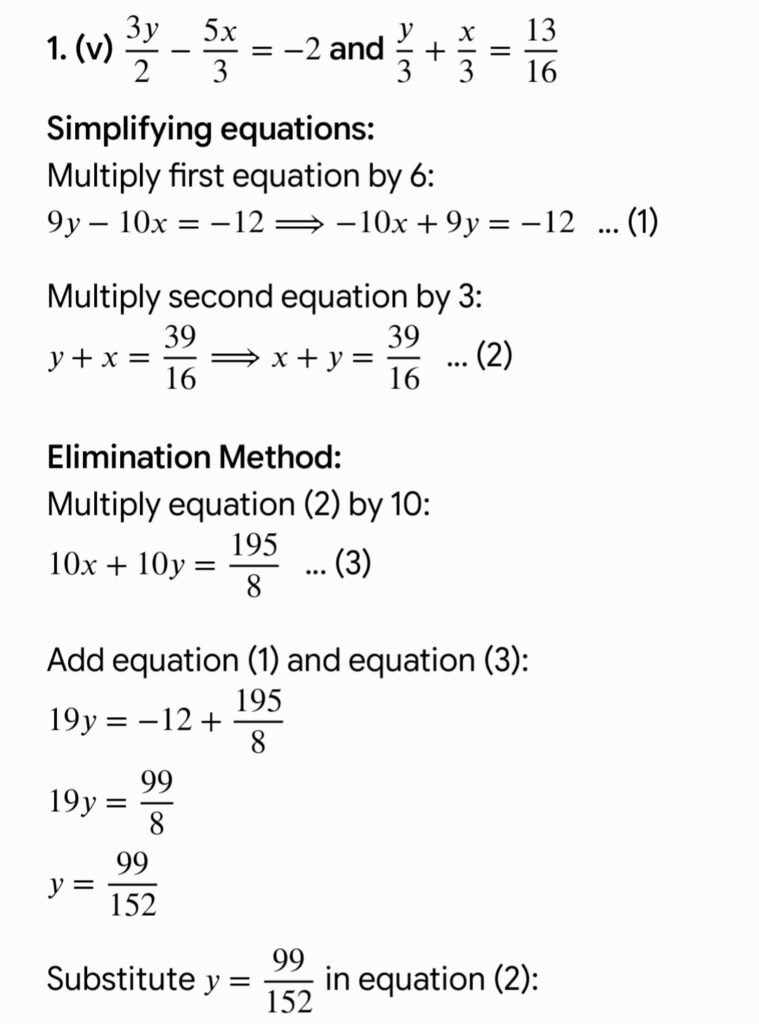
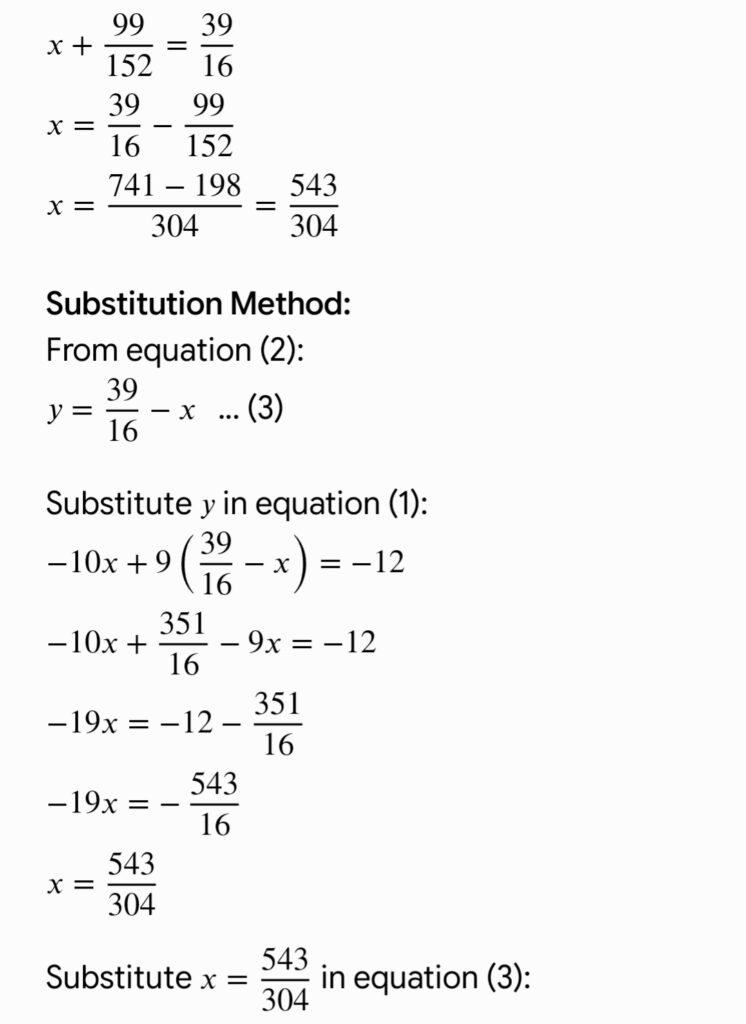
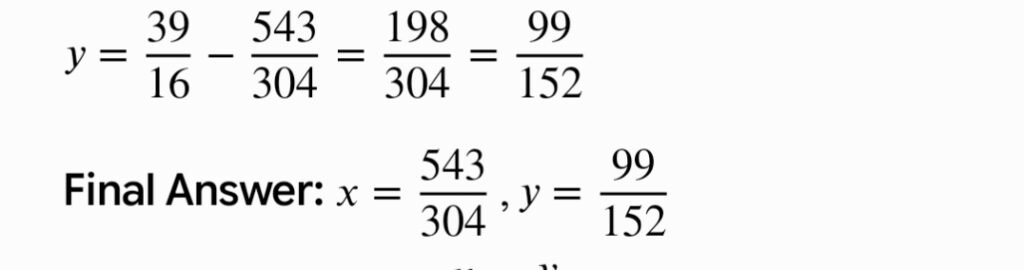
(v) 3y/2 – 5x/3 = -2 and y/3 + x/3 = 13/16
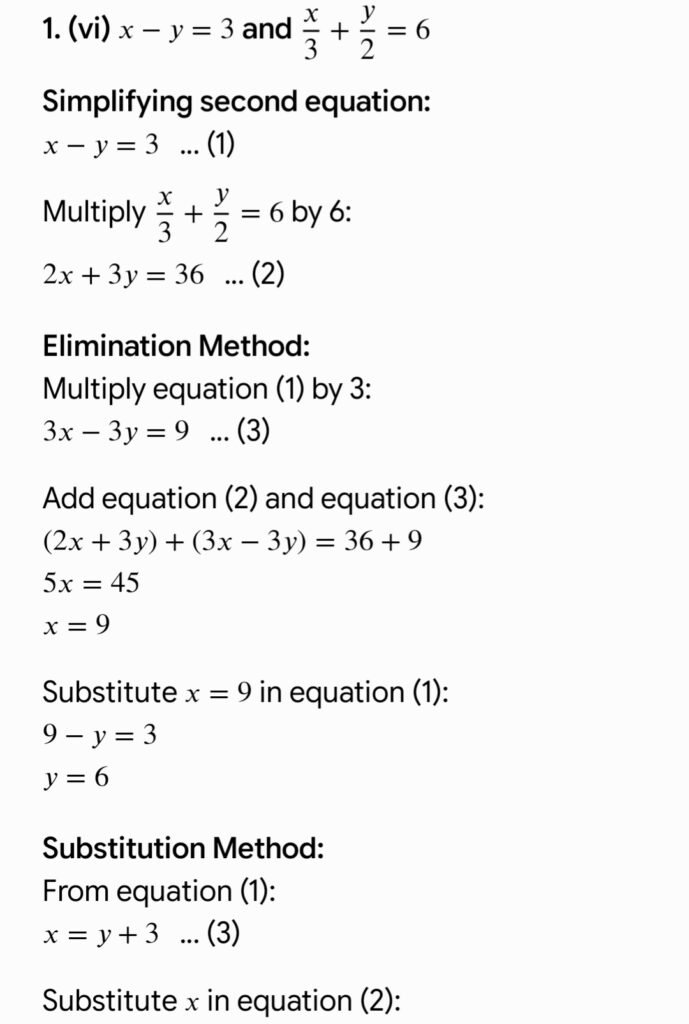
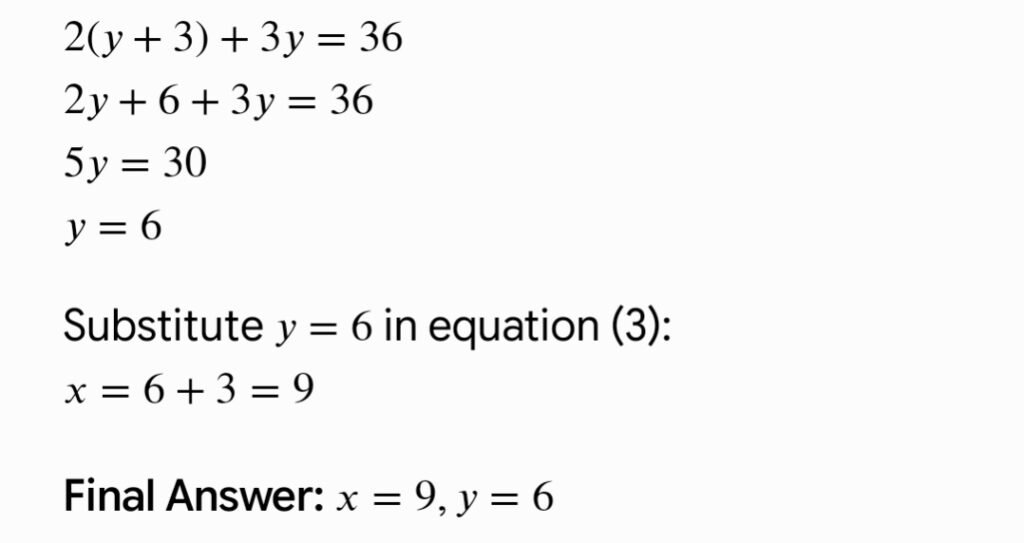
(vi) x – y = 3 and x/3 + y/2 = 6
SEBA Class 10 Maths Chapter 3.3 Solutions
2. Form the pair of linear equations in the following problems, and find their solutions (if they exist) by the elimination method:
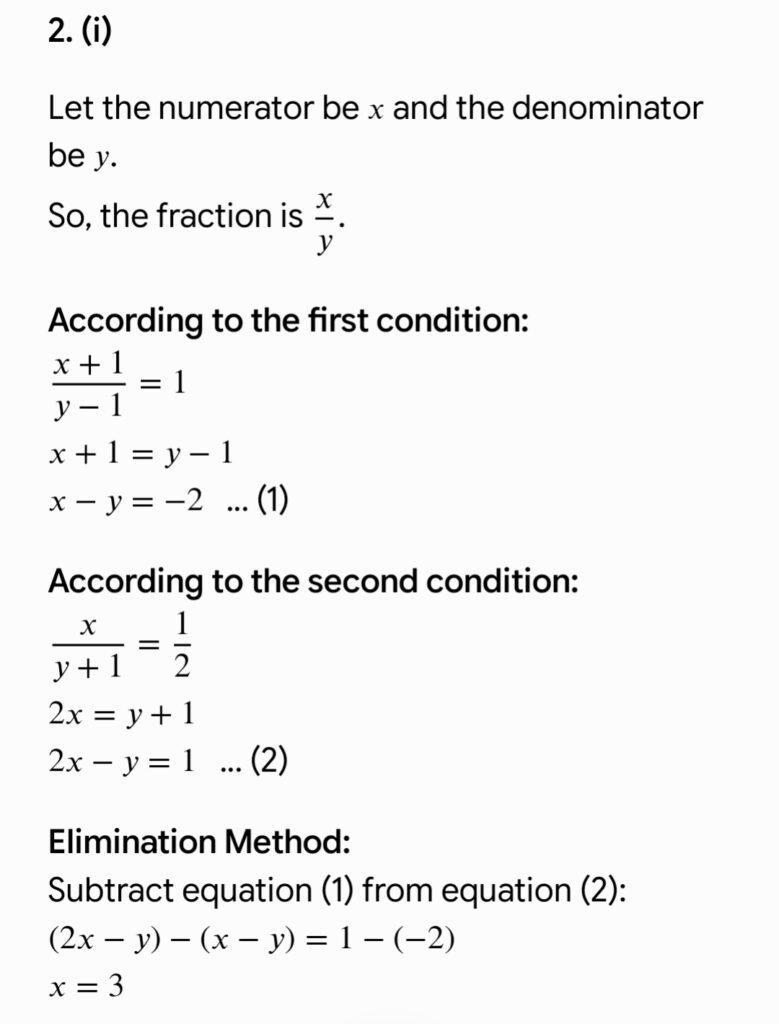
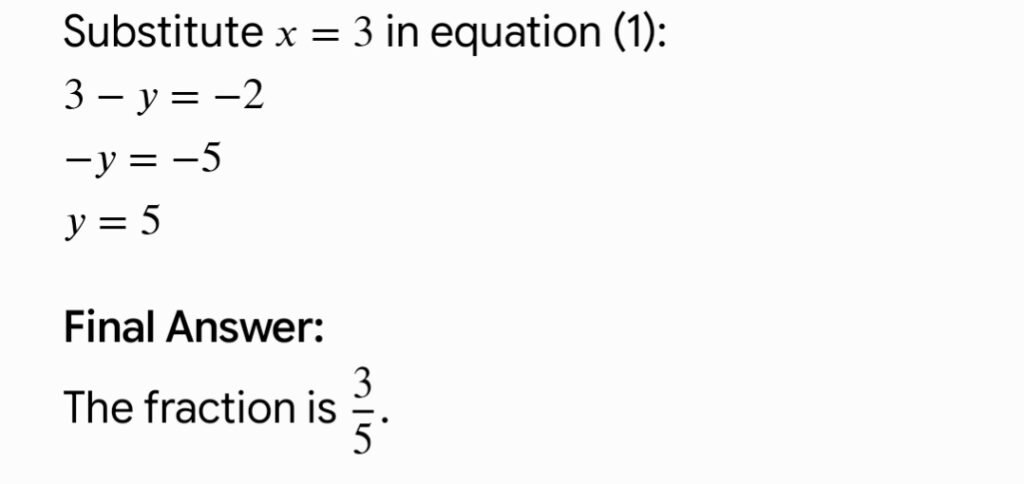
(i) If we add 1 to the numerator and subtract 1 from the denominator, a fraction reduces to 1. It becomes 1/2 if we only add 1 to the denominator. What is the fraction?
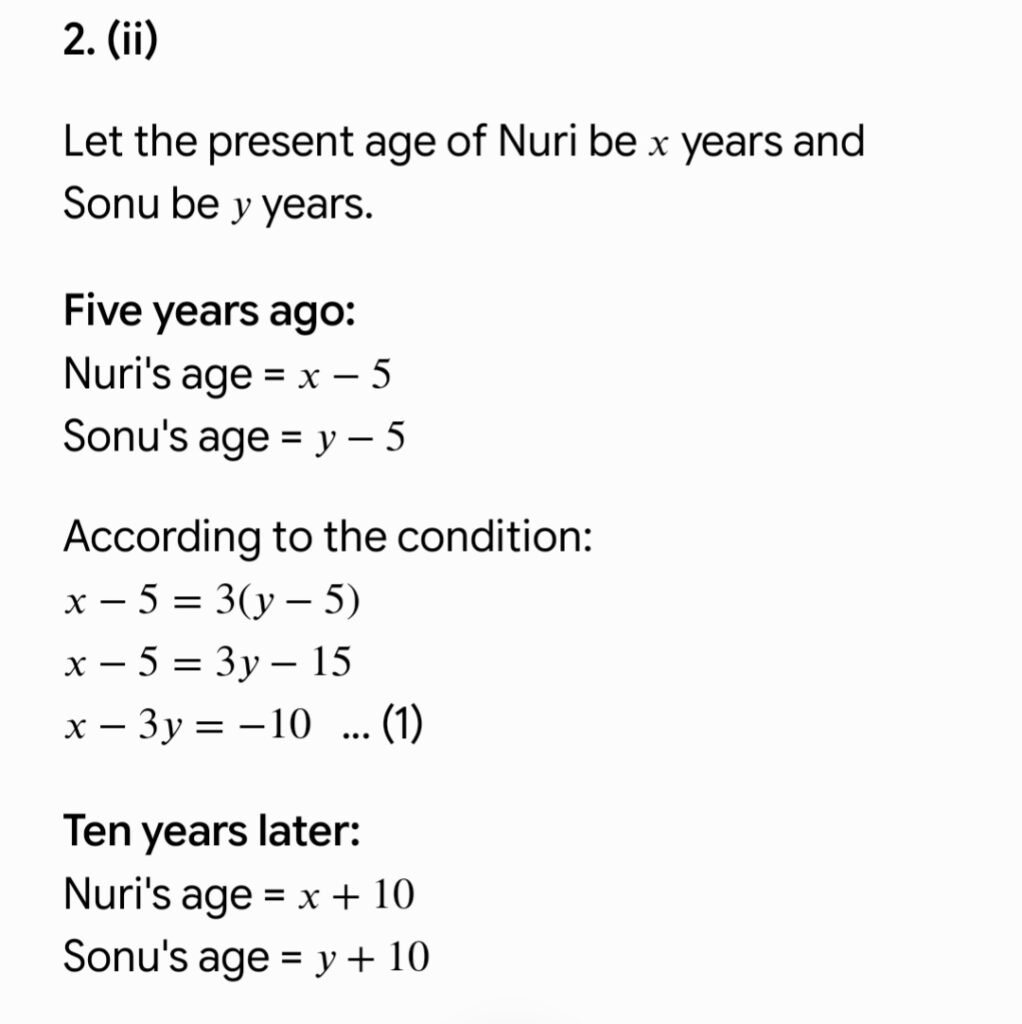
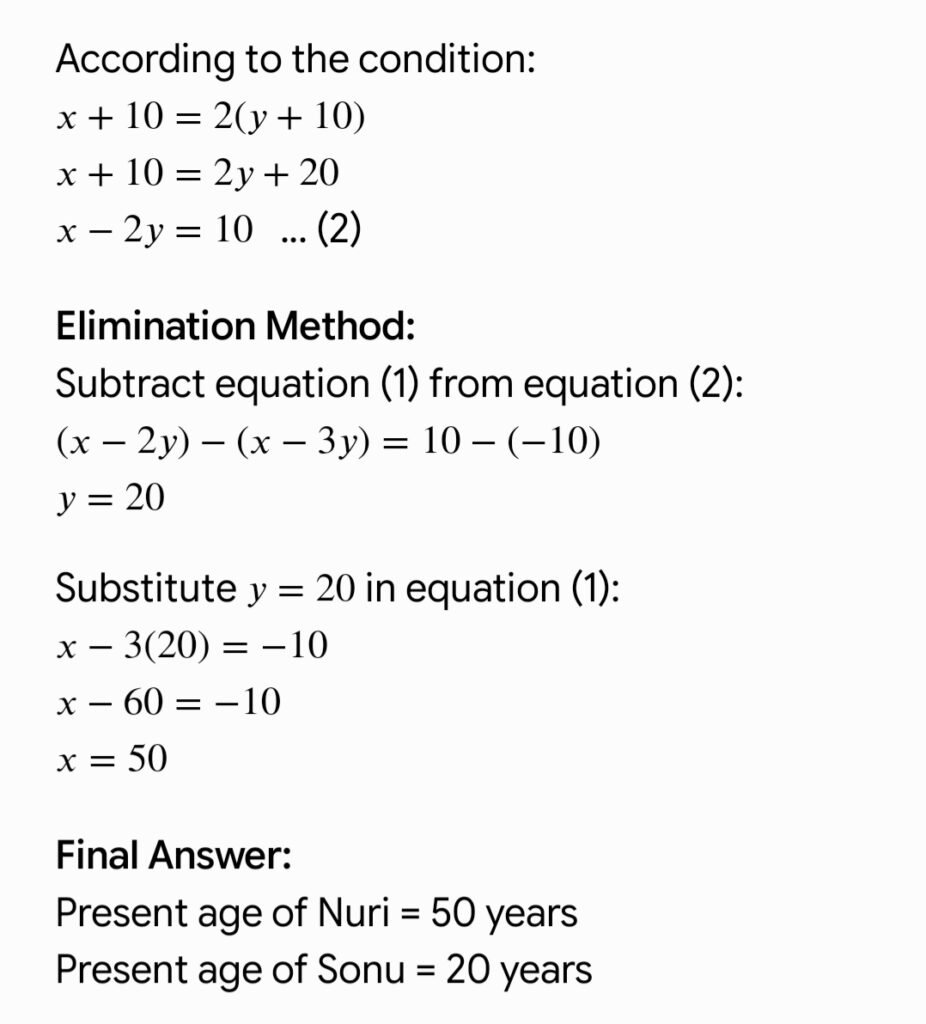
(ii) Five years ago, Nur was thrice as old as Sonu. Ten years later, Nur will be twice as old as Sonu. How old are Nur and Sonu?
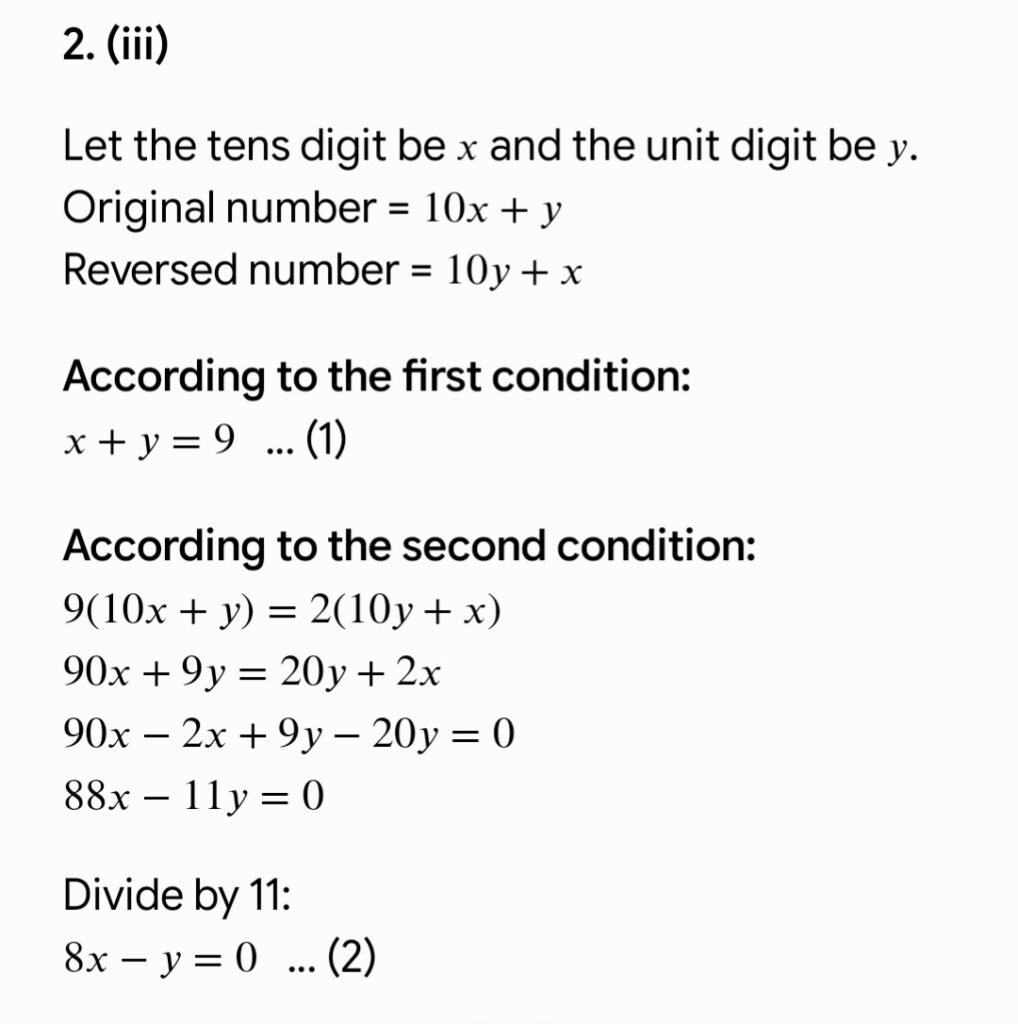
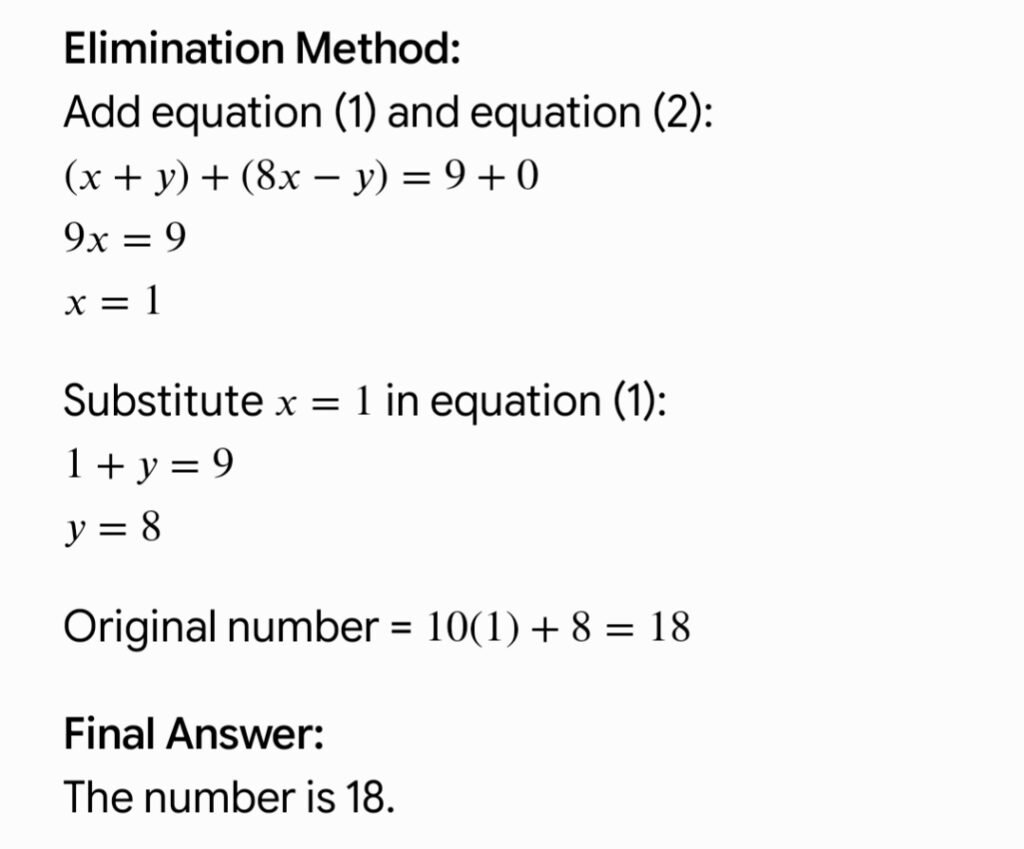
(iii) The sum of the digits of a two-digit number is 9. Also, nine times this number is twice the number obtained by reversing the order of the digits. Find the number.
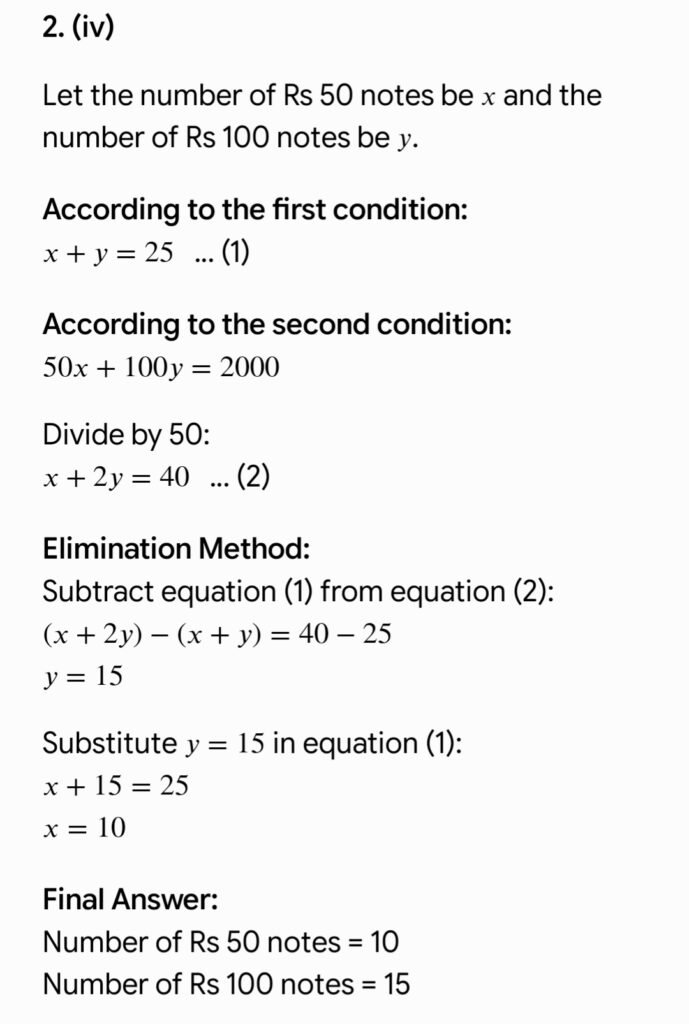
(iv) Meena went to a bank to withdraw Rs 2000. She asked the cashier to give her Rs 50 and Rs 100 notes only. Meena got 25 notes in all. Find how many notes of Rs 50 and Rs 100 she received.
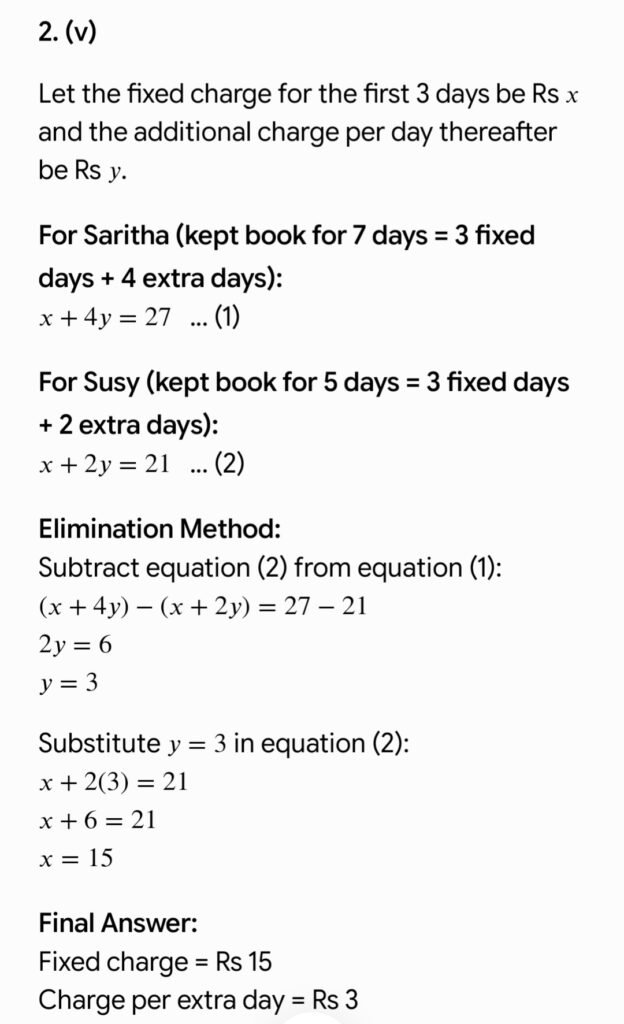
(v) A lending library has a fixed charge for the first three days and an additional charge for each day thereafter. Saritha paid Rs 27 for a book kept for seven days, while Susy paid Rs 21 for the book she kept for five days. Find the fixed charge and the charge for each extra day.
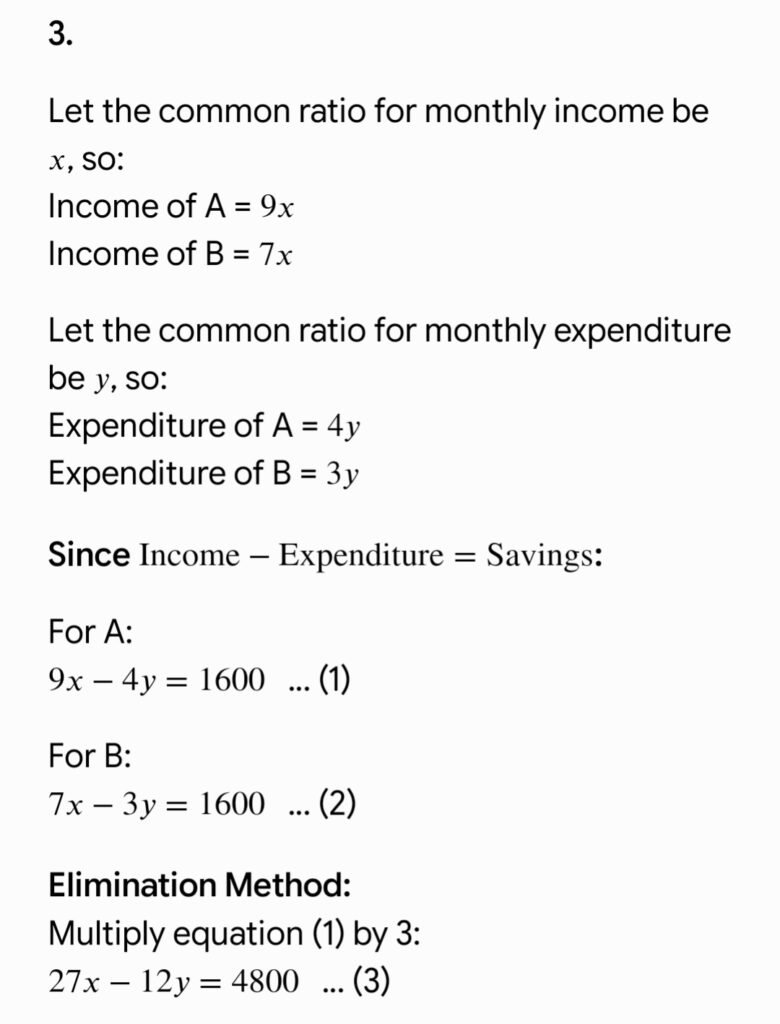
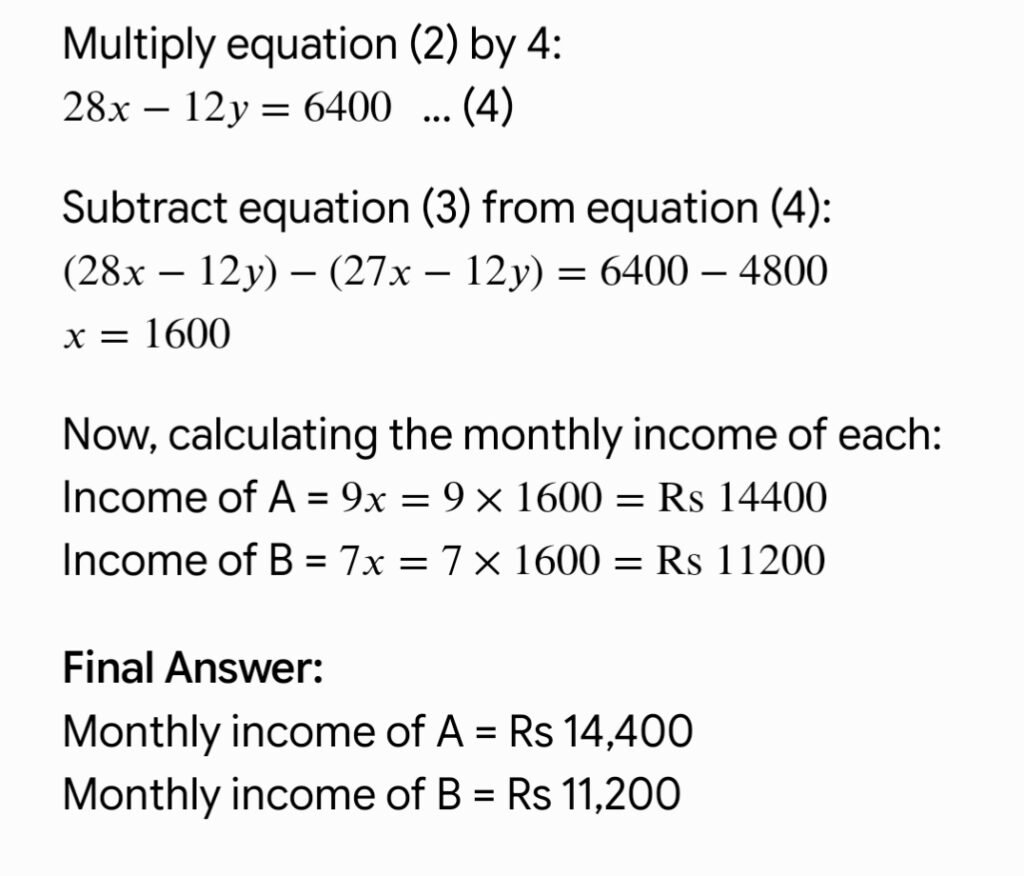
3. The monthly incomes of A and B are in the ratio of 9:7 and their monthly expenditures are in the ratio of 4:3. If each saves Rs. 1600 per month, find the monthly income of each.
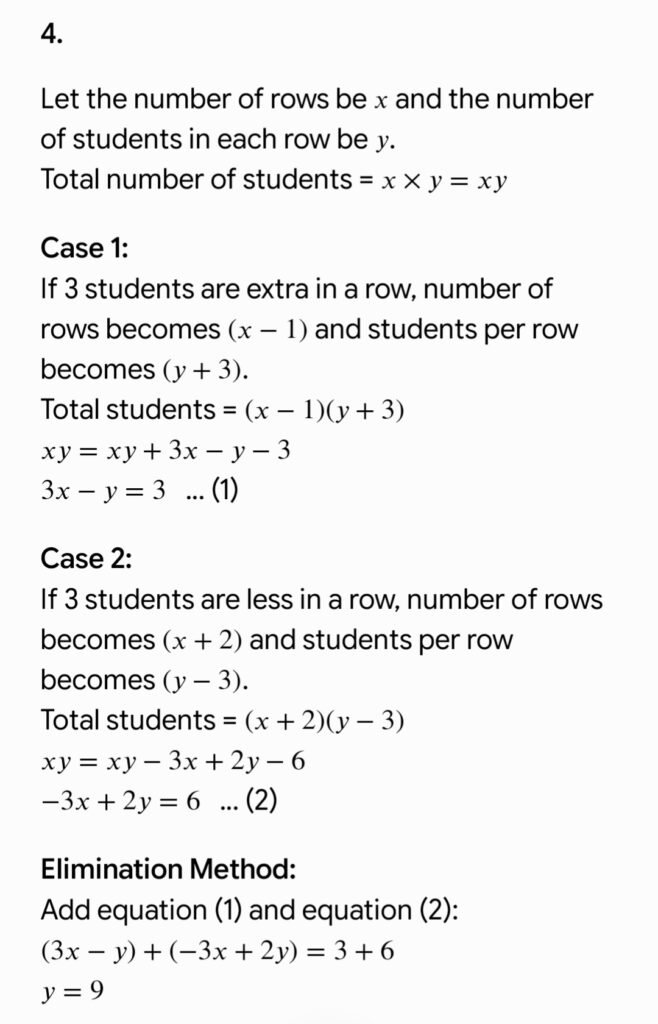
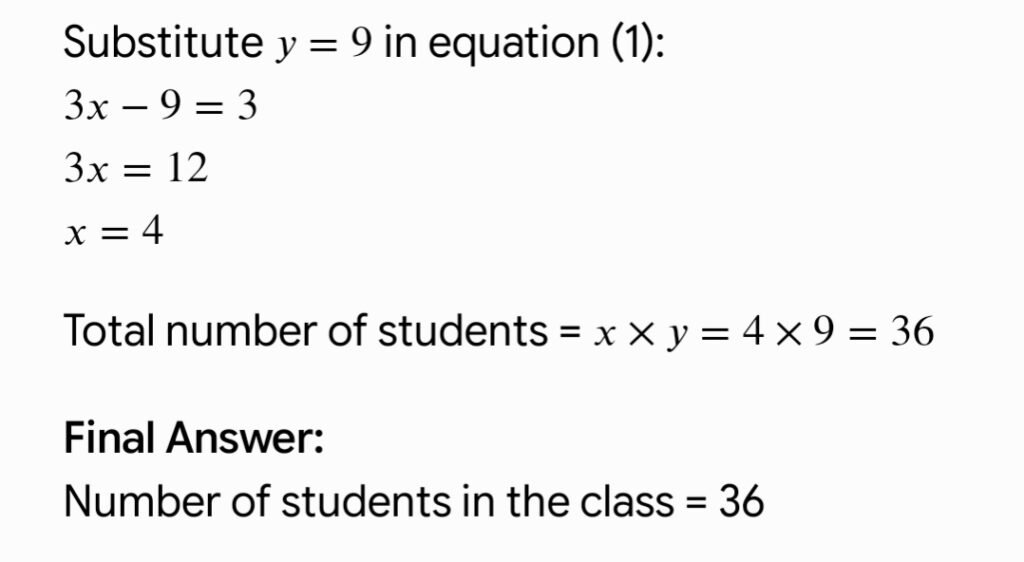
4. The students of a class are made to stand in rows. If 3 students are extra in a row, there would be 1 row less. If 3 students are less in a row, there would be 2 rows more. Find the number of students in the class.
Class 10 Maths Chapter 3 Exercise 3.3 Question Answer SEBA 2026-27
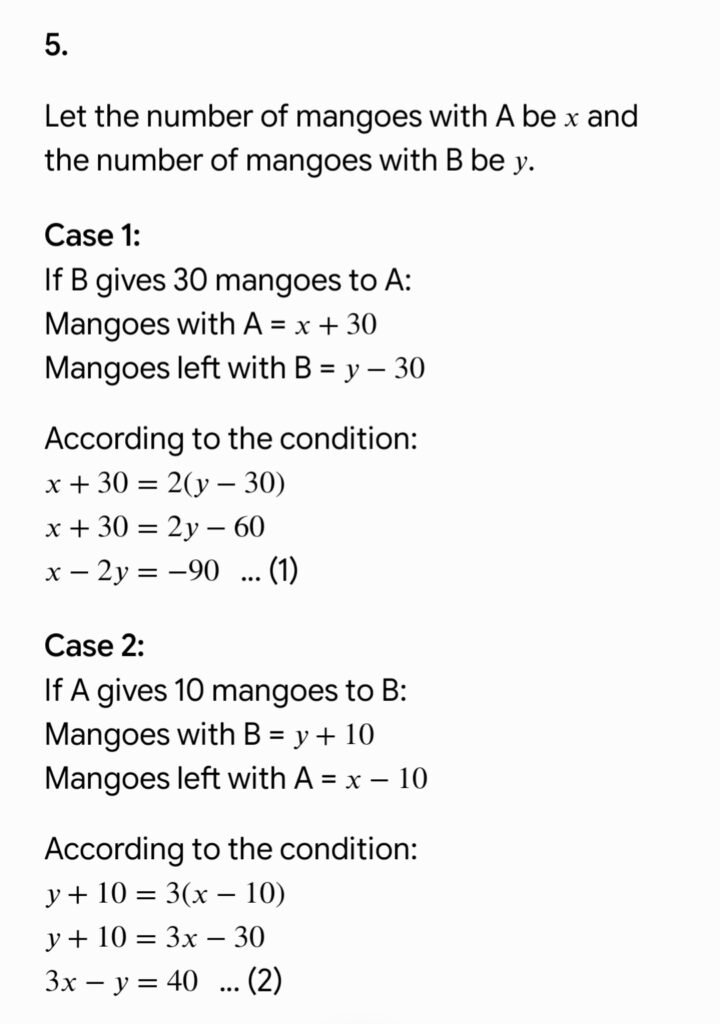
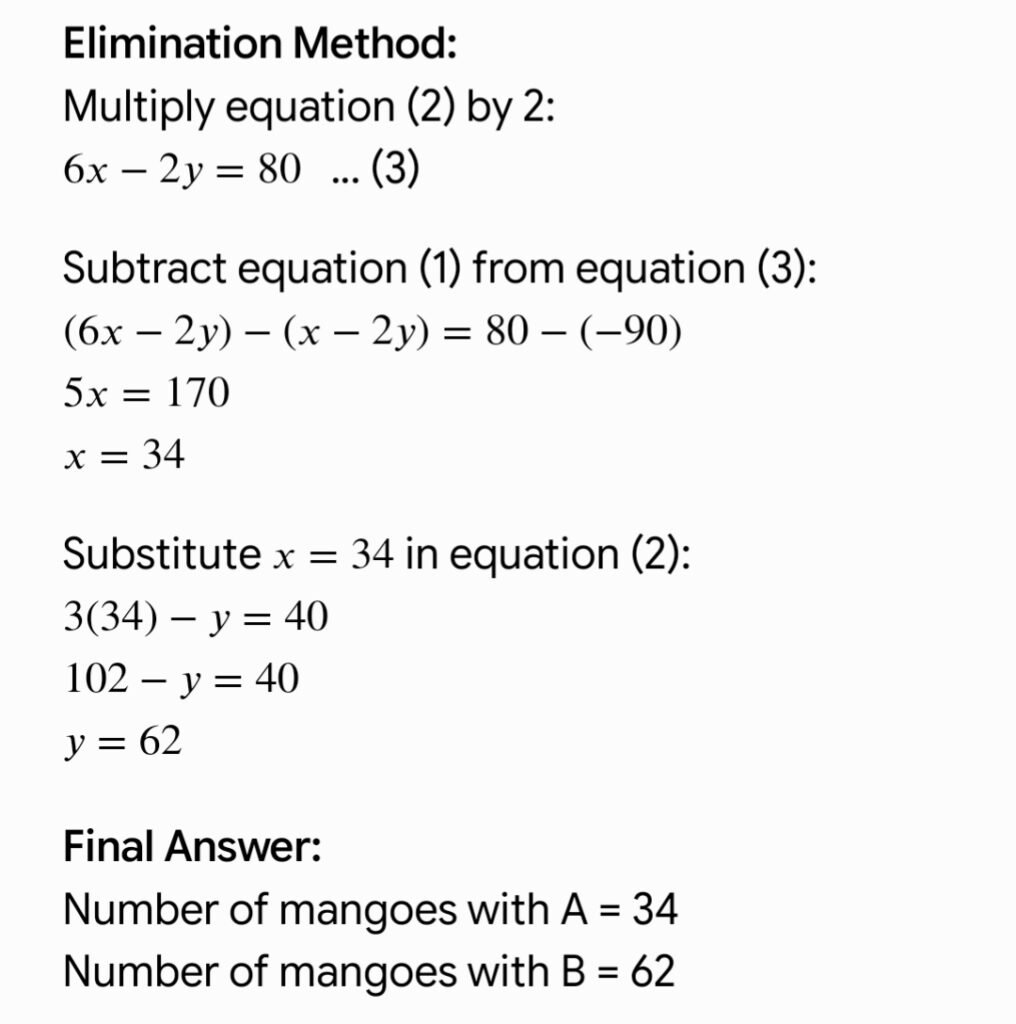
5. A and B each have certain numbers of mangoes. A says to B, ‘if you give me 30 of your mangoes, I will have twice as many as left with you.’ B replies, ‘if you give me 10, I will have thrice as many as left with you.’ How many mangoes does each have?
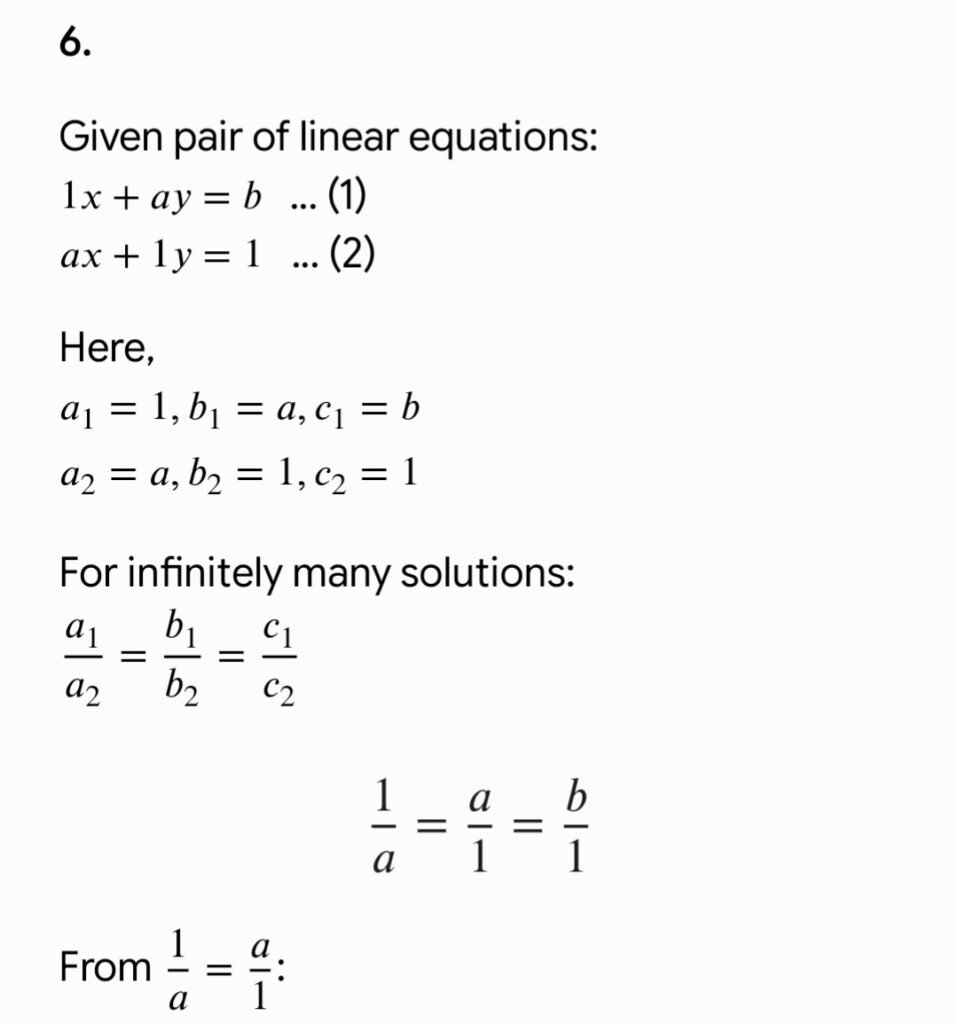
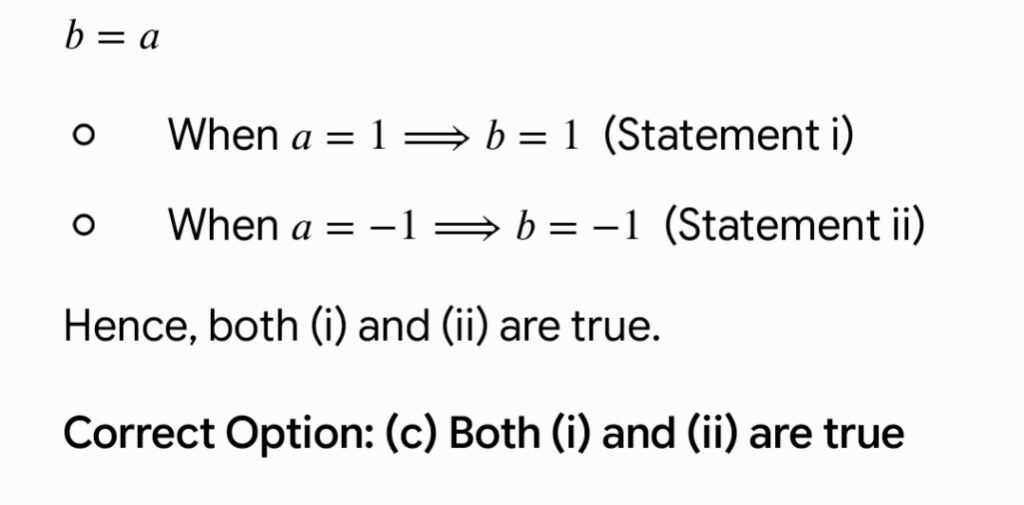
6. If the pair of equations x + ay = b and ax + y = 1 has infinitely many solutions, then choose the correct option from the given alternatives:
(i) a = 1, b = 1
(ii) a = -1, b = -1
(iii) a = 1, b = -1
(iv) a = -1, b = 1
* (a) Both (i) and (iii) are true
* (b) Both (ii) and (iv) are true
* (c) Both (i) and (ii) are true
* (d) Both (iii) and (iv) are true
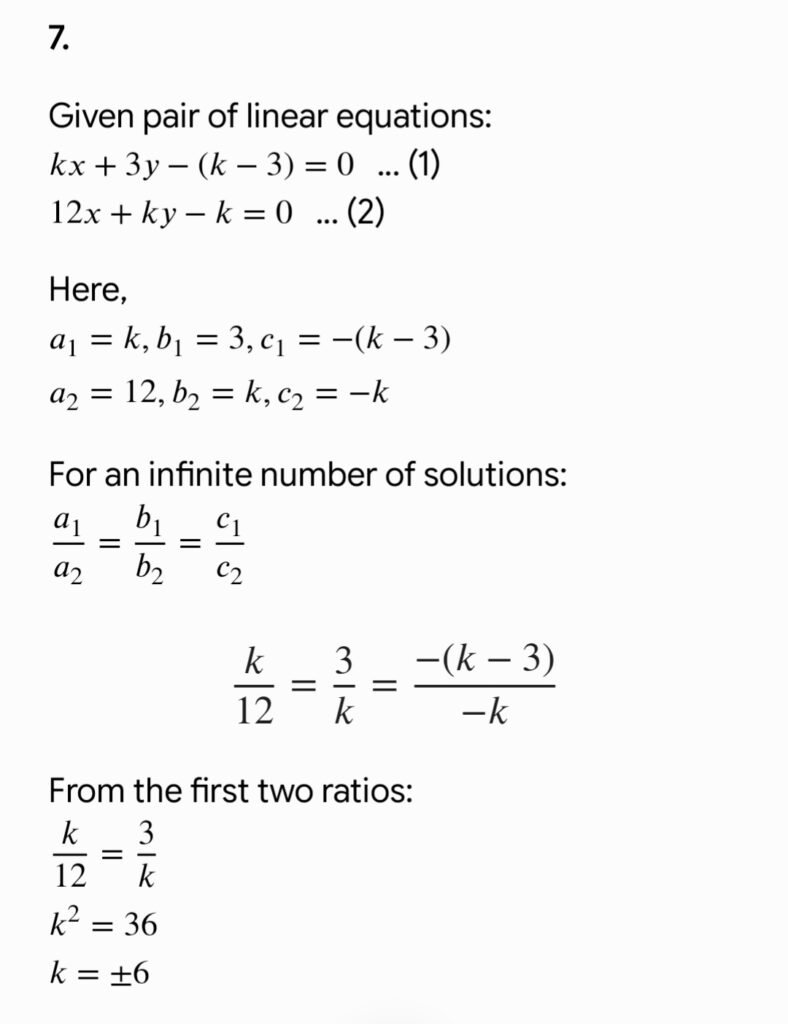
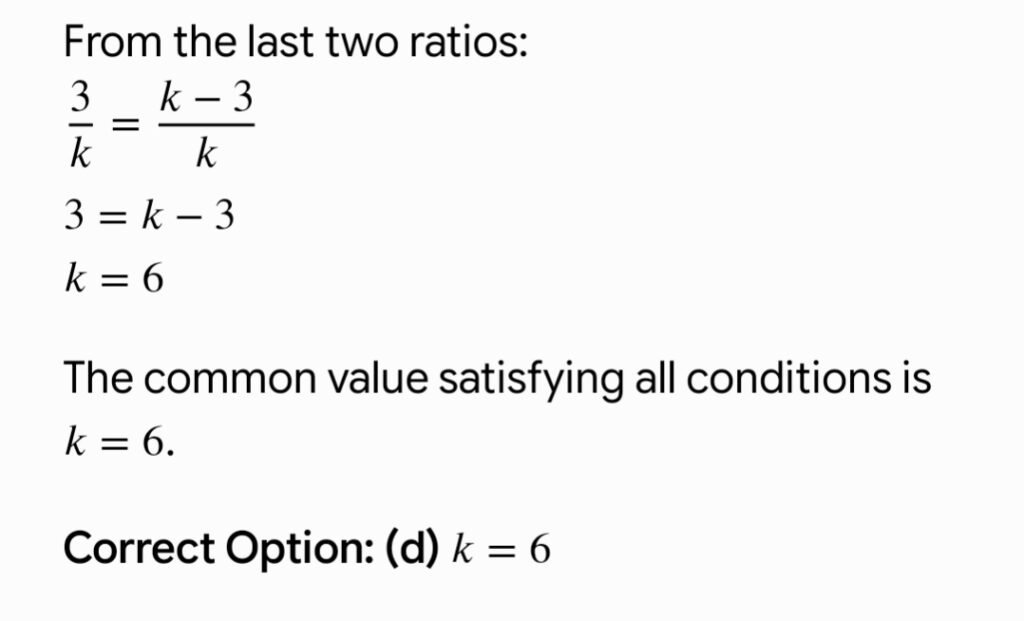
7. For what value of K, the following pair of linear equations has infinite number of solutions?
kx + 3y – (k – 3) = 0
12x + ky – k = 0
(a) k = -6
(b) k = 4
(c) k = -4
(d) k = 6
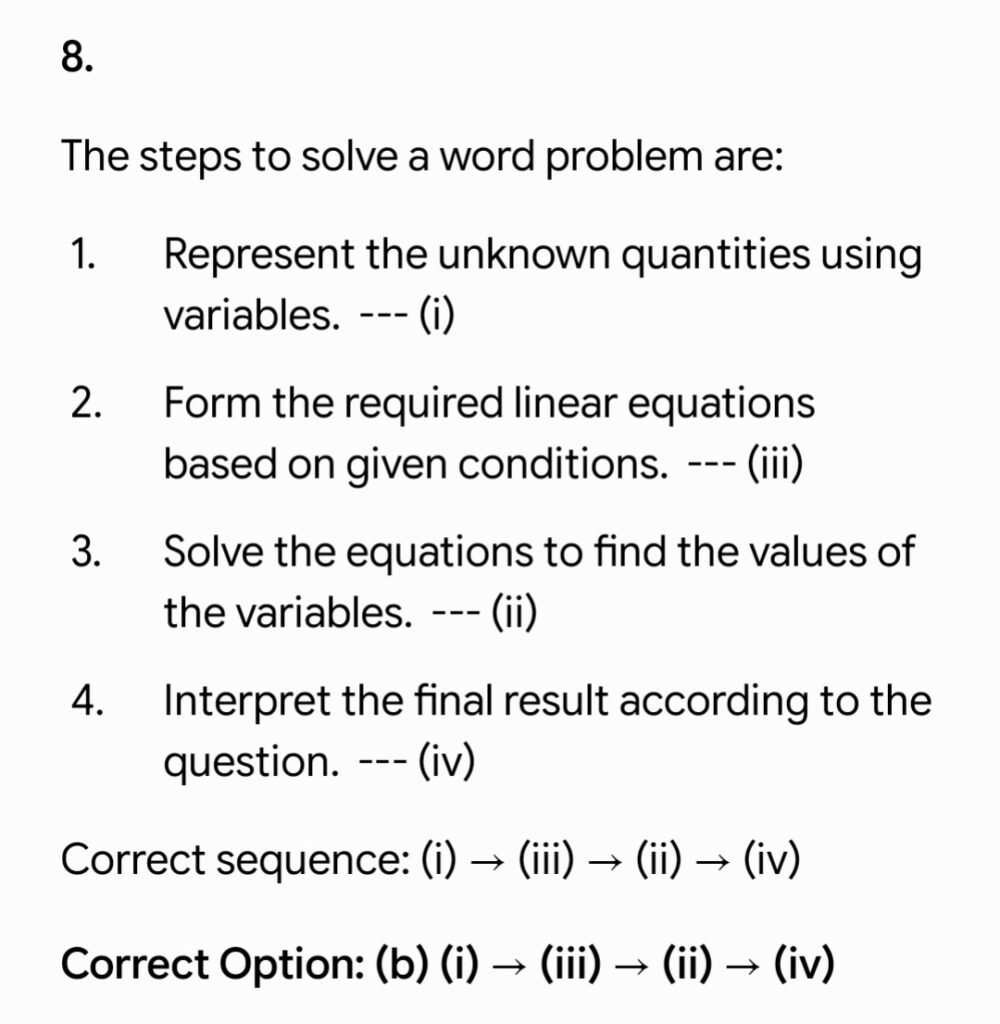
8. Following are the steps of solving a word problem of the linear equation in two variables. Choose the correct sequence from the given options:
(i) Represent the unknowns using variables.
(ii) Solve the equations.
(iii) Form the required equations.
(iv) Interpret the result.
(a) (i) -> (ii) -> (iii) -> (iv)
(b) (i) -> (iii) -> (ii) -> (iv)
(c) (iv) -> (iii) -> (ii) -> (i)
(d) (ii) -> (i) -> (iii) -> (iv)
Pair of Linear Equations in Two Variables Class 10 SEBA Ex 3.3 Solutions
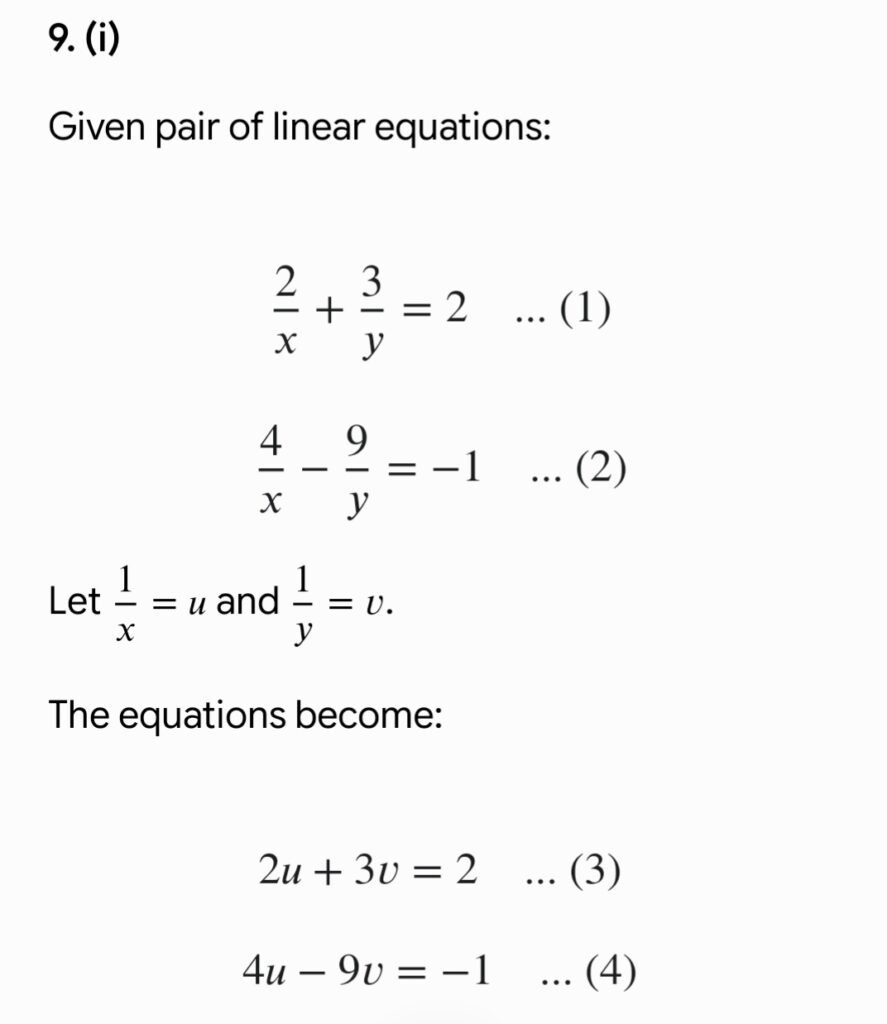
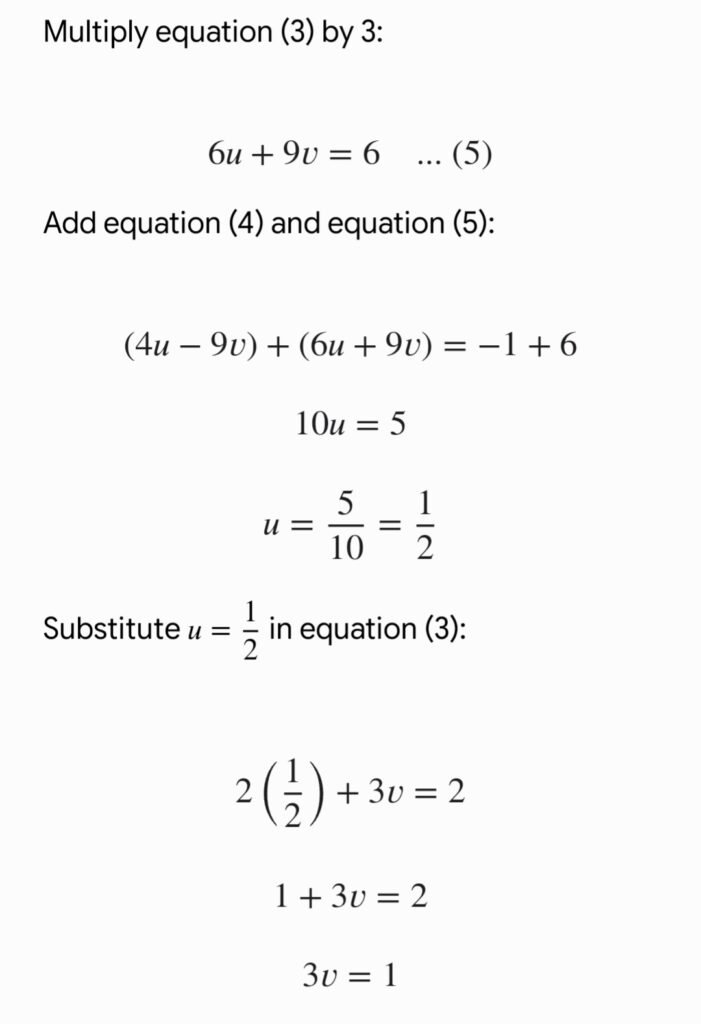
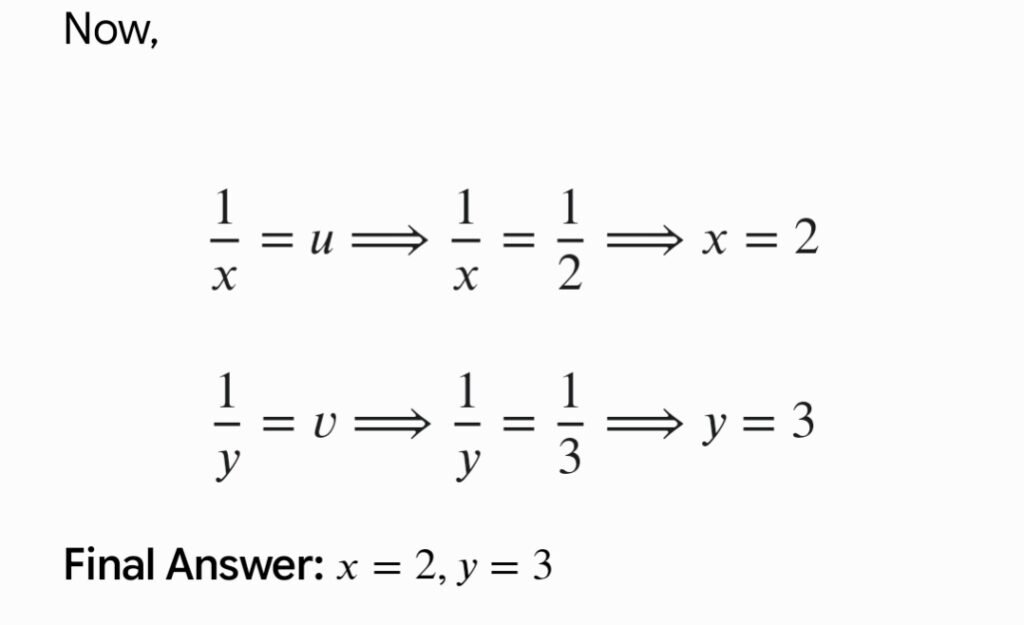
9. Solve the following pair of linear equations:
(i)
2/x + 3/y = 2
4/x – 9/y = -1
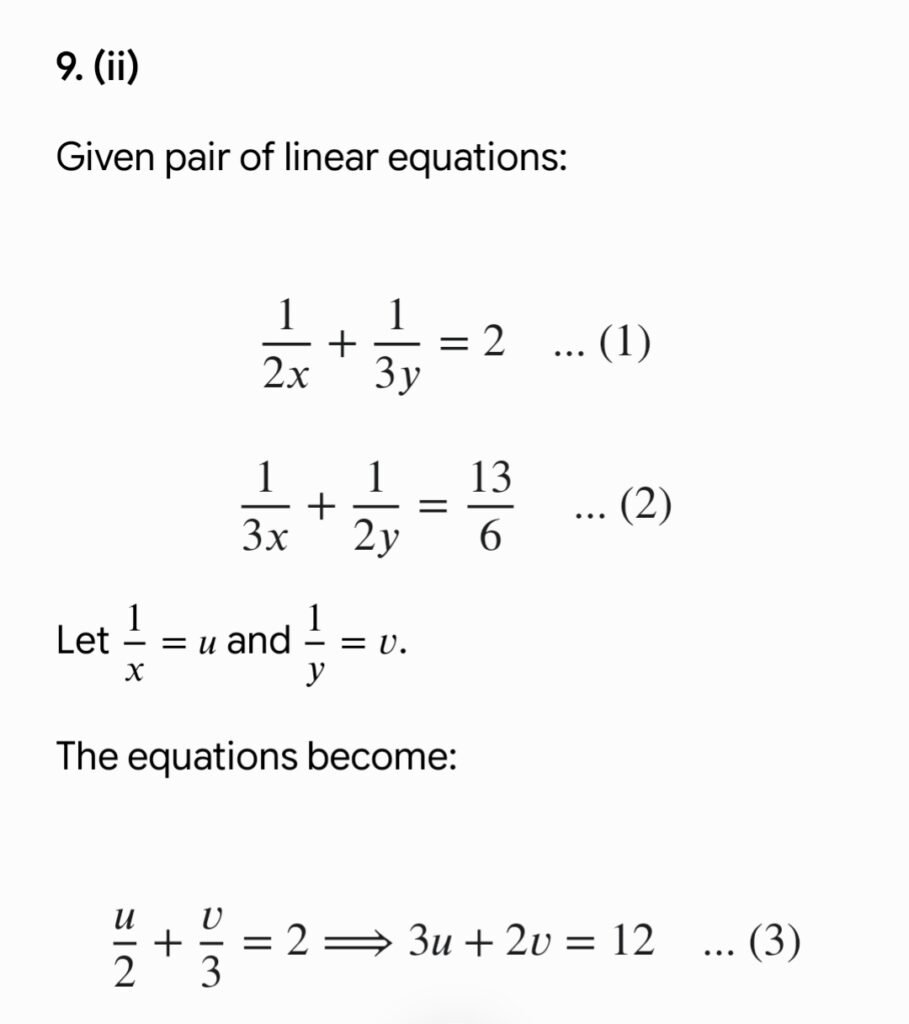
(ii)
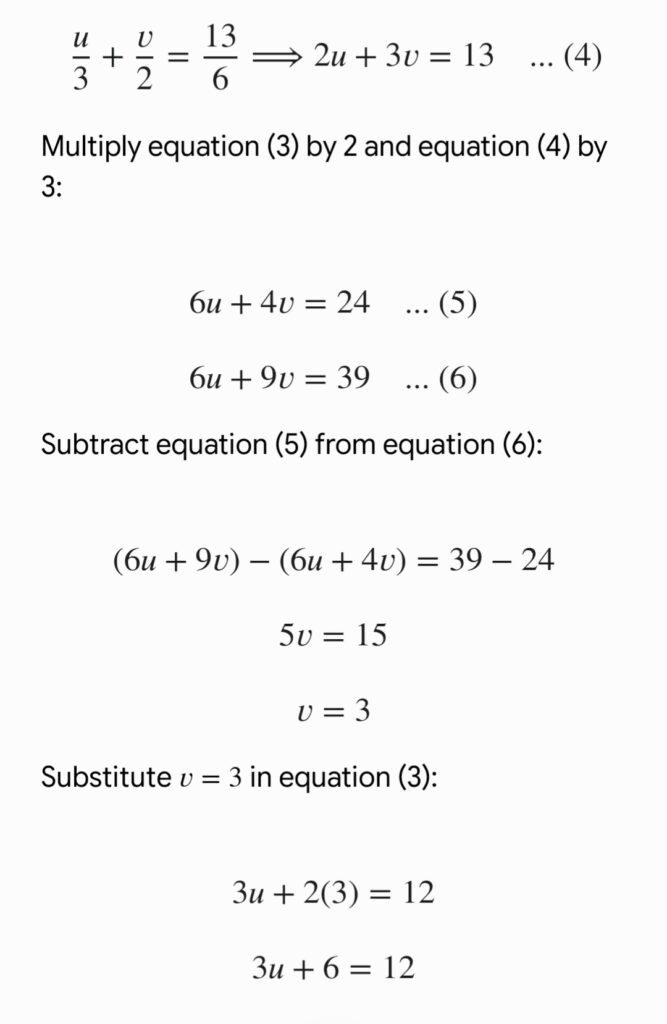
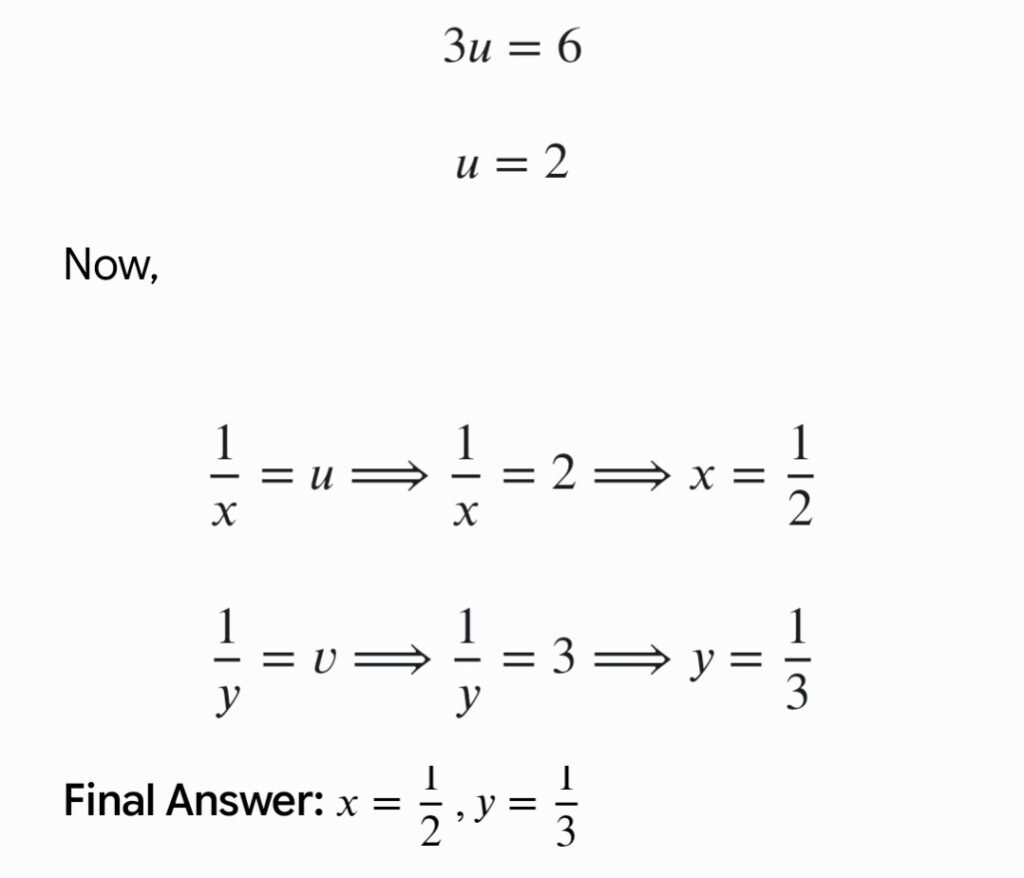
1/(2x) + 1/(3y) = 2
1/(3x) + 1/(2y) = 13/6
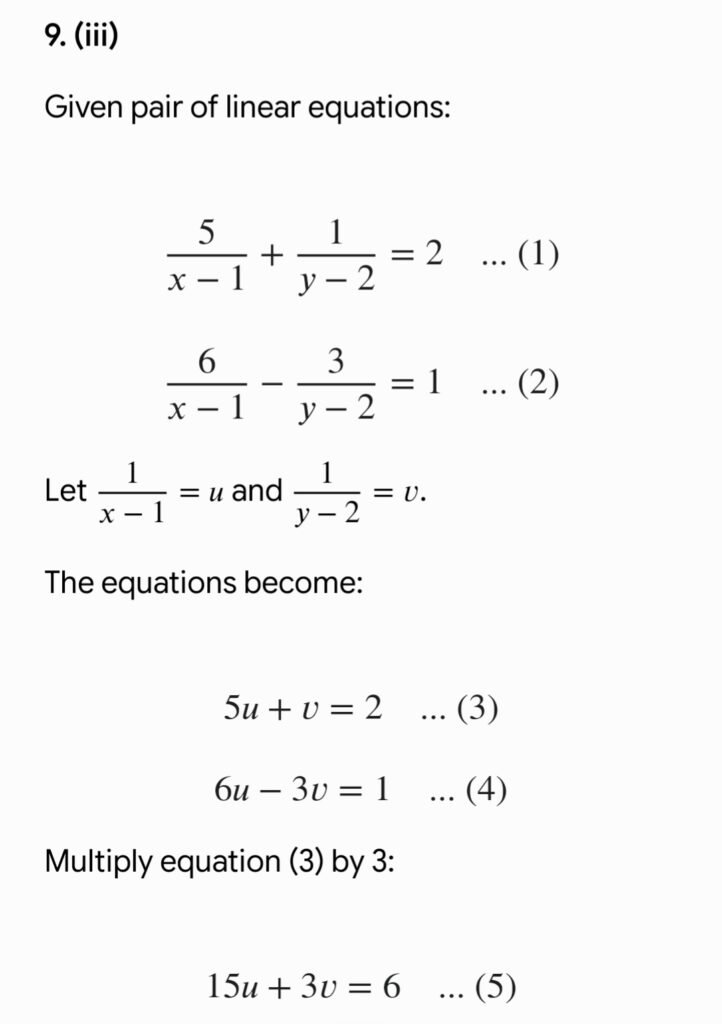
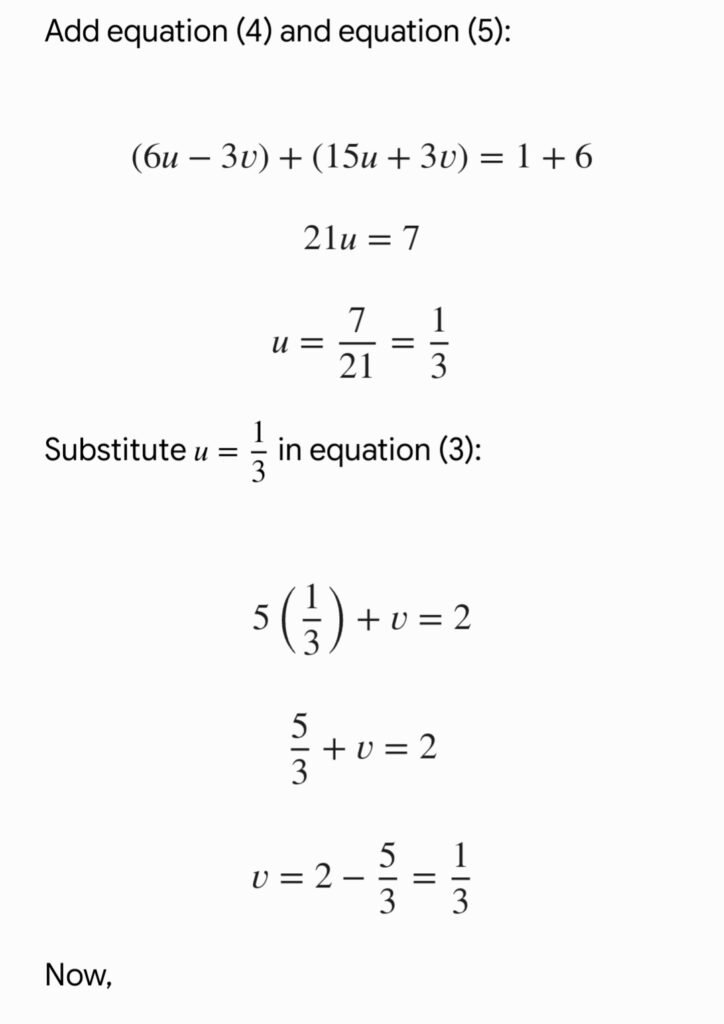
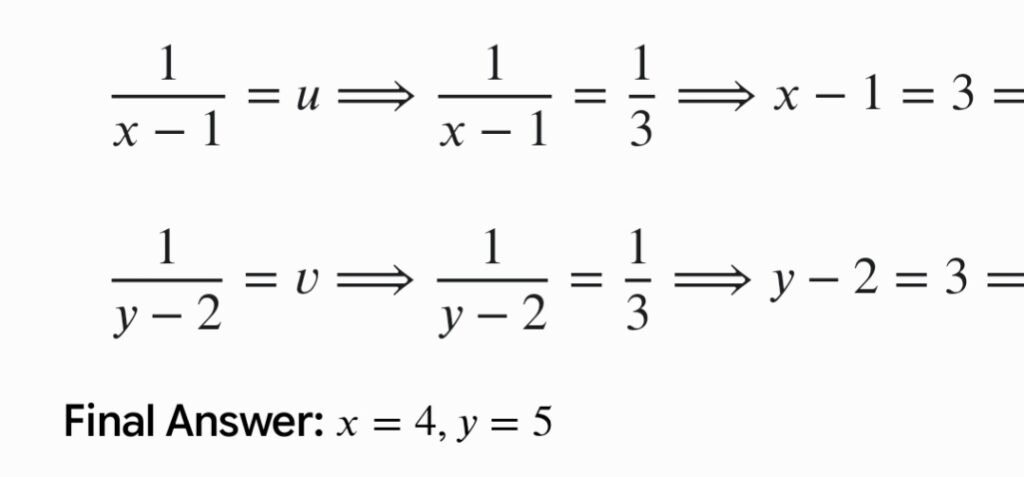
(iii)
5/(x-1) + 1/(y-2) = 2
6/(x-1) – 3/(y-2) = 1
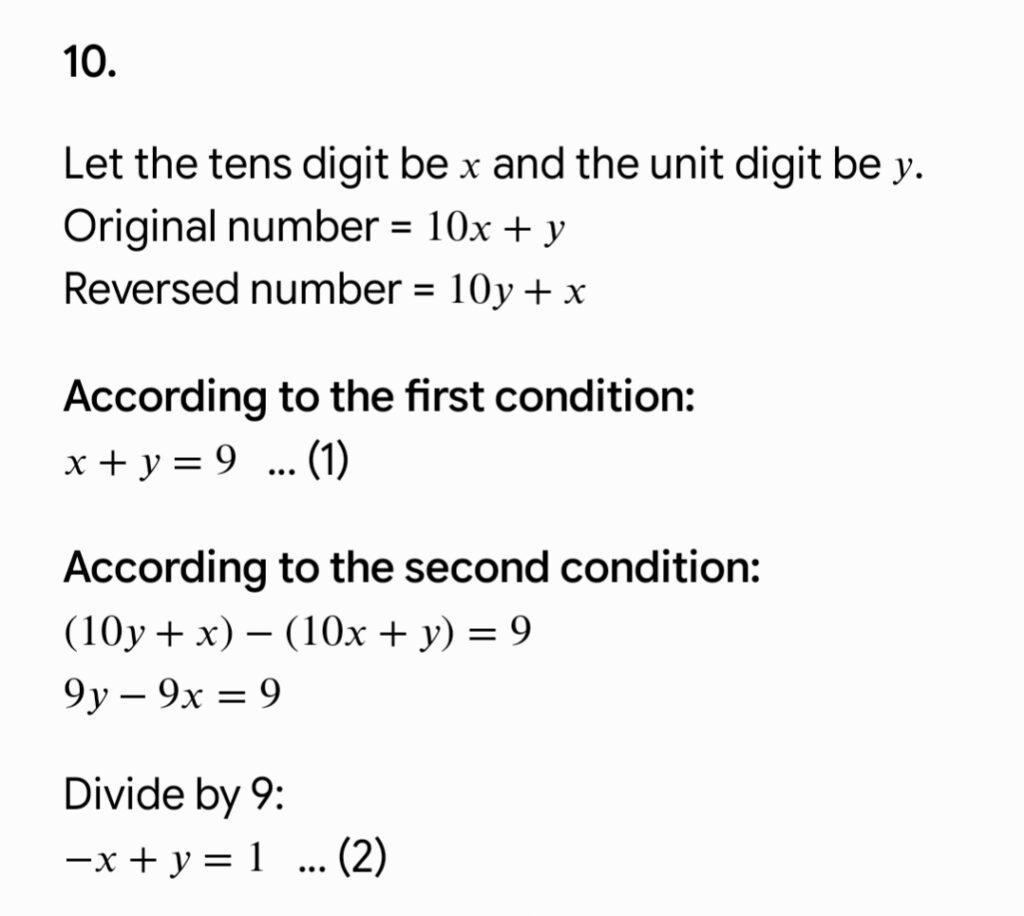
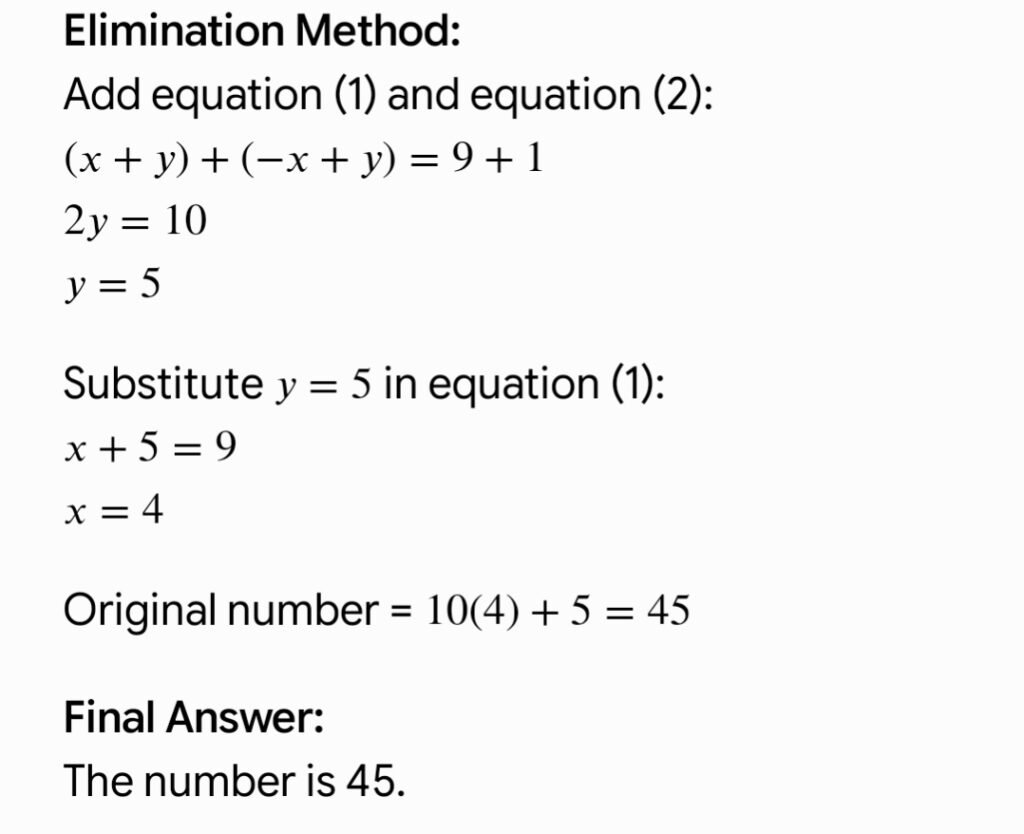
10. In a two digit number, the sum of the digit is 9. If the digits are reversed, the number is increased by 9. Find the number.
SEBA Class 10 Maths Chapter 3 Ex 3.3 Notes
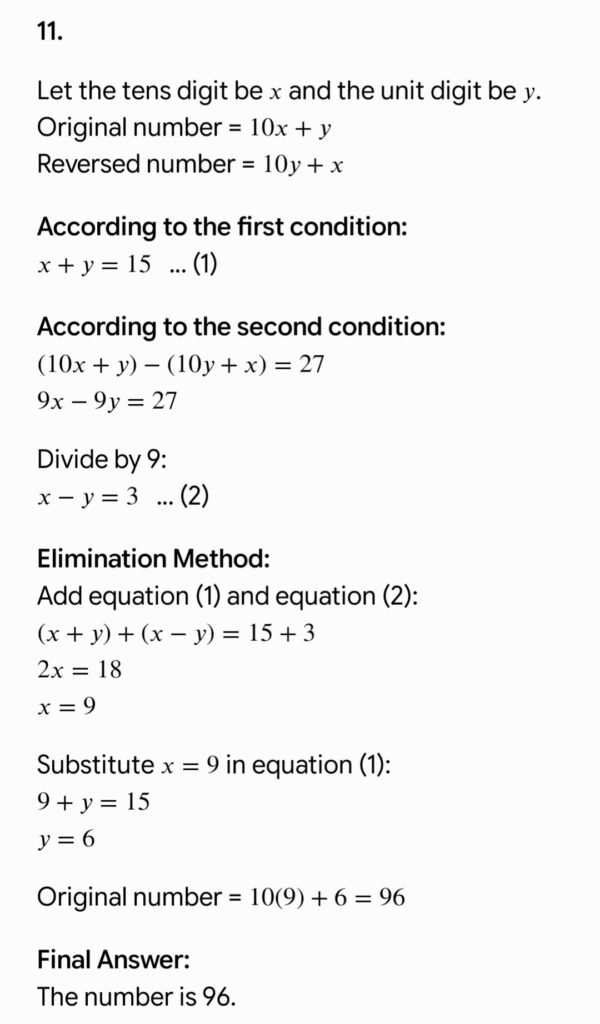
11. The sum of the digits of a two digit number is 15. The number decreased by 27 if the digits are reversed. Find the number.
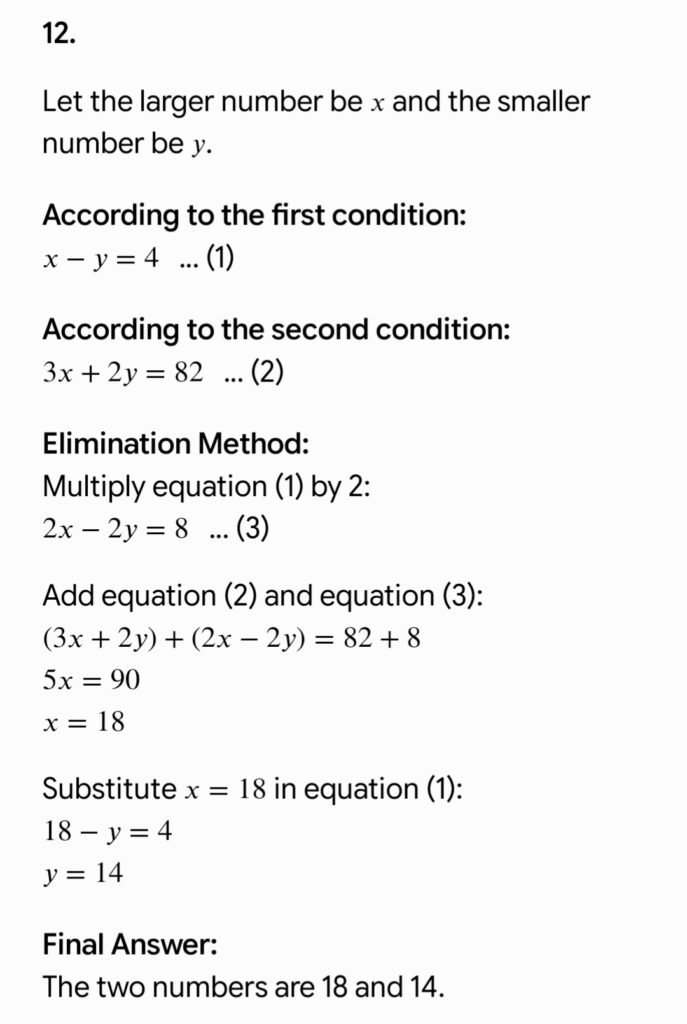
12. The difference between two numbers is 4. Twice the smaller number added to three times the larger number gives 82. Find the two numbers.
HSLC Class 10 Maths Chapter 3 Exercise 3.3 Answers
📐 Updated Exercise 3.3 Solutions Notice: This page features complete, step-by-step SEBA Class 10 Maths Chapter 3 (Pair of Linear Equations in Two Variables) Exercise 3.3 Solutions updated for the 2026–27 academic session. All algebraic substitution steps, variable elimination methods, and word problem solutions strictly follow the latest revised Assam Board (SEBA) textbook.
💡 Ace Your HSLC Class 10 Maths Exam:
- Have a doubt about variable substitution, eliminating coefficients, or framing algebraic equations in Exercise 3.3? Drop your questions in the comments section below!
- Save and bookmark this solution guide for fast revision before your unit tests, half-yearly, pre-board, and HSLC final examinations.
- Share this link with your classmates and WhatsApp study groups to help them master Class 10 Mathematics!