Looking for accurate SEBA Class 9 Maths Chapter 6 Exercise 6.1 (Lines and Angles) textual solutions for the 2026–27 academic year? Access step-by-step solutions for vertically opposite angles, linear pair axioms, intersecting lines, and angle proofs designed to help you score top marks in your annual exams.
1. In Fig. 6.13, lines AB and CD intersect at O. If ∠AOC + ∠BOE = 70° and ∠BOD = 40°, find ∠BOE and reflex ∠COE.
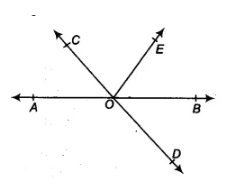
Answer:
Given:
∠AOC + ∠BOE = 70°
∠BOD = 40°
AB is a straight line.
∠AOC + ∠COE + ∠BOE = 180°
(∠AOC + ∠BOE) + ∠COE = 180°
70° + ∠COE = 180°
∠COE = 180° – 70° = 110°
Reflex ∠COE = 360° – ∠COE
Reflex ∠COE = 360° – 110° = 250°
CD is a straight line.
∠COE + ∠BOE + ∠BOD = 180°
110° + ∠BOE + 40° = 180°
150° + ∠BOE = 180°
∠BOE = 180° – 150° = 30°
Answer: ∠BOE = 30°, Reflex ∠COE = 250°
2. In Fig. 6.14, lines XY and MN intersect at O. If ∠POY = 90° and a : b = 2 : 3, find c.
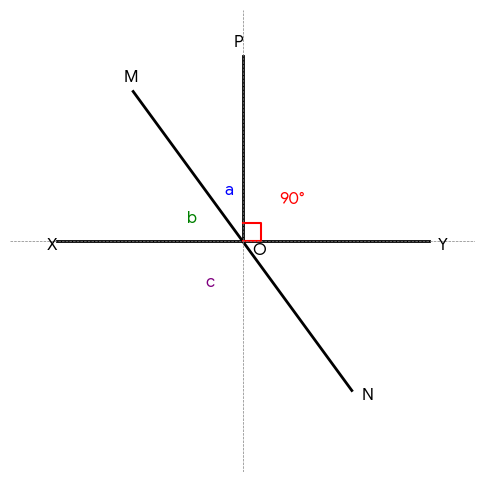
Answer:
Given:
∠POY = 90°
a : b = 2 : 3
Let a = 2x and b = 3x.
XY is a straight line.
∠XOM + ∠MOP + ∠POY = 180°
b + a + 90° = 180°
3x + 2x + 90° = 180°
5x = 90°
x = 18°
b = 3x = 3 × 18° = 54°
MN is a straight line.
∠XOM + ∠XON = 180° (Linear Pair)
b + c = 180°
54° + c = 180°
c = 180° – 54° = 126°
Answer: c = 126°
Class 9 Maths Chapter 6 Exercise 6.1 Answers
3. In Fig. 6.15, ∠PQR = ∠PRQ, then prove that ∠PQS = ∠PRT.
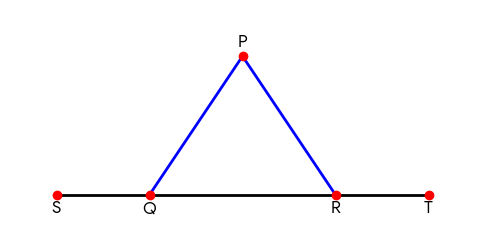
Answer:
Given:
∠PQR = ∠PRQ
To Prove:
∠PQS = ∠PRT
Proof:
S-Q-R-T is a straight line.
∠PQS + ∠PQR = 180° — (1) (Linear Pair)
∠PRT + ∠PRQ = 180° — (2) (Linear Pair)
From (1) and (2):
∠PQS + ∠PQR = ∠PRT + ∠PRQ
Since ∠PQR = ∠PRQ, subtracting them from both sides:
∠PQS = ∠PRT
Hence Proved.
4. In Fig. 6.16, if x + y = w + z, then prove that AOB is a line.
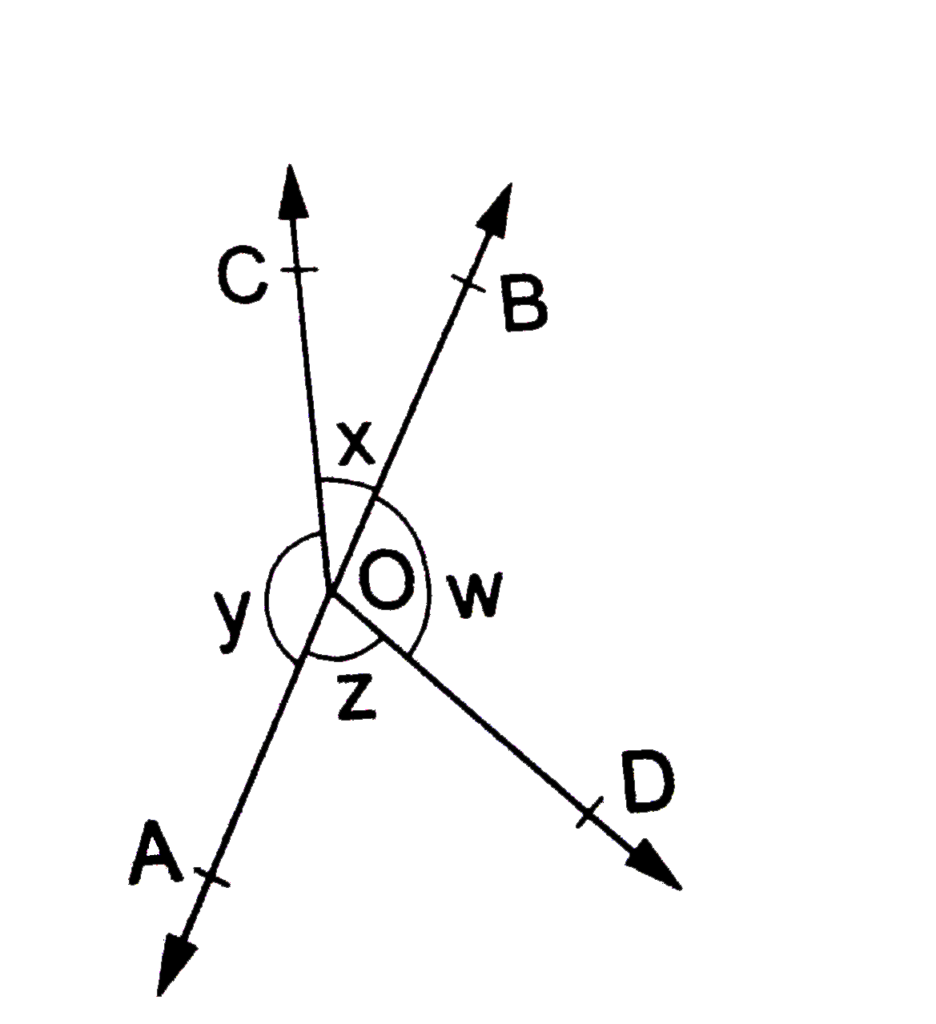
Answer:
Given:
x + y = w + z
To Prove:
AOB is a straight line.
Proof:
The sum of all angles around a point O is 360°.
(x + y) + (w + z) = 360°
Since w + z = x + y:
(x + y) + (x + y) = 360°
2(x + y) = 360°
x + y = 180°
Since the sum of adjacent angles x and y is 180°, they form a linear pair.
Therefore, AOB is a straight line.
Hence Proved.
SEBA Class 9 Maths Chapter 6 Ex 6.1 Notes
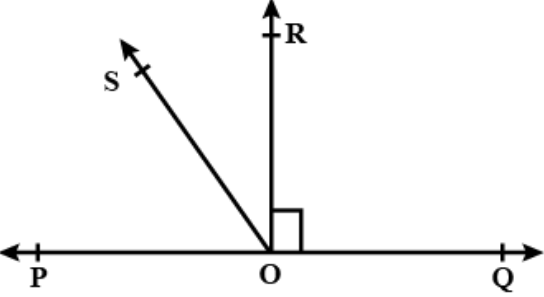
5. In Fig. 6.17, POQ is a line. Ray OR is perpendicular to line PQ. OS is another ray lying between rays OP and OR. Prove that
∠ROS = ½ × (∠QOS – ∠POS).
Answer:
Given:
OR ⊥ PQ
∠ROQ = 90°
To Prove:
∠ROS = ½(∠QOS – ∠POS)
Proof:
∠QOS = ∠ROQ + ∠ROS = 90° + ∠ROS — (1)
∠POS = ∠ROP – ∠ROS = 90° – ∠ROS — (2)
Subtracting equation (2) from (1):
∠QOS – ∠POS = (90° + ∠ROS) – (90° – ∠ROS)
∠QOS – ∠POS = 90° + ∠ROS – 90° + ∠ROS
∠QOS – ∠POS = 2∠ROS
∠ROS = ½(∠QOS – ∠POS)
Hence Proved.
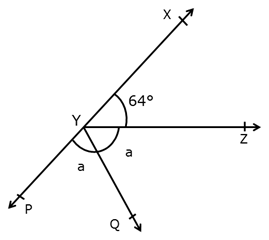
6. It is given that ∠XYZ = 64° and XY is produced to point P. Draw a figure from the given information. If ray YQ bisects ∠ZYP, find ∠XYQ and reflex ∠QYP.
Answer:
Given:
∠XYZ = 64°
XY is produced to P.
Ray YQ bisects ∠ZYP.
XYP is a straight line.
∠XYZ + ∠ZYP = 180° (Linear Pair)
64° + ∠ZYP = 180°
∠ZYP = 180° – 64° = 116°
Since YQ bisects ∠ZYP:
∠ZYQ = ∠QYP = 116° / 2 = 58°
∠XYQ = ∠XYZ + ∠ZYQ
∠XYQ = 64° + 58° = 122°
Reflex ∠QYP = 360° – ∠QYP
Reflex ∠QYP = 360° – 58° = 302°
Answer: ∠XYQ = 122°, Reflex ∠QYP = 302°
Lines and Angles Class 9 SEBA Ex 6.1 Solutions
7. Two Statements are given below:
Statement – 1 : If the sum of two adjacent angles is 180°, then the non common arms of the angles form a straight line.
Statement – 2 : If a ray stands on a straight line, then the sum of two adjacent angles so formed is 180°.
Choose the correct option.
(a) Both statement-1 and statement-2 are true
(b) Both statement-1 and statement-2 are false
(c) Statement-1 is true but statement-2 is false
(d) Statement-1 is false but statement-2 is true
Answer:
Both statements are fundamental axioms of linear pair angles (Linear Pair Axiom).
Answer: (a) Both statement-1 and statement -2 are true
8. When two straight lines intersect:
(i) Adjacent angles are complementary
(ii) Adjacent angles are supplementary
(iii) Vertically opposite angles are equal
(iv) Vertically opposite angles are supplementary
Choose the correct option.
(a) (i) and (iii) are correct
(b) (ii) and (iv) are correct
(c) (ii) and (iii) are correct
(d) (iii) and (iv) are correct
Answer:
When two lines intersect:
Adjacent angles form a linear pair, so they are supplementary.
Vertically opposite angles are equal.
Therefore, (ii) and (iii) are correct.
Answer: (c) (ii) and (iii) are correct
Class 9 Maths Chapter 6 Exercise 6.1 Question Answer SEBA 2026-27
9. The following question contain an
Assertion (A) and a Reason (R) along with following four choices
(a), (b), (c) and (d), only one of which is the correct. Mark the correct choice.
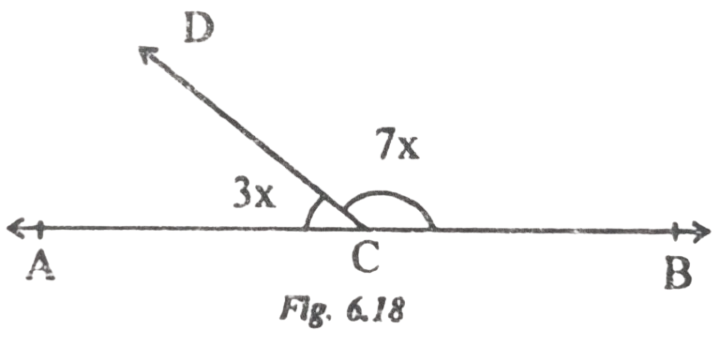
Assertion (A) : In Fig. 6.18 given below, if ACB is a straight line then ∠BCD = 126°.
Reason (R) : If a ray stands on a line, the sum of two adjacent angles so formed is 180°.
(a) Both Assertion (A) and Reason (R) are true and Reason (R) is a correct explanation of Assertion (A)
(b) Both Assertion (A) and Reason (R) are true but Reason (R) is not the correct explanation of Assertion (A).
(c) Assertion (A) is true but Reason (R) is false.
(d) Assertion (A) is false but Reason (R) is true.
Answer:
ACB is a straight line.
∠ACD + ∠BCD = 180° (Linear Pair)
3x + 7x = 180°
10x = 180° → x = 18°
∠BCD = 7x = 7 × 18° = 126°
So, Assertion (A) is true.
Reason (R) is the correct definition of Linear Pair Axiom and correctly explains Assertion (A).
Answer: (a) Both Assertion (A) and Reason (R) are true and Reason (R) is a correct explanation of Assertion (A)
10. The three statements are given below.
(i) If two straight lines intersect, then the vertically opposite angles are equal.
(ii) A line has only one end point.
(iii) If the two adjacent angles are complementary and equal then each angle is 45°.
Choose the correct option.
(a) (i) and (ii) are true
(b) (i) and (iii) are true
(c) (i), (ii) and (iii) are true
(d) (ii) and (iii) are true
Answer:
Statement (i) is TRUE (Vertically opposite angles are equal).
Statement (ii) is FALSE (A line extends infinitely on both ends; a ray has one end point).
Statement (iii) is TRUE (x + x = 90° → 2x = 90° → x = 45°).
Therefore, (i) and (iii) are true.
Answer: (b) (i) and (iii) are true
SEBA Class 9 Maths Chapter 6.1 Solutions
📐 Updated Exercise 6.1 Solutions Notice: This page features complete, step-by-step SEBA Class 9 Maths Chapter 6 (Lines and Angles) Exercise 6.1 Solutions updated for the 2026–27 academic session. All angle proofs, linear pair properties, and geometric calculations strictly follow the latest revised Assam Board (SEBA) textbook.
💡 Master Class 9 Maths Concepts:
- Have a doubt about linear pairs, complementary/supplementary angles, or vertically opposite angles in Exercise 6.1? Drop your questions in the comments section below!
- Save and bookmark this solution guide for fast revision before your unit tests, mid-term, and annual examinations.
- Share this link with your classmates and WhatsApp study groups to help them master Class 9 Mathematics!